The Saudi economy enjoys substantial reserve assets to overcome shocks to the oil sector, according to a report issued by the National Commercial Bank. (NCB)
“In our view, the Kingdom’s ‘lack of response’ in the face of declining oil prices is because it recognizes that its own power to affect oil prices is now less than it used to be,” said the researchers who prepared the NCB’s latest Saudi Economic View.
The financial sector in the Kingdom remains expansionary despite the turbulent oil and equity markets, said the report.
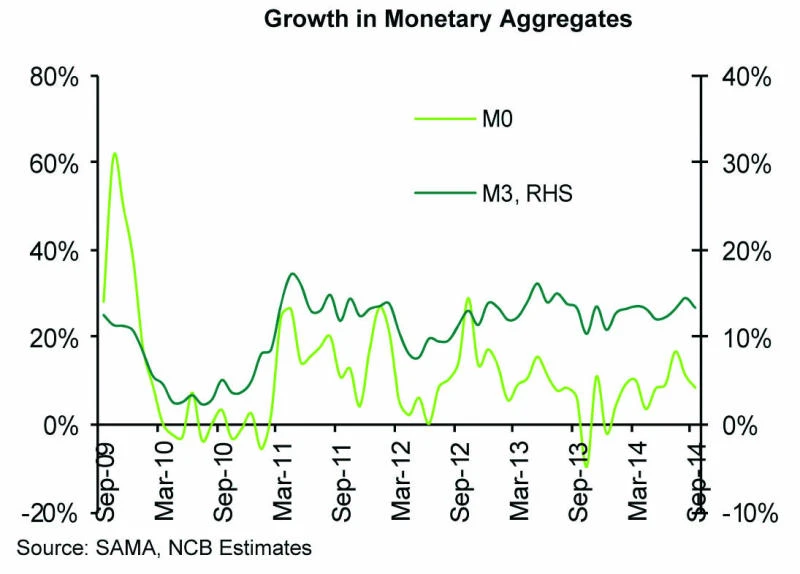
Aggregate money demand continues to push growth in supply, which annually peaked in October this year at 14.7 percent.
In September, broad money supply (M3) growth retained its double-digit growth at 13.4 percent. Therefore, the annualized growth rate of money supply in Q3 concluded levels on par with.
The monetary base expansion peaked this year in July at the rate of 16.7 percent, and moderated in the following consecutive months to 11.3 percent, and 8.5 percent, in the third quarter, according to the review.
Demand deposits, which account for around 56 percent of the money supply reached SR940.8 billion by the end of September, surging by 13.9 percent Y/Y.
Time and savings deposits, the second largest component of money supply, have been gaining momentum since the beginning of the year, which peaked in the third quarter at 23.3 percent . Time and savings deposits accumulated SR397.7 billion by the end of September, thus accounting for 23.3 percent of money supply. Currency outside banks recorded SR158.1 billion in the same month, climbing by 13.7 percent Y/Y, in its highest acceleration this year. On the other hand, quasi monetary deposits slid by 5.7 percent to SR183.7 billion in their first annualized decline since June 2012.
Referring to inflation, the report said that consumer prices continued to edge higher in September following a demand pull in August.
Annualized CPI recorded a 2.8 percent upturn in August and September from 2.6 percent in July, putting the average inflation rate for the quarter around 2.75 percent. The shifting cyclicality of Ramadan amplified annualized price changes for the most important category, food and beverages, which rose by 2.9 percent Y/Y.
Food inflation decelerated gradually from a record high of 6.89 percent mid- 2013 due to the lower imported inflation associated with the strengthening dollar and ending commodity cycle. In July this year, food inflation posted a record low of 1.98 percent from which it rebounded to 2.9 percent in September. The rebound in food prices in September indicates a correction to commodity prices, which to some extent has materialized. Renovation, rent and utilities’ prices were around 3.4 percent in September, below this year’s average of 3.7 percent.
Therefore, the exogenous factors which contributed to lowering headline inflation may have a lesser impact next year. In addition, the existing supply bottle necks in the housing market add upward pressure on prices which we do not expect to be alleviated under the cur- rent pace of the housing market reform.
“We maintain our opinion that headline inflation will average around 2.75 percent this year and inch higher next year, although it will remain below 3 percent,” said the report.
According to the report, the Saudi stock market failed to maintain its momentum which has been building up throughout most of the first three quarters of this year. Last month, the main index posted its third consecutive monthly decline by 14.1 percent to settle at 8,624.89 as OPEC members opted not to cut oil production and leave oil prices tumbling. The buildup to the OPEC meeting influenced investors to reduce their exposure to the equity market, said the review.
It said that traders have been quick to react on negative news while history shows they have been quite hesitant on the positive side. As such, the need for institutional trading has been greatly emphasized by the latest slide of Tadawul.
The Capital Market Authority’s (CMA) deadline is over for finalyzing the trading regulations for foreign institutions and their trading should commence in the first half of 2015 as the market awaits the announcement of the final regulations.
This will provide a degree of stability for the market as initial estimates indicate an inflow of SR200 billion which will be targeting long-term investment positions rather than intra-day trading. Analyzing November’s performance on a sectoral basis reveals that the petrochemicals sector posted the second largest decline at 20.8 percent as the telecommunications sector realized the largest loss at 26.9 percent.
While all sectors decreased, the media and publishing sector experienced the smallest decline at 4.2 percent last month.
The bearish momentum was the main theme for November as Tadawul dipped well below the 9,000 level pressured by the oil market and the accounting discrepancy announced by Etihad Etisalat Co, locally known as Mobily. The CMA subsequently suspended the stock’s trading for three days until the company revised their financials which previously reported revenue from unrealized sources, according to the review. Regarding the level of investor appetite, which is gauged by the average daily traded volumes, activity levels in the market softened by 5.8 percent during November to a daily average of SR7.4 billion.
Consequently, the daily traded average for the first 10 months of 2014 has settled at SR8.6 billion which is 55.5 percent more than the average of 2013.
The recent drop in stock prices has created attractive opportunities for investors to expand their portfolios given the strong corporate profitability announced last quarter.
The market’s average price-to- earnings (P/E) ratio dropped to 13.90 by the end of November, down from 16.37 in October, a lower P/E indicates better valuation. Accordingly, Saudi institutions have been net buyers over the past couple of months as their investment horizon is much broader than individual traders.
The primary market concluded the initial public offering (IPO) of the National Commercial Bank earlier this month as it sought to attract $3.6 billion through 300 million shares available for individuals. The IPO was oversubscribed by 2307 percent through 1.26 million subscribers, requesting shares with a total worth of over $83 billion to claim the title for the largest IPO in the Arab region and the second largest in the world this year. Additionally, the IPO of Electrical Industries Company which is offering 13.5 million shares at SR54 per share has ended oversubscribed by 522.7 percent through 1.74 million subscribers.
The appetite for IPOs in the primary market reflects the increasing wealth of individuals which has been accumulating over the years given the strong economic conditions in Saudi Arabia. The healthy business environment will provide more companies with the platform to expand and turn public in the future as the opportunities in the Saudi market have been lucrative, according to the report. Moving forward, it said that the challenges for the market are skewed to the short-term with a recent concern sur- rounding oil prices which could slow government expenditure. Nonetheless, the Saudi economy enjoys substantial reserve assets to overcome shocks to the oil sector.
On the equity front, the healthy business environment has boded well for the 14 publicly traded companies as the cement sector has gained near 9 percent this year on Tadawul to reflect the lucrative financial situation for the industry.
According to the report, the oncoming new factories will create a more competitive market, however; as projects are scattered all over the country, so are the cement companies which will benefit from geographical proximity. Demand is expected to steadily grow through new projects, maintenance, and renovation needs for already built structures.
The researchers also commented on the oil market as OPEC kicks the ‘barrel’ down the road:
The report said: “The lack of any Saudi response, in contrast to the long-held belief that it would step in to support prices if the oil price fall below $100/barrel, is debatably the main reason why the price declined to the $90s a barrel in September, and then gave way to another decline to the low $70s a barrel in November.”
It added: “In our view, the Kingdom’s lack of response, in the face of declining oil prices is because it recognizes that its own power to affect oil prices is now less than it used to be, also to take the burden of an output cut alone risks hurting market share and undermining long-term fiscal sustainability, and in any case, Saudi Arabia has sizable financial reserves to endure a period of lower oil prices. However, a collective action is difficult as a few OPEC’s members are under fiscal and security pressures, especially Libya, Iraq, and Iran, and very likely to exempt themselves from any deal.”
KSA financial sector remains expansionary despite oil shock