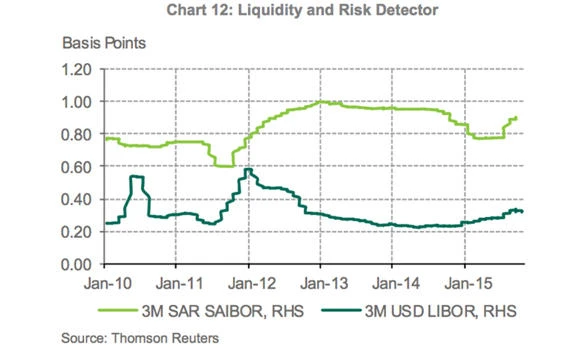
The Saudi Arabian monetary system remains resilient despite mounting fiscal pressures emanating from the oil plunge. Until July, Saudi banks maintained low interbank rates as the average for 3-month SR deposits stood at 77 bps compared to an average of 94 bps in 2014.
The spread between SR USD deposits have also shrank to 48 bps on the same month, well below last year’s average of 70 bps. The low inflation specter relaxes banks demand for risk premiums and alleviates concerns for solvency, allowing for cheaper borrowing costs. In addition, the US Federal Reserve’s continued monetary accommodation helped Saudi banks maintain high liquidity so far, according to a Saudi Economic Review released by the National Commercial Bank (NCB).
Going forward, however, the bank said: "we expect tighter liquidity, especially with the Saudi government issuing development bonds in order to maintain its spending plans. The bonds which were sold to local banks and institutions in three tranches of five, seven, and 10-year maturities are expected to crowd out credit for the private sector, the largest consumer of credit in the Kingdom. This is evident as through August and September, we noticed that the Saudi Offered Interbank Rate (SAIBOR) crept up gradually, reaching 90 bps."
Compared to last year where demand for credit was the main driver for the interbank rate rising, this year, the slowdown in credit activity is accompanied by a tighter availability of liquidity. Broad money supply (M3) recorded an 8.3 percent annualized growth, falling short of the double-digit trend we witnessed the last two years. Total deposits recorded a subpar 7.1 percent annualized growth in July, affected by a contraction in time and savings deposits and quasi deposits by 3 percent and 6.4 percent, respectively. Lower growth in the depositary base which is the main source of credit is expected to lead banks to provision for their loans, complying to SAMA’s (Saudi Arabian Monetary Agency's) regulations. It’s worth-noting that Saudi banks’ excess reserve ratio fell to 27.9 percent in July, the lowest since November 2008.
Moving onto the assets side, the NCB report said auto synchronicity between loans and deposits is clearly displayed by the deceleration in bank credit to the private sector to 9.8 percent, the lowest level in four years. Total fresh credit extended to the private sector this year reached SR79.9 billion by the end of July making total outstanding credit to private debtors at SR1.28 trillion. In regards to credit to public institutions, which represent a meager 2.9 percent of banks’ credit portfolio, it stood at SR38.2 billion, down by around 12.8 percent by annual comparison.
Saudi banks’ holdings of government bonds stood at SR52.6 billion, upturning by 6.8 percent Y/Y and "we expect to see a sizeable surge in the coming months owing to the recent issuances, potentially pushing outstanding government bonds to SR100 billion by the end of the current year."
The government is not expected to completely phase out tapping into its foreign reserves despite the debt issuances.
SAMA’s foreign assets stood at around $664 billion by the end of the second quarter, down by more than 9 percent a year earlier.
Saudi banks consolidated credit portfolio shows that around 51.8 percent of loans are short term, with medium term, and long-term loans accounting for 16.8 percent and 31.4 percent, respectively, the NCB report said.
KSA monetary system resilient despite falling crude prices