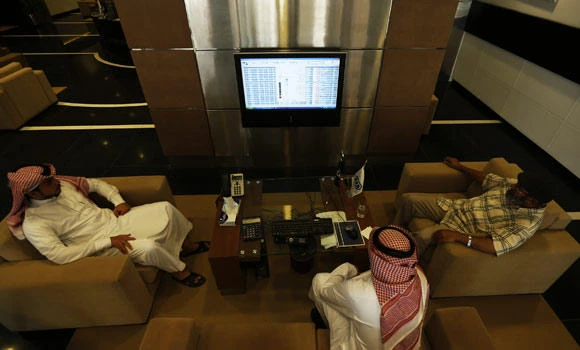
Saudi share prices tumbled on Thursday to finish off a difficult week marked by volatile oil prices and world stock markets falling on fears of a weaker economy and global insecurity.
The Tadawul All-Share Index fell 355.46 points or 3.59 percent to close at 9,547.54.
Some analysts believe that Saudi Arabia’s drop was magnified by investors selling to prepare for the National Commercial Bank’s (NCB) SR22.5 billion initial public offer of shares.
Basil Al-Ghalayini of BMG Financial Group commented: “What made things even more concerning in the local market are the mixed views of investors and traders on the marketability of the NCB’s IPO in view of the big controversy of its Shariah-compliant status.”
He added: “The volatility of the oil prices and the unpredictability of geopolitical risks, coupled with the recent IMF’s cautious remarks on global growth projections, have collectively affected investors’ sentiments negatively; locally and globally.”
On Thursday, banks and financial services index dropped 3.26 percent on the Saudi bourse while petrochemical industries index fell 4.18 percent.
Petrochemical stocks are heavily weighted in the Saudi market and lower oil prices look likely to erode the competitive advantage which regional petrochemical producers enjoy over foreign rivals.
Brent crude oil, which has slid more than 28 percent since June, hovered around $86.30 per barrel on Thursday, near a four-year low.
Economists and fund managers continue to believe the oil price decline will not be disastrous for Gulf economies and markets.
John Sfakianakis of Ashmore Group said: “Saudi stocks have seen a significant correction and a reversal is not far away given that valuations are now becoming very attractive again.”
He added: “Over the short to medium term I’m not worried about the Gulf economies vis a vis oil prices.”
Sfakianakis said: “If oil prices correct to $60 then that will have a significant impact on regional economies. But the eventuality of this happening is not high. Oil prices should revert to the $90-100 level over time.”
Regional analyst Jarmo Kotilaine commented: The GCC countries are well positioned to handle the volatility through their strong reserves and a measure of fiscal consolidation. The key to understanding the fiscal impact is the duration of the market correction. This is still far from clear.”
KSA stocks tumble by 3.6% ahead of SR22.5bn share sale