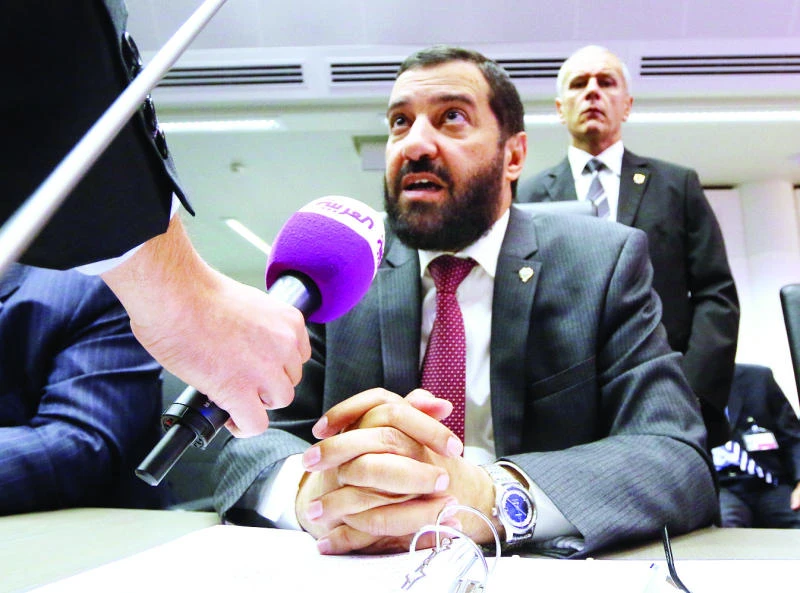
KUWAIT CITY: Kuwait on Wednesday accused oil-producing countries that had urged OPEC to cut its output, in a bid to curb sliding prices, of doing the opposite by pumping more crude.
Oil Minister Ali Al-Omair defended the oil cartel's decision last week to maintain production levels, insisting that member states want to keep their market share.
"Everyone wanted you (OPEC) to cut your output while they increased production and flooded the market. This is unacceptable to us and we have to preserve our market share and continue with a production level that covers our needs," Al-Omair told parliament.
He did not name any country, but appeared to allude to non-OPEC members, mainly oil-rich Russia, the world's largest producer of crude that had urged OPEC in the past to cut production.
"After discussing the issue of cutting output at OPEC, we found that there was no point in reducing production," Al-Omair said.
"The output surplus on the international market was 1.8 million barrels per day, and amid a slow world economy there is no point in cutting output while others raced to raise their production," he said.
He said the Organization of Petroleum Exporting Countries had sought to coordinate with non-OPEC oil producers over supplies and prices.
"We will not sacrifice our interests for the sake of adjusting market prices," said the minister who said he hoped the OPEC decision would benefit the market in the future.
Last week's OPEC decision sent oil prices crashing to five-year lows.
Al-Omair said Kuwait was pumping 2.7 million barrels a day, around 300,000 lower than its average daily production for the past three years. A portion of the decline was the result of halting production at a Saudi-Kuwaiti offshore oilfield.
However, oil prices rebounded slightly on Wednesday but the Russian ruble hit fresh all-time lows against the dollar and the euro, while European equities marked time on the eve of an ECB meeting.
On crude oil markets, US benchmark West Texas Intermediate (WTI) for delivery in January rose 67 cents to $67.55 a barrel.
Brent North Sea crude for January gained 44 cents to stand at $70.98 in London afternoon deals.
Oil prices had tumbled by about two dollars on Tuesday after Iraq announced plans to boost the country's crude oil exports after striking a deal with the autonomous Kurdish region.
"We are seeing some consolidation in the market at the moment," Daniel Ang, investment analyst at Phillip Futures in Singapore, told AFP.
"We are likely to see such ups and downs for the rest of the year as the crude market finds a good price to stabilize upon after recent losses," he added.
In foreign exchange Wednesday, Russia's currency hit a record low of 54.82 rubles to the dollar and all-time trough of 67.82 against the euro. The ruble recovered somewhat to stand at 53.60 to the dollar and 66.00 to the euro in late afternoon trading.
The ruble, hit by Western sanctions against Russia over the crisis in Ukraine and plunging oil prices, suffered on Monday its worst one-day drop since Russia's debt meltdown in 1998.
Elsewhere Wednesday, the euro fell to a 15-month low point at $1.2321. It climbed back to stand at $1.2334 in afternoon trade, still down from $1.2381 late on Tuesday.
The dollar was strong also against the Japanese unit, reaching a seven-year high of 119.48 yen. It later stood at 119.34, up from 119.22 yen on Tuesday.
On the London Bullion Market, gold rose to $1,203.25 an ounce from $1,197 on Tuesday.
In European equities trading, euro zone stock exchanges rose ahead of a meeting of the European Central Bank Thursday at which analysts expect the central bank to move closer towards a massive economic stimulation program in light of dangerously low inflation and stalled growth.
At 12:05 p.m. (1705 GMT) the Dow Jones Industrial Average rose 8.54 points, or 0.05 percent, to 17,888.09, the S&P 500 gained 3.81 points, or 0.18 percent, to 2,070.36 and the Nasdaq Composite added 11.55 points, or 0.24 percent, to 4,767.36.
Kuwait: Oil producers pump more while urging OPEC cut