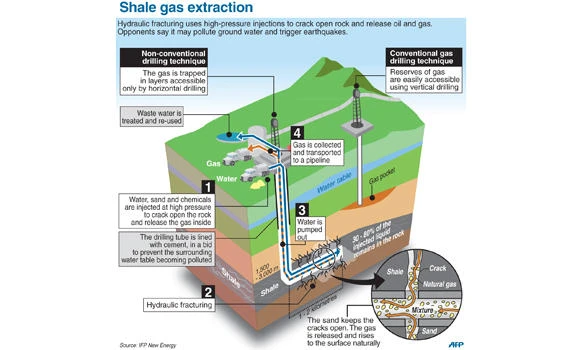
PARIS: Cheap oil prices are likely to end up squeezing high-cost producers like US shale drillers, who next year may face the biggest drop in output in nearly a quarter century, the IEA said.
Cheap fuel is also hooking consumers, with oil demand growth set to hit a five-year high this year, the International Energy Agency said in its monthly report.
The oil market has been driven for the past year and half by an increasingly transparent policy by OPEC to safeguard its influence against upstart shale producers who could change global dynamics by cutting US dependence on imported oil.
High crude prices of over $100 per barrel in 2013 were allowing US shale producers to exploit costly technology to extract previously unreachable oil and sharply increase supply in the top oil-consuming nation.
But with Organization of Petroleum Exporting Countries refusing to cut production, crude oil prices slumped to six-year lows last month, with the main US oil contract dropping to below $40 at one point.
The IEA, a Paris-based institution which analyzes energy markets for advanced oil-consuming nations, said the industry was now beginning to react to lower prices by cutting output.
“US oil production is likely to bear the brunt of an oil price decline that has already wiped half the value off” the main international oil contract, the IEA said in its report.
“After expanding by a record 1.7 million barrels per day in 2014, the latest price rout could stop US growth in its tracks,” it added.
The IEA forecast non-OPEC oil output may drop by half a million barrels per day next year — the biggest decline in 24 years — with US shale producers accounting for four-fifths of that drop.
“On the face of it, the Saudi-led OPEC strategy to defend market share regardless of price appears to be having the intended effect of driving out costly, inefficient’ production,” said the IEA.
While it had previously expected US shale output to rebound next year, the IEA said “the latest price rout takes 2016 futures prices below the average breakeven cost for all major shale plays” and as such “the current slump in drilling and completion rates is expected to extend well into next year.”
US oil output has until recently held up fairly well against the drop in prices although the sector has cut back drilling and laid off tens of thousands of workers.
But it fell for the fifth week in a row in the week to September 4, dipping to the still relatively high 9.14 million barrels per day, according to information released Thursday by the US Department of Energy.
The IEA noted that the low prices were hurting not only US producers, but those in Russia and the North Sea as well. Low prices were also putting high-cost projects in OPEC countries at risk, it added.
And the gambit has not been without wider risks for OPEC countries, whose public finances have been pummelled as the price of their main revenue source plunged.
OPEC countries have had to tighten their belts.
The IEA doesn’t forecast oil prices, however a report Friday by Goldman Sachs investment bank said they could fall as low as $20 per barrel before clearing out the supply glut.
However the IEA sees the drop in oil prices, along with a gradually improving global economic outlook, accelerating growth in demand for oil, in particular demand for OPEC output.
If forecasts oil demand growth to hit a five-year high of 1.7 million barrels per day (bpd), and stay at an above trend at 1.4m bpd next year.
The IEA increased its forecasts for overall demand this year and next by 0.2m bpd to 94.4m bpd this year and 95.8m bpd in 2016. It cut its forecast for non-OPEC supply by 0.3m bpd next year to 57.7m bpd.
The IEA does not make supply forecasts for OPEC, but said it expects market demand on OPEC suppliers to rise to 31.3m bpd in 2016, an annual increase of 1.6m bpd as low prices dent high-cost production support higher demand.
OPEC output dipped 0.2 mbpd to 31.57m bpd last month, the IEA said, but that was still up 1.2m bpd from last year.
Oil prices were down on Friday, after having climbed the previous day on falling US output.
Brent North Sea crude for delivery in October, the European benchmark, fell $1.19, or 2.4 percent, to $47.70 a barrel in London trading.
US benchmark West Texas Intermediate for October fell $1.38, or 3.0 percent, to $44.54 per barrel.
Oil market shake-up set to squeeze US shale: IEA