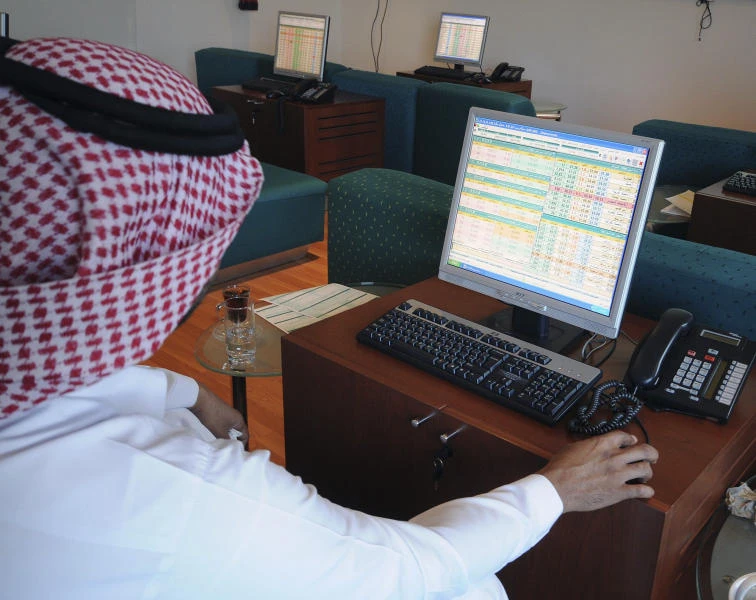
The rally in the Saudi stock exchange is partly driven by the market’s recent break above 8,000 points, say analysts.
“Market has broken the 8,000 mark and investors are willing to take increasing bets in many sectors including petrochemicals and banks,” John Sfakianakis, chief investment strategist at Saudi investment firm MASIC, told Arab News.
His remarks came as Tadawul All-Share Index (TASI) extended gains to hit a new 59-month high yesterday, boosted by banks and petrochemical shares.
“There are selective stocks in both of these sectors that still seen as a strong buy and investors are taking positions,” said Sfakianakis.
The benchmark index climbed 0.3 percent to 8,156.77 points, its highest level since September 2008. The market has risen 20 percent year-to-date.
The petrochemical sector index rose 1.10 percent and the banking index 0.23 percent.
“TASI’s performance has been positive so far this year due to a number of local factors, including strong economic fundamentals, good second quarter result and positive momentum in other GCC markets,” said Fahad Alturki, head of research at Jadwa Investment.
“These factors supported the performance of some sectors that are driven by local demand and consumption,” he said.
Alturki added: “The external environment has also been supportive with positive indicators on demand for Saudi oil over the last few months as well as positive economic data in the US, China and the EU, though downside risk remains on the background owing to regional geopolitical events and a fragile global economic recovery.”
Commenting on Tadawul’s trends, Jarmo T. Kotilaine, a regional analyst, said: “The market mood has clearly benefited from the uptrend in oil prices, which tends to be good for the competitiveness of the Saudi petrochemicals sector and the banking environment alike. The fears about continuous oil price weakness appear to have subsided with the US economy staging a fairly consistent, albeit slow recovery.”
Also, he said, the euro zone has returned to growth.
Although worries still persist about parts of the global economy, including China, there is more evidence of firmer ground in the advanced economies.
Recent data releases have tended to surprise on the upside, for instance US real estate data and even Chinese home prices.
“The positive mood will almost certainly be tested by fears about monetary policy tightening, although actual progress in this regard may prove slow. Hence the impact may well be recurrent volatility rather than a trend change,” Kotilaine said.
Ibrahim Al-Dossary, a financial consultant, said the Saudi bourse reached 8,131 points when it reopened after Eid Al-Fitr. “This was the highest reached by the market this year,” he pointed out.
He said the value of stock exchange declined to SR4.8 billion daily during the past three days.
Al-Dossary said the bourse achieved remarkable gains last week as a result of the good performance of the petrochemical sector, which rose by two percent.
Other sectors that drove the market up were cement, which rose by 1.8 percent, construction up 2.35 percent and real estate 1.5 percent.
Speaking to Reuters earlier, Hesham Tuffaha, a Riyadh-based fund manager, said: “We have started to see the market relatively overvalued.”
He said: “There are many sectors that are being driven by strong growth but the largest sectors, banks and petrochemicals, have not posted double-digit growth, which is the only thing that can justify the sharp rally in the index.”
The market may therefore come under pressure from profit-taking in the near term, he said.
Some analysts told Reuters that the banking and petrochemical sectors posted only single-digit growth in second-quarter earnings, and argue this may not be enough to extend the bull-run.
Petchems, banks boost KSA stocks to 59-month high