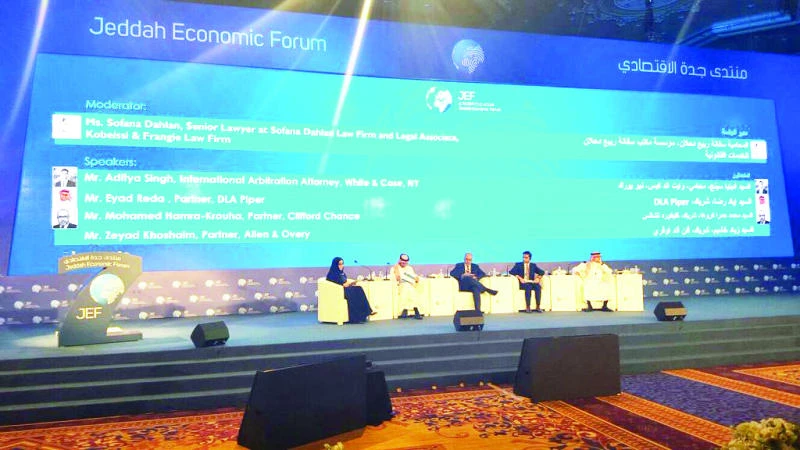
JEDDAH: The third session of Jeddah Economic Forum 2016 on Wednesday, themed Legal and Regulatory Challenges, highlighted the challenges faced by public-private partnership (PPP) projects from a legal perspective.
Moderating the panel discussion, Sofana Dahlan, senior lawyer at Sofana Dahlan Law Firm & Legal Associate, and Kobeissi & Frangie Law Firm, introduced the panelists.
They included Eyad Reda, partner at DLA Piper, Zeyad Khoshaim, partner at Allen & Overy, Mohamed Hamra-Krouha, partner at Clifford Chance, and Aditya Singh, international arbitration attorney at White & Case New York.
When asked why PPP is good for Saudi Arabia, Reda said: “There is no one answer for any country; it all depends on sectors. It’s a political, economic and strategic question."
“However, there are several reasons why the Kingdom must choose PPP,” he said. “Firstly, it reduces burden on the Saudi budget and can get better value for money. It also maximizes public access to private sector skills and techniques, and facilitates access to the private sector debt finance along with the discipline it entails.”
Reda explained that PPP gives the government control of the project’s cost and quality and helps the government to divest certain risks. “But the real challenge is how to access these advantages.”
Discussing the stakeholders’ legal alignment, Reda explained that it is essential to keep all stakeholders fully informed and educated on various PPP issues, right from the beginning of the project.
The panel discussion highlighted the key reason for the success of a number of countries with PPPs; it is to put in place a comprehensive PPP program, taking into consideration the legislative, regulatory and process of the program.
Khoshaim explained how the infrastructure assets retrieve differently from the legal standpoint and spoke about the regulatory framework that the Kingdom examines to streamline PPPs.
Meanwhile, Singh spoke on the prominence of international arbitration. “International arbitration is essential for reasons such as international enforceability, neutral forum, control and procedural flexibility, arbitrators with special knowledge or expertise and confidentiality.”
Stressing international enforcability, Singh said “156 state parties acceded to the 1958 New York Convention, while Saudi Arabia acceded to the New York Convention in 1994.”
The discussion also dealt with choosing the right advisers early on — for technical, legal and financial services. This effectively adds to a government’s institutional capacity and the support available both internally and externally to successfully structure and sell a project.
Reda further stressed that the Saudi legal and regulatory challenges of PPP are government approvals, sovereign and bank guarantees, enforceability of rights, tenders and procurement laws, bid closing process, local classification and legal structure and compliance, which includes Saudization.
In addition, setting up a legal entity in the Kingdom and identifying the right partners were some of the main challenges of PPP, he said, adding that financing of the public sector projects must be approved by the Ministry of Finance.
“With the right legal and institutional framework and a clear legal understanding of the PPP models in the Kingdom, we confidently expect to see more successes in PPPs going forward,” Reda said.
PPPs reduce burden on Saudi budget: Expert