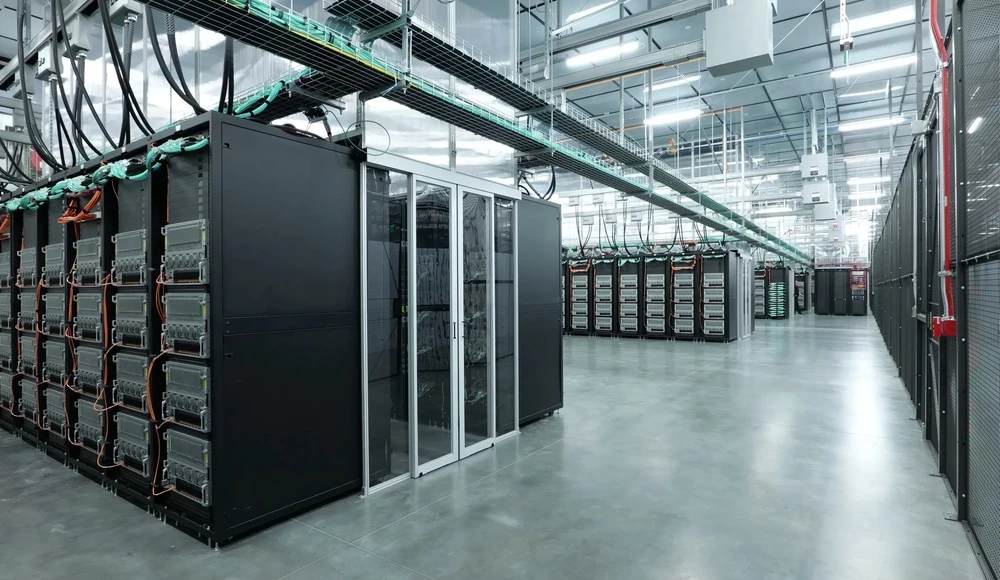
- Saudi Arabia can deliver electricity to AI data centers faster than the US, leveraging its advanced infrastructure and clear expansion plans, according to Siemens Energy CEO Christian Bruch.
- The rapid speed of power delivery is crucial for competing in the AI industry, with even a six-month difference in data center launch impacting development significantly.
- Saudi Arabia's strategic infrastructure planning includes clear targets through 2030, facilitating easier project implementation compared to other countries.
- Siemens Energy is investing $150 million to expand its Dammam facility, which will include a new transformer factory and create 130 to 150 jobs.
- Siemens Energy aims to establish local manufacturing capabilities to bolster energy security and reduce reliance on international supply chains.
- The company plans to make Dammam a regional hub for power system repairs and local talent development, further enhancing its operational capabilities by 2030.
JEDDAH: Saudi Arabia can supply electricity to AI data centers faster than the US, giving it an edge in attracting computing investments through its advanced power infrastructure and clear plans to expand generation capacity, Siemens Energy CEO Christian Bruch has said.
Speaking to Mohammed Fathi of Asharq Bloomberg at the company’s Dammam facility, Bruch said the speed of power delivery has become a key factor in competing for AI projects. He added that advancing or delaying a data center’s launch by six months can make a significant difference as artificial intelligence and superintelligence technologies develop rapidly.
Asked whether the Kingdom could supply electricity to data centers faster than the US, Bruch said: “Yes, I think so.” He noted that Saudi Arabia had made significant progress in developing its power infrastructure in recent years and had a clear, coordinated plan for adding new generation capacity.
This comes as the company invests around $150 million to expand its Dammam facility, adding 60,000 sq. meters and establishing a factory for large power transformers.
The expansion is also expected to create around 130 to 150 additional jobs, as the company seeks to strengthen local manufacturing, serve Saudi demand and export to international markets.
Saudi Arabia’s planning and execution advantage
Bruch described Saudi Arabia as “a model for strategic infrastructure planning,” saying its clear targets through 2030 and defined electricity generation requirements help suppliers plan and deliver projects in phases, making the process more straightforward than in other countries.
He said the Kingdom could also supply electricity to data centers at “highly competitive” costs, enhancing its appeal to companies seeking locations for their investments.
Data center operators would find Saudi Arabia a suitable location for their projects, he added, noting that the US “will not always remain the only destination.”
Asked about discussions with Humain, Bruch did not disclose any specific agreements but said he expected further announcements on larger-scale, higher-capacity data center computing projects in Saudi Arabia.
He added that Siemens Energy’s role is to supply equipment, while other entities would handle operations.
Major transformer factory planned for Dammam
The Dammam expansion marks another step in Siemens Energy’s industrial development in the Kingdom. The company began with a gas turbine factory, later added compressors for the oil and gas sector, and opened a facility for electrical switchgear used in the power grid last year, according to Bruch.
He noted that the new transformer factory would be one of the company’s key manufacturing facilities in this field globally, with production capacity sufficient to serve both the Saudi market and international markets.
He added that a further expansion phase could be implemented in the future if business develops in line with the company’s expectations.
Bruch did not specify the plant’s annual production capacity but said it would manufacture large power transformers for high-voltage networks, including Saudi Arabia’s main 380-kilovolt transmission grid.
He further said: “What we need is clarity on the stability of the environment — in other words, is there sustained demand? Is there a long-term strategy? And that is what I see in Saudi Arabia today.”
The investment builds on Siemens Energy’s major contracts in the Kingdom. In June 2024, the company announced a deal worth around $1.5 billion to supply key technologies for the Taiba 2 and Qassim 2 gas-fired power plants, alongside a 25-year maintenance agreement. Each plant is planned to have a capacity of approximately 2,000 megawatts and will use HL-class gas turbines, steam turbines and generators.
In March 2025, Siemens Energy announced a further $1.6 billion contract to supply key technologies for the Rumah 2 and Al-Nairyah 2 power plants, with a combined capacity of 3.6 gigawatts.
The deal includes 25-year maintenance agreements. At the time, the company said key components for the plants would be manufactured at its Dammam facility. The plants were scheduled to begin connecting to the grid in simple-cycle mode in 2027, before transitioning to full combined-cycle operation the following year, according to the timeline announced at the time.
Saudi capacity allocation amid global demand
Bruch said Siemens Energy was in talks over new gas-fired power projects in Saudi Arabia and was reserving production capacity for the Kingdom, despite strong global demand partly driven by the expansion of data centers.
The CEO added that Siemens Energy’s turbine sales pipeline currently extends through 2032, but rescheduling production and balancing the mix of turbine types and sizes could create opportunities to allocate additional capacity to certain projects.
Commenting on whether production capacity could be allocated to Saudi Arabia before 2030, he said: “Yes,” adding that it depends on the turbine type and size, component availability and suppliers’ commitments, stressing that the main challenge is ensuring on-time delivery and securing all components, including blades and guide vanes, while maintaining competitiveness.
Local manufacturing to strengthen energy security
Bruch said the Kingdom’s industrial expansion was aimed at making energy systems more resilient to disruptions caused by pandemics, shipping delays and military conflicts.
He added that manufacturing closer to customers enables local quality testing, strengthens workforce development and supply chains, and attracts other manufacturers. It also allows energy infrastructure to be expanded or rebuilt more quickly when needed.
He also said that regional conditions had prompted the company to reroute some shipments originally planned to pass through the Strait of Hormuz, but had not significantly disrupted its operations, as Siemens Energy had been able to find alternative solutions.
He noted that one of the company’s goals is to turn Dammam into a regional hub for rapid response and power plant repairs, while building local capabilities to handle around 80 percent of cases with Saudi-based personnel and reducing the need to urgently bring in experts from abroad.
He said the company’s team in Saudi Arabia comprises around 1,000 people and that expertise would continue to develop gradually, with specialists from abroad supporting the transition while Saudi talent is developed year by year.
Looking ahead to 2030, Bruch said the priority is to deepen local capabilities and attract suppliers to the industrial ecosystem surrounding the Dammam facility.
He said the company would also expand its transformer and switchgear operations and explore opportunities to take on more gas turbine work.
Bruch criticized delays in decision-making on offshore wind projects in Europe, saying they had created a three-to four-year gap despite companies’ investments in factories and jobs.
He said consistent planning and a firm commitment to energy projects were essential to keeping factories running and retaining skilled workers, adding that Saudi Arabia is doing this well.