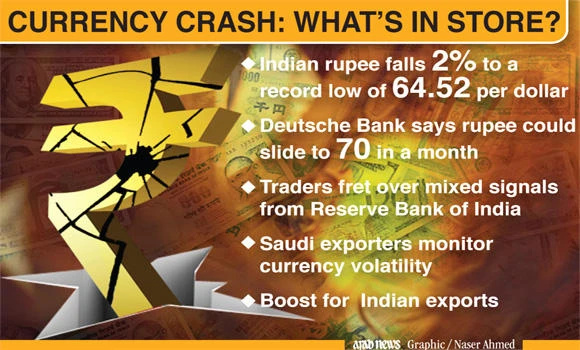
A weaker Indian rupee may lend some impetus to Indian trade with Saudi Arabia as well as potentially attracting more tourism, according to a leading economist.
“From the perspective of Saudi exports, this is likely to mean more challenging. Subsidies on hydrocarbons have been scaled back in India and the rupee equivalent of prices of oil etc will increase,” Jarmo T. Kotilaine, regional analyst, told Arab News.
His remarks came as the rupee plunged to a record low on heavy dollar demand from importers.
The rupee fell 2 percent to a record low of 64.52 to the dollar despite what traders said was sporadic central bank intervention in both the spot and forward markets.
“A weaker rupee is naturally positive news for India in the sense that it will boost the competitiveness of Indian exports,” said Kotilaine.
But he stressed: “Of course, the impact of this volatility tends to be to an extent mitigated by hedging, etc., But in general the near-term effect should boost the competitiveness of Indian goods and erode that of Saudi goods in India.”
John Sfakianakis, chief investment strategist at Masic in Saudi Arabia, commented: “Ideally goods imported over time from India should become cheaper but that is dependent on importers passing the lower price onto the consumer and the rupee staying low over time. Such pass through events take time to be felt by the final recipient of goods as a falling currency stays depreciated for sometime. But some pricing adjustment should be seen in observed.”
Indian stocks closed down 1.86 percent. Shares have fallen nearly six percent in the past three days on concerns over the rupee and a faltering economy.
Rupee’s fall raises trade challenge