- Arriving passengers made up 52.3% of the total traffic, exceeding 37 million, while departures were about 33.7 million.
- The rise in traffic supports Saudi Arabia's National Transport and Logistics Strategy, which aims for over 300 million air passengers and 150 million tourists by 2030.
- King Fahd Causeway Port accounted for 49.1% of land passenger traffic, with January being the busiest month at over 7.4 million passengers.
RIYADH: Passenger traffic through Saudi Arabia’s land ports rose 7.2 percent to more than 70.7 million in 2025, as cross-border travel increased, official data showed.
Arriving passengers accounted for 52.3 percent of the total, exceeding 37 million, while departures reached about 33.7 million, or 47.7 percent, according to the General Authority for Statistics' Road Transport Statistics 2025 report.
Regional connectivity
The increase comes as Saudi Arabia seeks to strengthen regional connectivity under its National Transport and Logistics Strategy, which targets more than 300 million air passengers.
The Kingdom is also aiming to attract 150 million domestic and inbound tourists annually by 2030, up from 67 million in 2021.
The strategy also aims to improve road infrastructure, with targets of ranking sixth globally in the Road Infrastructure Quality Index and placing Saudi Arabia among the world’s top 10 countries in the Logistics Performance Index, according to the ministry.
Joseph Salem, partner in the travel and transportation practice at international management consulting firm Arthur D. Little, said: “The 70.7 million passengers crossing Saudi Arabia’s land ports in 2025 highlight the increasingly important role of road transport in regional mobility and cross-border connectivity.”
He added: “Land travel remains highly competitive due to its flexibility, accessibility and cost-effectiveness, particularly for short- and medium-distance journeys across the Gulf Cooperation Council.”
Salem said demand is driven by growing tourism, business travel, family visits and stronger regional integration. “As connectivity improves, land ports will play an increasingly strategic role in supporting Saudi Arabia’s mobility and tourism ambitions,” he added.
King Fahd Causeway
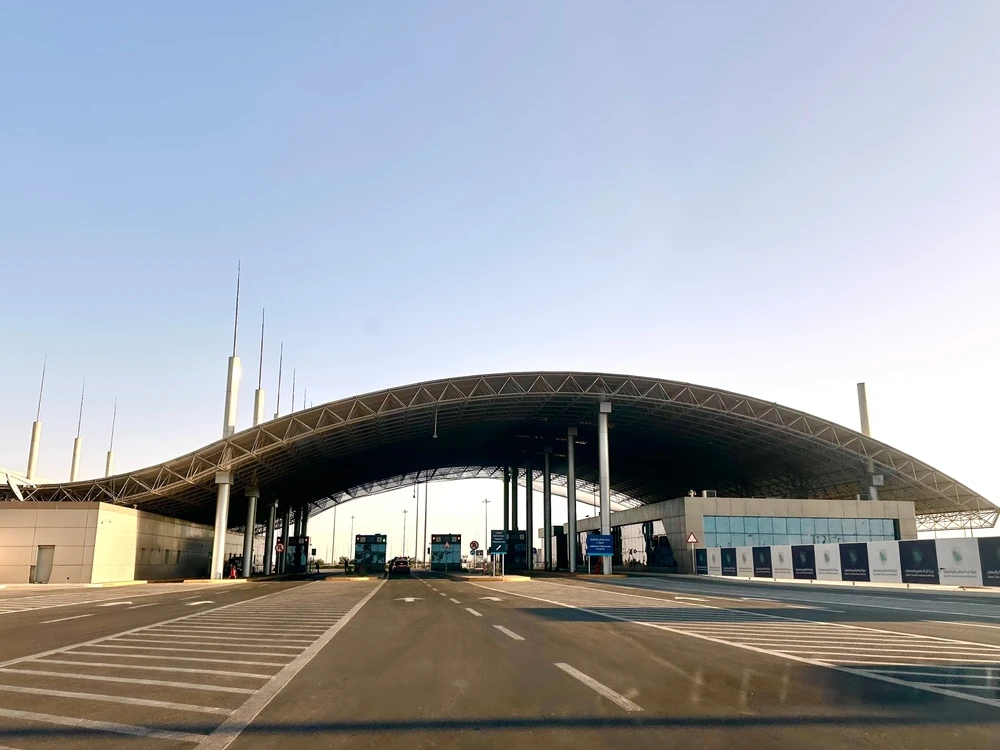
King Fahd Causeway Port handled 49.1 percent of passenger traffic through the Kingdom’s land ports, the largest share among the facilities, followed by Al-Khafji Port at 12.2 percent.
January was the busiest month, with more than 7.4 million passengers, while March recorded the lowest traffic at approximately 4.6 million.
Land freight volumes increase 4.4%
Freight volumes transported through Saudi Arabia’s land ports increased 4.4 percent to more than 26.8 million tonnes in 2025, with growth recorded in both exports and imports.
Exports rose 6.3 percent to 14.3 million tonnes, while imports increased 2.4 percent to 12.5 million tonnes, according to GASTAT.
Al-Batha Port accounted for the largest shares of both export and import volumes, handling 27.9 percent and 31.9 percent, respectively.
Al-Hadithah Port accounted for 23.2 percent of exports, while Riyadh Dry Port handled 26 percent of imports.
Driving licenses exceed 11.3m
The number of valid driving licences in Saudi Arabia exceeded 11.3 million at the end of 2025, with private licences accounting for 87.2 percent of the total.
Saudi nationals represented 51 percent of licence holders, compared with 49 percent for non-Saudis. Men accounted for 87.6 percent of holders, while women made up 12.4 percent.
Newly issued driving licences totalled approximately 1.2 million during the year, down 8.1 percent from 2024. Licence renewals also declined by 8.1 percent, to more than 1.1 million.
Riyadh Region accounted for 37.4 percent of newly issued licences, followed by Makkah Region at 19.8 percent and the Eastern Region at 17.2 percent.