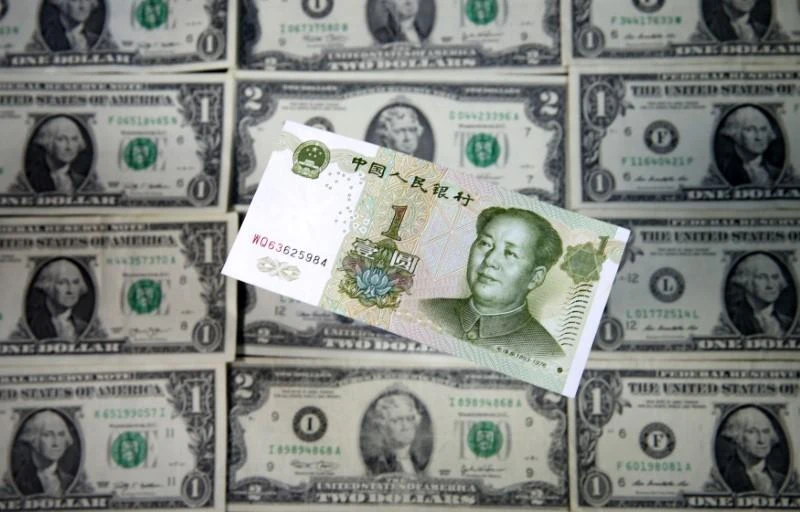
- Pakistan has given facility of forwarding booking in Yuan to promote trade with China
- Financing CPEC projects in Yuan will bridge demand-supply gap, economists say
KARACHI: As China encourages trading partners and countries involved in Belt and Road Initiative (BRI) to trade in Yuan, Pakistani traders say internationalization of Chinese currency hardly replaces their dollar needs though it reduces pressure on the country’s foreign exchange reserves.
China’s bilateral trade with countries and regions involved in BRI in the past five years has exceeded $6 trillion, according to National Development and Reform Commission (NDRC) of China.
Beijing has signed 171 cooperation agreements with 29 international organizations and 123 countries including both the developed and developing states.
Pakistan is also among countries that have opened the door for settling all bilateral trade with China in Yuan instead of the dollar.
The State Bank of Pakistan (SBP) had signed a Currency Swap Agreement with the People’s Bank of China in 2011 with the objective of promoting bilateral trade and financing direct investment between the two countries in the respective local currencies.
However, traders and experts believe the need for dollars would still be there due to huge Sino-Pak trade imbalance.
“Our imports exceed our exports and if we trade in Yuan it means that we need more Yuan to pay the Chinese exporters. So, to fill the gap, we need dollars converted to Yuan for payment,” Masood Naqi, an exporter and former Chairman of Korangi Association of Trade and Industry, told Arab News.
He said that “exporters in China also enjoy incentives on dollar based exports, depending on regions.”
“To fully capitalize on the benefits of currency swap, both countries need to move forward after they agreed on government to government (G2G) level,” said Naqvi adding that “Business to Business (B2B) advancement is the most import element for mutual trade benefits to materialize.”
Imran Ghani, Chairman of Pakistan-China Business Council of Federation of Pakistan Chambers of Commerce and Industry (FPCCI) said bilateral trade with China in Yuan will have advantages both for Pakistani exporters and importers.
“Our major portion of economy is import based and if we trade in Yuan then the balance of trade will also improve. The state bank and other banks are also facilitating in this regard,” he told Arab News.
Pakistan and China have signed second phase of Free Trade Agreement FTA-II which allows Pakistan’s 90 products duty free in Chinese markets and gives equal status those given to ASEAN nations.
Pakistani exporters have long been calling for making equal status with ASEAN countries part of free trade agreement with China. China-ASEAN trade volume reached $514.8 billion with a year-on-year increase of 13.8 percent in 2017.
“Pakistan has given facility of forwarding booking in Yuan because government wants to promote Yuan based trading with China,” said Ghani.
China is investing around $60 billion in Pakistan under the China Pakistan Economic Corridor (CPEC), an important component of BRI. Experts of international trade say that Pakistan will largely benefit due to trade in Yuan as the demand supply gap of Yuan could be bridged by financing CPEC projects in Yuan.
“The Yuan based trade is in our interest. The flow of Yuan through CPEC will bridge the supply-demand gap but the demand for dollar will not go away. However, the dollar may face hard times ahead,” Professor Dr. Athar Ahmed, senior economist and expert on International trade, told Arab News.
Pakistan, confronted with huge balance of payment crisis, is currently negotiating with International Monetary Fund IMF for $6-8 billion bailout program. The prolong dialogue with the fund are continuously exerting pressure on country’s foreign exchange reserves which hover $8.8 billion as on April 26, 2019.
Despite calling themselves all-weather friends, the trade between both the countries remains low and largely in the favor of China. During last fiscal year FY18, Pakistan was able to export only $1.75 billion worth of goods while China exported $11.47 billion worth of goods to Pakistan, according to a report by the State Bank of Pakistan.