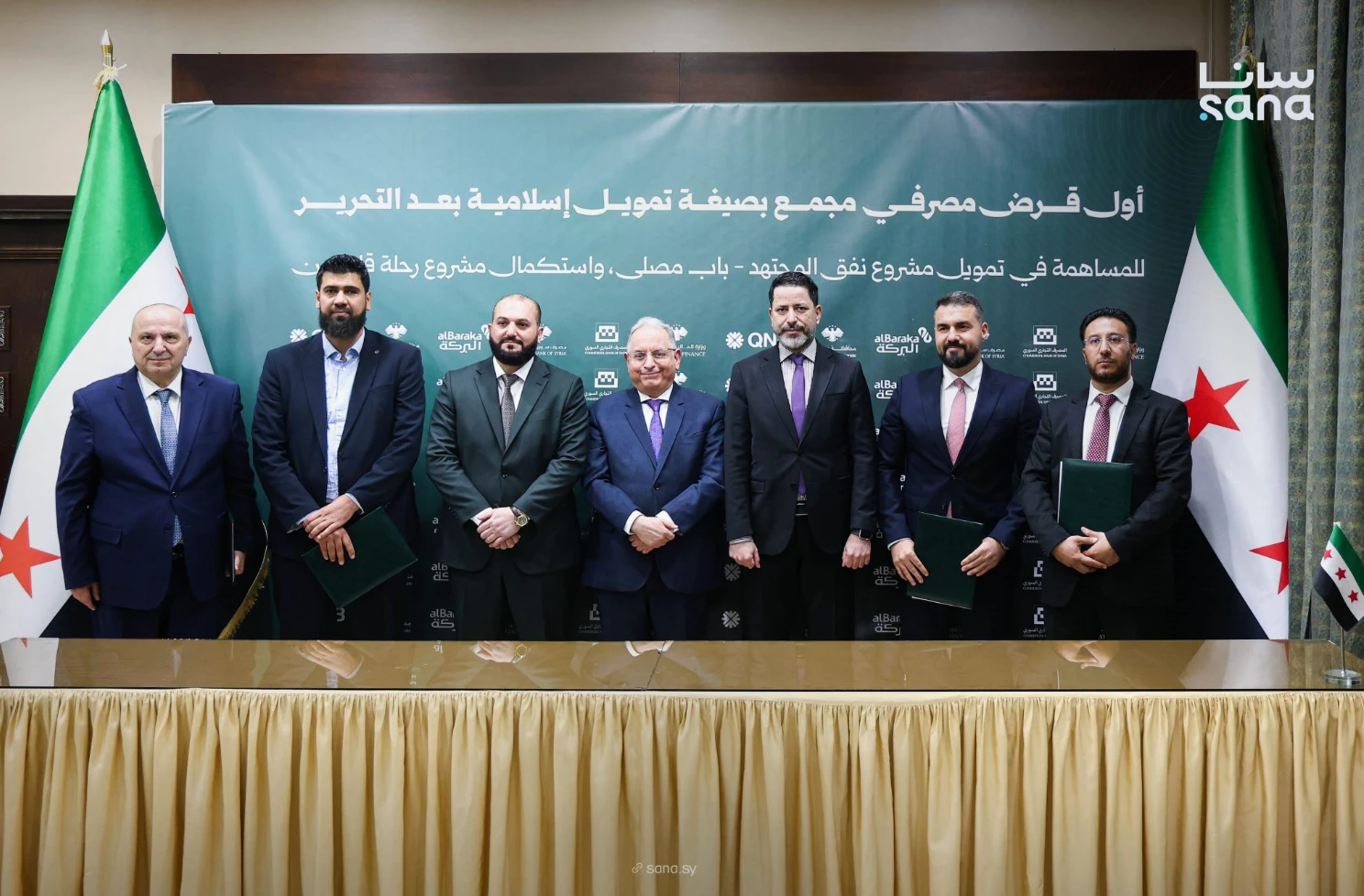
RIYADH: Syria has signed its first syndicated bank financing agreement structured under Islamic finance principles, bringing together three banks to fund two development projects in Damascus and provide an alternative to government budget financing.
The arrangement involves Al Baraka Bank Syria, QNB Syria and the Commercial Bank of Syria, according to the Syrian Arab News Agency, or SANA. The financing is sponsored by the Ministry of Finance and the Central Bank of Syria and carries a sovereign guarantee.
The value, tenor, profit rate and allocation among the participating banks were not disclosed.
The agreement comes as Syria seeks alternative sources of development finance amid pressure on public finances. Government revenue totaled about $2.7 billion in the first half of 2026, compared with expenditure of $3.7 billion, producing a deficit of approximately $1 billion, according to the Finance Ministry.
“This financing eases pressure on the public budget. Today, we cannot rely on the public budget to finance every project, so we had to look for other financing solutions that serve our growing development needs,” Finance Minister Mohammed Barnieh said following the signing.
Barnieh described the syndicated facility as a new model of cooperation between the government and public and private banks that could be extended to larger development and investment projects.
Projects and financing terms
The facility will finance the Al-Mujtahid–Bab Musalla tunnel and the final phase of the Qasioun Journey project in Damascus.
The proposed 2-km underground tunnel is intended to connect western and eastern Damascus. Governor Maher Marwan said construction was expected to take between two and two-and-a-half years, compared with an earlier estimate of 10 years.
Funding for the Qasioun project will cover superstructure work, exterior finishes and water, sewage and electricity networks. The development is scheduled to open in summer 2027, according to Marwan.
The governor said the Islamic facility had been reviewed by the Supreme Fatwa Council and specialists from the three participating banks. It offers what he described as a low profit margin and flexible repayment conditions.
Central Bank Governor Mohammed Raslan said syndicated financing could expand banks’ capacity to fund infrastructure while bringing together state-owned and private institutions, as well as conventional and Islamic lenders.
Separately, a US economic delegation met officials from the Syrian Sovereign Fund a day earlier to assess investment opportunities, with the fund saying several agreements and projects involving US companies were under negotiation. The talks followed Washington’s termination of its Syria sanctions program in July 2025.
Fiscal and reconstruction context
The financing agreement comes against a backdrop of pressure on Syria’s public finances, with the government looking to increase investment while managing limited budgetary resources.
Revenue reached 31 percent of the annual estimate, while spending accounted for about 35 percent of approved expenditure. The ministry expects project implementation and investment spending to accelerate during the second half.
Syria’s wider reconstruction costs are estimated at $216 billion, including $82 billion for infrastructure, according to the World Bank. Direct physical damage from more than 13 years of conflict was estimated at $108 billion.
The World Bank also approved a $100 million grant in August to modernize Syria’s financial sector, which it described as small, bank-centered and heavily reliant on cash. The project will support banking rehabilitation, payment infrastructure, supervision and financial-integrity systems.