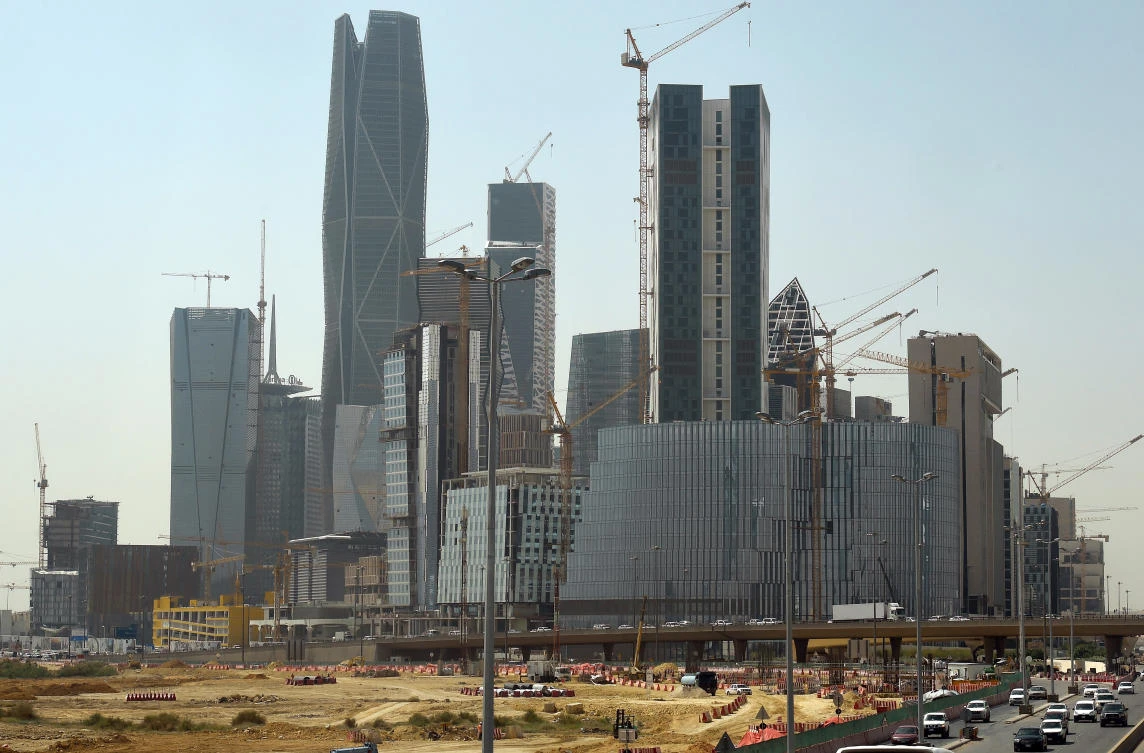
- Saudi Arabia's infrastructure development is shifting towards private-sector involvement, driven by the National Infrastructure Fund and the National Privatization Strategy, targeting over $64 billion in investments by 2030.
- The banking sector is evolving from rapid growth to structured project financing and efficient capital deployment, with banks focusing on originating and distributing assets rather than holding them.
- Significant projects like the SR8.5 billion Jubail–Buraydah water pipeline highlight private-sector participation in large-scale infrastructure investments.
- Emerging financing opportunities for banks include project finance, corporate loans, and supply-chain financing, fueled by investments in transport, housing, and energy sectors.
- The next wave of investment is expected to focus on industries like water, minerals, artificial intelligence, and data centers, supporting Saudi Arabia's economic growth.
- Local banks currently finance around 60% of construction spending, providing a stable foundation for continued loan growth amid evolving infrastructure projects.
RIYADH: Saudi Arabia’s infrastructure pipeline is entering a more private-sector-driven phase as the Kingdom expands financing options across transport, power, water and digital infrastructure, experts have told Arab News.
The shift is underpinned by the National Infrastructure Fund’s mandate to mobilize private capital and deepen infrastructure financing, while the National Privatization Strategy targets more than $64 billion in private-sector capital investment and more than 220 public-private partnership contracts by 2030.
Arjun Singh, partner at international management consulting firm Arthur D. Little Middle East, said Saudi Arabia’s banking sector has moved from proving it can fund the Vision 2030 transformation to a more mature phase focused on structured project finance, capital-market funding and more efficient deployment of bank capital.
He said that banks are increasingly shifting from holding assets on their balance sheets to originating, structuring and distributing them to other investors.
“Phase two is a maturation story, not a slowdown story. Growth has moderated from around 13 percent in 2025 to an expected 10-11 percent in the current year. In Q1, deposits grew 4 percent versus 1.6 percent loan growth. The message is clear — a system that spent five years lending faster than it funded is now rebalancing. That is what healthy looks like,” Singh told Arab News.
He noted the project pipeline is also becoming more bankable, with water plants, independent power and transmission projects, and mining developments, as well as airports and roads, offering more structured revenue streams.
The SR8.5 billion ($2.26 billion) Jubail–Buraydah independent water transmission pipeline illustrates the scale of investment and the role of private-sector participation in Saudi infrastructure.
Signed in March 2025, the 587-km project will connect the Eastern and Qassim regions with desalinated drinking water, with a design capacity of up to 650,000 cubic meters a day.
It also includes nine strategic reservoirs with a combined capacity of 1.63 million cubic meters, according to the Saudi Press Agency.
Faisal Al-Sarraj, Saudi country senior partner at multinational professional services networks PwC Middle East, also pointed to the broader financing opportunities emerging around the Kingdom’s infrastructure pipeline.
“There is a much wider network of contractors, suppliers and Saudi businesses growing around them that also need capital,” Al-Sarraj said.
He noted that for banks, that creates opportunities across project finance, corporate lending and supply-chain financing.
“We’re also seeing the way these projects are funded evolve, with more private capital coming into the market alongside government investment,” Alsarraj said.
Talat Hafiz, secretary general and spokesman of Saudi Banks at Media & Banking Awareness Committee, also explained that the significant investments across transport, housing, energy and industrial projects are creating new opportunities for private companies and driving demand for corporate credit and financing, in line with Vision 2030’s push to increase private-sector participation.
“For Saudi banks, this is creating lending opportunities across project finance, corporate loans, working capital, trade finance, and financing for contractors, suppliers and other companies involved throughout these project value chains,” he said.
Industries, infrastructure segments to drive the next wave of investment, opportunities
ADL’s Singh said the next wave of investment and financing opportunities will increasingly come from the infrastructure and industries that enable Saudi Arabia’s broader development, particularly water, minerals and downstream processing, as well as artificial intelligence and data centers, and contractor and supply-chain financing.
“In the past, the attention was on the destinations but banks have realized that the future returns are in the enabling layer,” he said.
Al-Sarraj from PwC also said the next wave of investment will come from infrastructure supporting Saudi Arabia’s growing economy.
“Al and data centers need power and connectivity. Manufacturing needs energy and logistics. As cities and industries grow, they need more transport, utilities and services around them,” he said.
Building on this, Hafiz said Saudi banks are moving toward a broader and more diversified project pipeline, creating opportunities across infrastructure, housing, and utilities, as well as industrial projects, tourism, transportation and logistics.
Non-giga-projects to support manufacturing, utilities
Edmond Christou, senior equity analyst at research platform Bloomberg Intelligence, said Saudi Arabia’s non-giga-project spending is more heavily allocated toward manufacturing and utilities, with a smaller share going toward commercial and office space, hospitality and retail.
Similarly, Hafiz said non-giga-projects will increasingly support construction activity and bank loan growth, with “the broader ecosystem of housing, transport, utilities, industrial facilities, tourism, healthcare, education and commercial developments” a substantial and recurring source of financing demand.

Strategic spending reshapes Saudi construction pipeline
The Saudi construction market is entering a phase of more targeted spending, said hristou, adding that capital allocation is expected to increase over the next one to three years in digital infrastructure, including IT and computer technology, as well as advanced technology, renewable energy and manufacturing.
Christou said local banks finance around 60 percent of construction spending, meaning the existing project pipeline remains sufficient to support loan growth and funding demand even if overall spending declines.
He added that local banks finance around 60 percent of construction spending, meaning the existing project pipeline remains sufficient to support loan growth and funding demand even if overall spending declines.