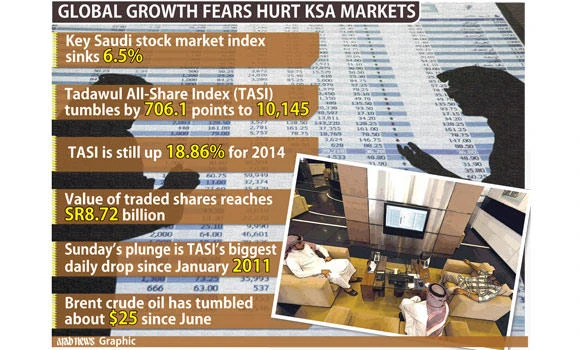
Declines on global bourses and falling oil prices sparked a sell-off in the Saudi stock market on Sunday, with the Tadawul All-Shares Index (TASI) shedding 6.51 percent to close at 10,145.38 points.
Share prices in other Gulf states also nose-dived with investors spooked over global growth fears, declining oil prices and conflicts, analysts and investors said.
The Dubai Financial Market index, which has made the largest gains among the Gulf markets so far this year, shed 6.54 percent to close at 4,619.60 points — its lowest point in about three months.
TASI dropped by 706.1 points in its biggest daily drop since January 2011, causing the key index to close below its 100-day average for the first time since December 2012.
“The Saudi market is reacting a bit excessively due to the week-long holiday to the global sell-off in equities and the drop in oil prices,” John Sfakianakis of Ashmore Group said. “Going forward, the fundamentals are strong but the market was bound to take a respite given also its upward spike over the last few months,” said the analyst.
According to local reports, all but one of the 161 listed companies dropped on Sunday.
“Sunday’s plunge in stock prices can be attributed to the global sell-off, which signals a due correction after recent surges,” commented Mushtaq Ahmed, senior financial analyst at Zughaibi & Kabbani Financial Consultants, Jeddah.
“Saudi equities’ returns appeared to be too high in 2014, even going beyond the justified limits fundamentally. Perhaps, investors were ready to absorb this significant reversal,” he said.
Global markets took a big hit on Friday as investors fled to the safety of government bonds after a raft of weak indicators from Europe and China collided with concerns about the US Federal Reserve’s plans to reduce monetary stimulus.
Despite Sunday’s setback, TASI is up 18.86 percent for this year.
The index ended at 8,535.60 points on Dec. 31, 2013.
The value of traded shares reached SR8.72 billion on Sunday.
Asim Bukhtiar, vice president/head of research at Riyad Capital, said: “Today’s (Sunday) correction was driven by significant weakening in oil prices during the Eid holidays.”
Bukhtiar added: “With oil below the IMF projected breakeven price of $89 for Saudi Arabia, investors are searching for implications for the upcoming 2015 budget announcement.”
He said: “If the oil price recovery remains elusive, we may see some purse tightening which could curtail GDP growth in the year ahead. Drastic reaction was partly attributed to week-long closure. Perhaps if oil slide occurred outside of Eid holidays, the market decline may have been gradual.”
He added: “In the coming weeks, oil prices will be closely watched and whether the country announces any plans to reverse the downtrend. Fundamentals will shift if oil drops, and remains, below $80.”
On Friday, Brent crude oil touched its lowest level since December 2010 at $88.11, though it recovered to $90.21 by the end of day’s trade on short-covering. Brent has tumbled about $25 since June.
Reacting to Tadawul’s fall, Tamer El Zayat, senior economist at the National Commercial Bank, told Arab News: “I believe that the decline is too much too soon and it is highly likely that we will see a rebound on the back of positive third-quarter earnings.”
He also said: “It seems the overwhelmingly negative news were too much for the market to shrug off, with oil prices falling precipitously in a short period of time, as the major crude benchmarks entered into a bear market, falling by 20 percent since their peak in June.”
The economist said: “The geopolitical situation north and south of the Kingdom is worrisome as well, with Islamic State (IS) and Hotheen acting as destabilizing forces. Additionally, market participants might be liquidating in anticipation of the National Commercial Bank’s (NCB) IPO that will materialize this month.”
NCB has announced plans to raise $6 billion in an initial public offering in what is likely to be one of the biggest share sales globally this year.
Analysts say the IPO will be the largest ever in the Arab world, and ranks only behind Chinese e-commerce giant Alibaba Group’s $25 billion IPO on the international charts this year.
NCB will sell 500 million shares at SR45 each in an IPO that will run from Oct. 19 to Nov. 2.
Banks and Financial Services index also fell on Sunday as part of the market slide. It dropped by 1,402 points (6.15 percent) to 21,395.95 points.
Basil Al-Ghalayini, CEO of BMG Financial Group, commented: “Obviously, the entire GCC markets have noticed declines in their indexes. These declines were driven mainly by the recent IMF’s outlook for global economic growth for this year and 2015, mostly because of weaker expansion in Japan, Latin America and Europe.
He added: “Furthermore, it is feared that low interest rates have made investors “too complacent” in the euro zone, which may trigger sharp falls in key financial markets. These macroeconomic indications had a knock-on effect on the regional markets.”
The CEO said: “On the political front, the turmoil in the Middle East, especially on the Turkish and Syrian borders, pose further concerns on the region’s stability. Hence, investors start to get more nervous of the longevity of Syrian conflict.”
Jarmo T. Kotilaine, a regional analyst, said: “The short version is that there now suddenly seems to be much more uncertainty about the global outlook that was the case just months ago. Worries about the euro zone and China (as well as many other emerging markets) are raising concern about global growth. The emerging markets narrative is particularly important for oil prices which have been under downward pressure.”
Kotilaine added: “As people worry about demand, oil supplies are continuing to go up. The market dynamics, more than anything else, are probably a reflection of this nervousness and uncertainty.”
Tadawul joins global sell-off, plunges 6.5%