LONDON: Tin, just about every analyst is agreed, is a market suffering from chronic supply shortfall.
Established producers are struggling to maintain historical production levels, while new mines remain conspicuous by their absence.
The resources boom has largely passed tin by. The minnow of the industrial metals traded on the London Metal Exchange (LME) has simply not attracted the same sort of investment interest as bigger, brighter sectors such as iron ore or copper.
Evidence of supply-side constraint is plentiful.
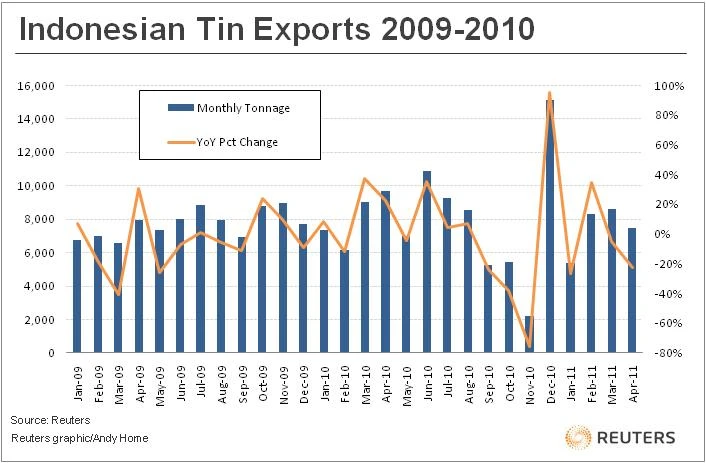
Exports from Indonesia, the largest exporter of the metal used in soldering and tinplate, fell 8 percent in the first four months of this year.
Production in China, the world’s largest producer and consumer, slid 4 percent over the same period.
That in Peru, another major origin country, also fell 3 percent in the first quarter of this year. Trade body ITRI suggests the country’s sole producer Minsur is struggling to maintain output due to “difficulties in controlling dilution in the narrow veins that are being mined currently as reserves are gradually depleted.”
But while the supply side part of the market narrative is intact, evidence of a deficit market has been curiously lacking so far this year. Stocks registered with the LME are actually up by 18 percent, or 2,160 tons, since the start of January.
This is not the first time the tin market deficit has gone missing.
It did so in the first part of last year, cracking what appeared to be a rock-hard bullish consensus and occasioning a spectacular price collapse from over $33,000 per ton in the first quarter to $19,000 by the close of the third.
Then it was a case of the price rising too fast and too high. Consumers reacted by thrifting and destocking to the point that rather than market deficit leading to high prices, high prices led to market surplus.
So what has happened this year?
The obvious inference is that rising stocks at a time of supply constraint must reflect changes to the demand side of the equation.
And to some extent that is true, industry observers noting what might at best be called patchy demand from Asia’s giant electronics sector in the first quarter.
But a more significant, though counter-intuitive, driver might be supply.
To understand why requires revisiting what happened when the tin price slumped over the course of the third quarter of 2011.
What grabbed the headlines back then was the response from Indonesian producers, particularly the clutch of smaller producers operating from the tin-rich islands of Bangka and Belitung.
The much-hyped export ban proved to be one of the shortest-lived price-support attempts in the history of commodity markets.
The agreement unraveled almost immediately amid much acrimony and pointing of fingers, mainly by the smaller producers at the country’s biggest producer, PT Timah, which argued that it couldn’t simply halt sales already booked under term contracts with consumers.
But it lasted long enough to distort the country’s export flows. Exports plunged to a multi-month low of 2,202 tons in November before rebounding to a multi-month high of 15,103 tons in December as material held back was released.
Rising LME stocks have reflected this late-2011 export burst, albeit with a time-lag created by the need for much of the metal sourced from the smaller producers to be re-refined.
This, by the way, is a normal feature of Indonesian tin exports and one that sheds an interesting light on the current government drive to extend the same sort of controls on tin to other unprocessed minerals.
Indeed, the impact on LME stocks might have been greater had it not been for a simultaneous price reaction in China.
The country’s imports of tin underwent a step change from September onwards. Net imports over the last six reported months through March have totaled tons, exceeding cumulative imports over the whole of calendar 2010.
Rather than consumers rushing in to capitalize on bargain-basement prices, it seems it was producers soaking up international units because they were cheaper than domestic concentrates.
The sharp drop in China’s refined production over the back end of 2011 and start of 2012 was not so much a reflection of weaker demand but more a conscious collective decision to capitalize on the arbitrage between international and domestic prices.
It was a decision derived from supply-side constraint, in this case mine production within China, but one that has ironically resulted in temporary oversupply.
The question now is whether underlying deficit is about to reappear.
Two warning flags come in the form of LME stocks and spreads.
Last week saw a flurry of cancelation activity with a total 2,525 tons, or around 17 percent of total LME stocks, being prepared for physical drawdown.
There has been some reverse movement this week but canceled tonnage still accounts for a hefty 22.5 percent of total LME stocks and open tonnage has slid to 11,045 tons.
Nearby time-spreads have reacted accordingly, the LME’s benchmark cash-to-three-months period contracting sharply to $20 contango at Wednesday’s close.
LME stock movements, it must be said, are becoming ever more difficult to read because of the queues of aluminum that are clogging up key locations, including Johor in Malaysia, where most of the LME tin is stored.
While the LME considers a proposal to introduce a specific load-out requirement for tin and nickel over and above its existing rules, tin players may have decided to take no chances and get as much material in the queue as early as possible.
That said, both previous supply-side reactions to last year’s price troughs are now fading.
Indonesian exports have returned to more normal monthly fluctuations, while Chinese tin imports are widely expected to moderate as the local market works through the tonnage accumulated over the last few months.
That may push back any acute tightening but acute tightening is still what most expect.
ITRI, for example, is still forecasting a 10,000-ton deficit this year and the potential for a price spike that would eclipse even last year’s boom.
That may seem unlikely right now, given that the tin price looks more in danger of revisiting last year’s lows as it succumbs to the wider gloom spreading across the industrial metal markets.
But this is a market with a track-record of accentuated volatility, capable of the sort of accelerated boom-bust cycle other commodity markets take years to navigate.
It is precisely that volatility that distorts what should be a simple narrative of deficit. It happened last year because of high prices and it looks as if it has happened again in the early part of this year because of low prices.
The deficit may go missing for prolonged periods of time but so chronic is tin’s supply dynamic that it will reappear sooner or later.
It may be starting to do so again.
— Andy Home is a Reuters columnist. The opinions expressed are his own.
The return of the elusive tin deficit