The outlook for the UAE’s banking system has been changed to stable from negative, says Moody’s Investors Service in a new report published Wednesday.
The outlook change reflects the continued improvements in the operating environment, as well as the ongoing recovery of the local real estate market, which Moody’s believes will lead to a decline in problem loan levels and an increase in profitability over the next 12 to 18 months.
In addition, the rating agency expects that banks will continue to maintain high liquidity and capital buffers that were built up since the onset of the global financial crisis.
The new report, “Banking System Outlook: United Arab Emirates,” is now available on Moody’s online portal.
Moody’s expects real GDP to grow by 3.6 percent in 2013 and 3.7 percent in 2014, supported by continued public sector spending, particularly in Abu Dhabi; and strong signs of recovery in Dubai’s more diversified private sector. This economic growth, combined with increasing confidence and the ongoing real estate market recovery, will support credit growth of 7 percent to10 percent in 2014.
Moody’s expects that this benign environment will support further declines in the problem loans to gross loans ratio to 8 percent to 9 percent over the outlook period, from a 10.5 percent system average at year-end 2012 (9.5 percent as of June 2013). Asset-quality metrics will also be supported by a reduction in the stock of problem loans due to the increasing volume of settlements, recoveries and commercial restructurings and expected loan growth.
Although loan loss coverage levels remain relatively low at around 53 percent for June 2013, this metric will improve as the problem loan balance falls.
Moody’s notes that this improvement in asset quality will drive lower loan-loss provisions which, when coupled with modest asset growth, will support an increase of the UAE banks’ net income to around 2.5 percent of risk weighted assets (RWAs) over the outlook period from around 2 percent as of year-end 2012. This performance will help to offset some of the weaknesses in top-line profitability, which will continue to face margin pressures, given the low prevailing interest rates and an increasingly competitive business environment.
Moody’s expects that the increase in net income will provide the UAE banks with the internal capital generation capacity necessary to support asset growth over the outlook period, while maintaining their strong Tier 1 capital levels, which stood at around 16 percent as of June 2013.
In addition to the shock-absorption capacity provided by robust capital metrics, we also anticipate that the banking system will maintain its strong funding and liquidity profile. The cash-rich federal government and stronger Abu Dhabi-based GRIs will continue to remain a key and stable source of deposits, limiting the system’s dependence on confidence-sensitive market funding.
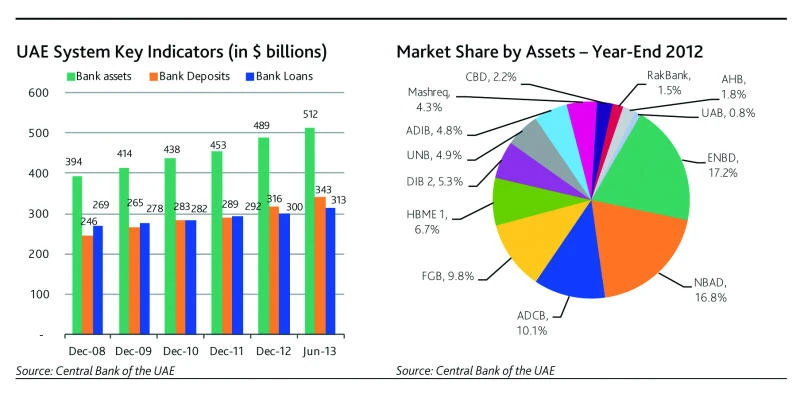
The strength of the UAE banks’ liquidity is reflected in the banking system’s liquid assets-to-total assets ratio of 30 percent as of December 2012 as well as a loans-to-deposit ratio of 93 percent (down from 108 percent in 2008).
Moody’s expects deposit growth to remain strong and that banks will continue to focus on liquidity management ahead of the implementation of Basel III liquidity ratios.
UAE banks ‘to benefit from property recovery’