DAVOS: The latest developments from the World Economic Forum's annual meeting in Davos, Switzerland, where top executives and world leaders are gathered this week.
***
The United States says it will no longer oppose lending to Argentina from multilateral banks.
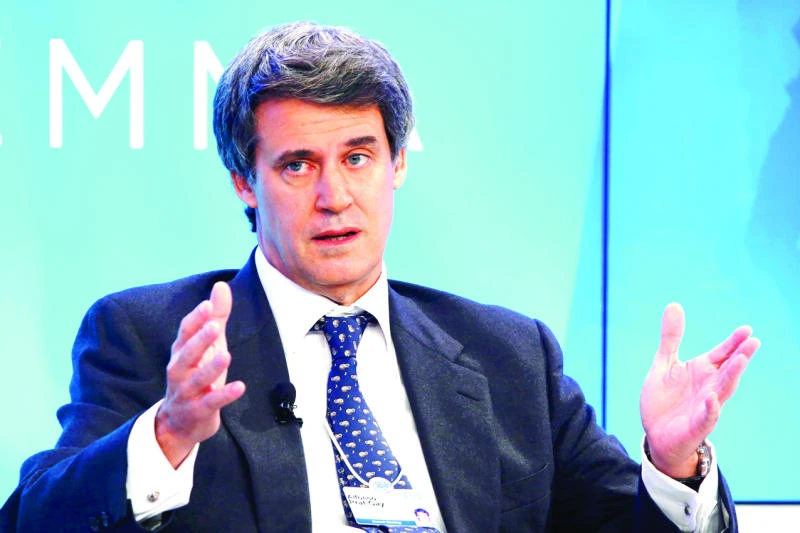
The US Treasury statement follows a meeting between US Treasury Secretary Jacob J. Lew and Argentine Finance Minister Alfonso Prat-Gay at the World Economic Forum in Davos, Switzerland, on Thursday.
It says the policy change was prompted by the Argentine government's "progress on key issues and positive economic policy trajectory."
Argentina is in the process of renegotiating about $10 billion of unpaid debt to US hedge funds that refused to give it debt relief at restructurings in 2005 an 2010.
Market-friendly Mauricio Macri took office as Argentine president in January, replacing Cristina Fernandez, who frequently clashed with Washington.
***
Canadian Prime Minister Justin Trudeau says his government is working on ways to boost the economy beyond a previously planned $10 billion deficit.
Speaking Thursday to The Associated Press at the World Economic Forum in Switzerland, Trudeau said, "We will do what needs to be done." He didn't elaborate.
The drop in oil prices has hit Canada's economy hard, and the Canadian dollar is diving too. Trudeau has vowed to spend billions on infrastructure in an effort to stimulate the economy in a budget being announced in the coming weeks.
Trudeau also said Canada is "committed to continuing" in the US-led coalition against Islamic State extremists, even though there Canada is pulling out warplanes. Speaking to young entrepreneurs in Davos, he said, "Yes there's a need for ... military engagement."
***
The vice president of China says the country "has the confidence and capacity to maintain medium to high growth."
Concerns about a slowdown in the world's second-largest economy have roiled financial markets in recent weeks. China's growth fell to a 25-year low of 6.9 percent last year.
Li Yuanchao said that after years of super-high growth, China is entering another phase, dubbed the "new normal."
The country is trying to shift its focus from an overreliance on manufacturing toward more consumer spending and small business. Li said: "The economy will grow more steadily and have more diversified driving forces."
***
British Prime Minister David Cameron says he is not asking for anything "outrageous" from European Union leaders so that he can campaign for the country's continued membership in the 28-country bloc.
In a speech at the World Economic Forum in Davos, Cameron said Thursday that his aim is to "secure the future of Britain in a reformed European Union."
He said that if a deal does not emerge at a February summit of EU leaders then he can wait. His party's manifesto pledge was to hold a referendum by the end of 2017.
If offered a good deal at the summit, Cameron said he would take it.
Cameron laid out his four reform proposals. He wants changes to rules affecting migration and benefits; to "hard-wire" competitiveness into the EU's DNA; to make sure non-euro countries like Britain aren't discriminated by the 19 EU countries that use the euro currency; and to get Britain out of the idea of an "ever-closer union."
***
European leaders said they will do what they can to make sure British Prime Minister David Cameron can support his country's continued future in the European Union in a referendum expected this year.
Mark Rutte, the Dutch Prime minister whose country currently holds the rotating presidency of the 28-country EU, said Thursday he's "fairly optimistic" a deal with Britain will emerge in February, but that he's "not absolutely sure."
Addressing a panel at the World Economic Forum at the Swiss ski resort of Davos, Rutte voiced his strong support for Britain's continued membership of the EU as the country is outward-looking and trade-oriented.
Cameron is seeking a series of reforms on things like benefits, powers for national parliaments and movement of people. He has voiced his hope that a successful renegotiation will lead to the British people backing Britain's future in the referendum that is expected this year.
French Prime Minister Manuel Valls said it would be a "tragedy" if Britain left the EU — so-called Brexit.
***
A Chinese market regulator says the country has no option but to support growth this year, using its large financial reserves if needed.
As concerns over a slowdown in the world's second-largest economy roil markets, Fang Xinghai, from China's Central Leading Group for Financial and Economic Affairs, said Thursday: "We cannot afford to let growth rate to fall too sharply, because that would ignite a lot of financial problems inside China. So we will have appropriately expansionary fiscal and financial policy this year."
At a panel in Davos, Switzerland, Ray Dalio, the chairman of Bridgewater Associates, said the biggest concern was China's currency. As it weakens, that will weigh on the global economy.
He said: "That happens at a time there is a weakness in the rest of the world."
United States drops rivalry to multilateral Argentine loans