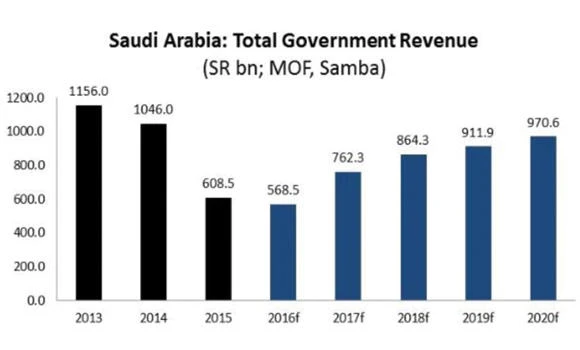
JEDDAH: The days of double-digit spending growth are clearly gone, and the Saudi economy will need to adjust to a very different landscape in the years ahead, according to the Samba Financial Group.
“For Saudi Arabia, 2016 is set to be extremely challenging,” stated the group’s Economics Department in a recent report.
It points out that the fiscal stance has been tightened considerably, and additional cuts to capital spending and procurement are likely this year.
“Most notably, subsidies on utilities, gasoline and gas have all been reduced. This is welcome from a fiscal perspective, but will provide further headwinds for consumers and businesses. As a result, we expect virtually no expansion of the nonoil economy this year,” said the report.
It also said that there was a welcome upturn in nonoil revenue last year and a number of new initiatives suggest that nonoil revenue will become much more important in the years ahead.
The following years should be a little less arduous as oil prices rise and the authorities’ fiscal stance loosens slightly, said the report.
Budget financing will continue to place a strain on international reserves, but growing domestic debt issuance — for which there is plenty of room and appetite — will help to reduce the rate of drawdown, according to the report.
The potential introduction of VAT also offers another decent nonoil revenue gain, Samba economists pointed out.
GCC-wide initiatives of this sort seldom bear fruit, but in the new oil price environment a VAT seems likely to go ahead within the next couple of years.
“Based on extrapolations from points of sale data, and assuming that the rate is introduced at 5 percent, we estimate that this could yield around SR35 billion to the government, equivalent to about 1.2 percent of 2018 GDP,” stated the report.
“We have revised our medium term economic outlook for Saudi Arabia in line with changes to our oil price forecast and the 2016 budget. The latter was a bell-weather for the economic outlook: the government appears committed to getting the fiscal position back on a sustainable footing, even if that means a much weaker growth performance,” said the Samba economists.
“We now envisage a further cut to government spending this year, following last year’s unexpected 13 percent reduction. Our oil price forecast suggests that the government might not squeeze spending quite as much as the budget suggests, but we still anticipate a 9 percent reduction from last year’s actual,” the report added.
The situation should improve in 2017 as oil prices gain strength, supported by a weaker dollar. But the fiscal stance is unlikely to be relaxed significantly, and activity in the nonoil economy is likely to remain subdued by recent standards. Only in 2018-20 will there be sufficient fiscal stimulus to push nonoil growth up to the sort of averages achieved earlier in the decade.
“The fiscal outlook will remain challenging, but the government’s commitment to spending restraint coupled with the substantial scope for domestic debt should relieve pressure on international reserves,” the report added.
It said that the government’s oil revenue is set for another downturn in 2016, following last year’s 51 percent decline.
However, one important offsetting factor is the likelihood that Saudi Aramco will withhold less export revenue than last year given its reduced investment needs. Therefore, the decline in government oil revenue this year is set to be milder than might have been the case at around 13 percent.
According to the report, a notable feature of the 2016 budget statement was the sharp rise in nonoil revenue in 2015.
This increased by 29 percent to reach SR164 billion.
This is almost 7 percent of GDP and represents 27 percent of total revenue — the highest proportion for many decades. Of course, this partly reflects the collapse in oil revenue, but the nominal gain is still encouraging.
VAT ‘could yield around SR35bn to government’