
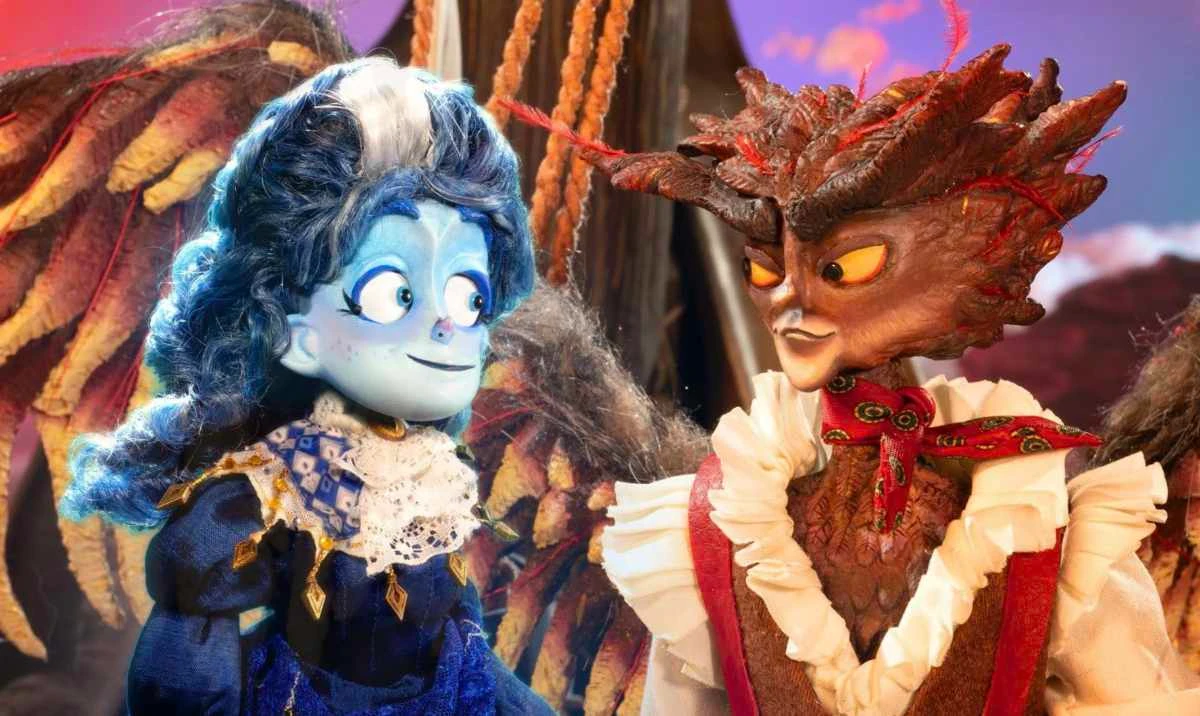
- Directed by brothers Arturo and Roy Ambriz, the film is a prequel to anthology series ‘Frankelda's Book of Spooks’ or ‘Los Sustos Ocultos de Frankelda.’
In the stop-motion, dark animation musical film: ‘I am Frankelda,’ we journey to post-colonial Mexico as our fearless young leader, Francisca Imelda, is rattled with internal and external torment and uses her pen as a weapon.
Out as ‘Soy Frankelda’ in Spanish in 2025, it is notably the very first independent Mexican feature film made entirely using the stop-motion animation technique. An English dubbed version was produced by Netflix in mid-2026 and it is now streaming on Netflix MENA.
Directed by brothers Arturo and Roy Ambriz, the film is a prequel to their Cartoon Network Latin America anthology series: ‘Frankelda's Book of Spooks’ or ‘Los Sustos Ocultos de Frankelda.’
“Dreams and nightmares are bound together; that which you imagine, imagines you,” the narrator begins the story.
It starts in 1866 in Real Del Monte, Mexico, on a cliff overlooking fluffy clouds and a lush ground, peppered with vibrant flowers and trees.
A woman stands and paints wild scenes on a canvas as her young daughter, aforementioned Francisca, scribbles stories in a notebook while seated next to her, the swirling breeze keeping them company.
Each of them works from their imaginations, creating fantastical stories from characters that emerge from within.
As she offers her daughter words of encouragement and wisdom, the mother, who has been plagued with a terrible cough, collapses.
Perhaps symbolically, it starts to rain over the knocked-down, freshly-finished painting, the colors bleeding into the earth as the grouchy grandmother, who was hovering nearby, whisks them both away.
The next scene is the funeral of the mother. That is when some very peculiar things start to happen.
Under the grip of the ever-grumpy grandmother, who loudly proclaims that writing is a waste of time for girls, Francisca frequently escapes to find her quill and notebook to make up even more stories. She ferociously writes over the noise.
Prince Herneval, a winged creature from another realm, overhears Francisca reading her stories aloud to little local children. The children scream in fright, furthering the fury of the grandmother.
Already feeling misunderstood and abandoned, the prince—whose kingdom relies on scary stories planted into humans to survive—recruits Francisca to work in his kingdom.
Upon arrival, Francisca adopts a "royal nightmare maker" title and transforms into a ghostly persona, Frankelda.
“What motivates you to write?” is asked of her in one scene. “Well, to get away from my reality. My writing flows when I unburden my thoughts,” Francisca, or Frankelda, replies earnestly.
She enters her subconscious as she is forced to encounter the real monsters: ones she created.
Despite some minor wrinkles, it is a smooth story overall.
The main takeaway, for me, is that we should never underestimate the power of storytelling. And that even little girls have the ability to build worlds with words. And maybe, if we give it a chance, we can live within it.

