- Projects in logistics and tourism explore faster cargo quotations and coordinated visitor experiences
ALKHOBAR: Artificial intelligence agents are moving beyond answering questions and generating content in Saudi Arabia, taking on tasks ranging from preparing air cargo quotes to coordinating travel between destinations.
The emerging applications offer a glimpse of how agentic AI could reshape two sectors central to the Kingdom’s economic diversification plans: logistics and tourism.
At Saudia Cargo, AI workers are being integrated into commercial operations to process customer requests and generate freight quotes. Meanwhile, an initiative involving Red Sea Global and AlUla is testing how AI agents representing different destinations can coordinate a traveler’s journey.
Both reflect a shift from AI tools that assist employees to agents capable of executing multistep tasks across existing digital systems.
Hisham Malakah, vice president of shared services at Saudia Cargo, said the deployment differs from conventional automation because the AI can interpret unstructured customer requests rather than rely on fixed inputs.
“What sets this deployment apart from legacy automation or basic chatbots is that we are not simply introducing an isolated tool, but fundamental digital infrastructure designed to strengthen the broader aviation logistics ecosystem,” Malakah told Arab News.
The system can classify email requests for quotations in multiple languages while retaining context throughout the quoting process. Connected to the carrier’s commercial systems, the AI workers can access capacity, flight schedules, customer-specific rates and service parameters.
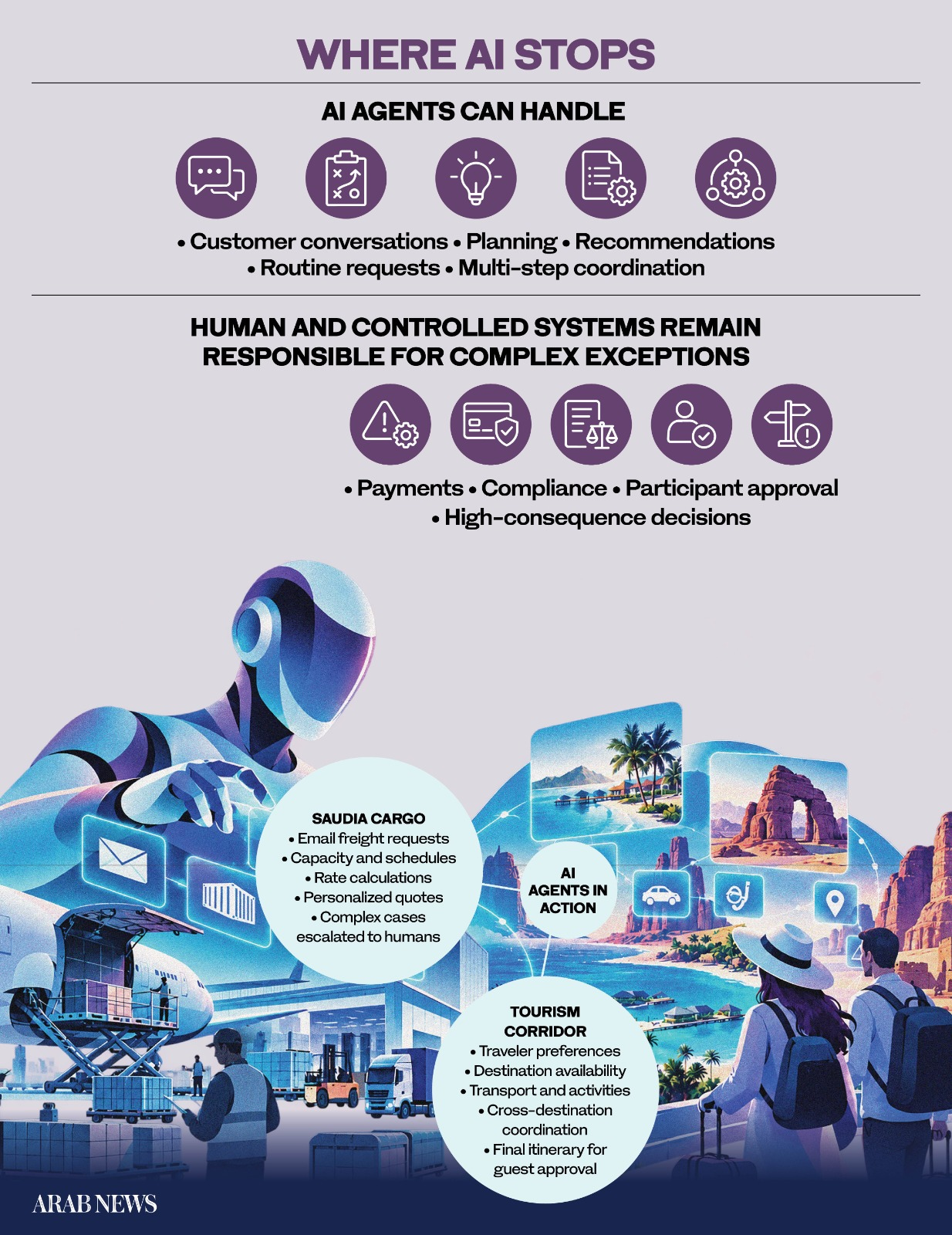
“The AI workers autonomously handle the end-to-end processing of routine email rate requests — from classifying sales opportunities and triaging inbound requests to calculating complex multi-leg options, selecting appropriate service tiers like Specialized Pharma or Specialized Fresh, and formulating complete, personalized quotes within seconds,” he said.
Autonomy varies according to the complexity of a request, with non-standard or high-value cases escalated to human sales teams.
“Every action taken by an AI worker is fully logged, auditable, and executed strictly within commercial boundaries, pricing rules, and compliance parameters established and controlled by Saudia Cargo,” he said.
AI agents begin talking to each other
In tourism, the next step is enabling AI agents representing different destinations to communicate directly.
Globant and Tourise developed an Agentic Protocol for Tourism to provide a common framework for coordination across the travel industry. Its Agentic Tourism Corridor is designed to put that approach into practice, beginning with Red Sea Global and AlUla.
Federico Pienovi, CEO for APAC and MENA at Globant, said a live implementation requires agents from separate destinations to coordinate across different systems and policies.
“What live implementation demands is the actual engineering of that seamless coordination: sovereign destination agents that can negotiate autonomously, communicate intent, and deliver business outcomes in real time,” Pienovi told Arab News.
For example, an agent representing Red Sea Global could identify an opportunity to extend a visitor’s stay and contact an AlUla agent to check availability and assemble an itinerary.
“The two agents then work out the logistics between them: private transfers, a stargazing experience, a golden-hour heritage visit, all coordinated and offered to the guest as a single, seamless journey, ready for their approval,” he said.
Rather than transferring entire guest records between destinations, the model allows agents to exchange information relevant to a specific interaction while each destination retains control of its systems and customer relationships.
“Think of it less like a single AI assistant and more like a well-coordinated team,” he said.
“When a guest makes a request, a lead agent takes charge, understanding what the guest needs, identifying which specialist agents to consult, and crafting the response.”
Specialist agents handle tasks such as accommodation, transportation, dining and activities, retrieving information from their respective destination systems before reporting back to the lead agent.
Drawing boundaries around autonomy
As AI agents take on more tasks, a key question is how much decision-making authority they should have.
In the tourism corridor, AI handles conversations, planning and recommendations, while separate systems manage transactions.
“Critically, the AI handles the conversation and decision-making, while separate rule-based systems manage the actual bookings, payments, and compliance, because those are areas where mistakes cannot happen,” Pienovi said.
Human oversight remains part of the governance framework, with new participants required to undergo testing and approval before accessing live guest data. Agent interactions are also logged for auditing.
“The system is deliberately designed with a clear boundary between what AI does and what it does not do,” Pienovi said.
At Saudia Cargo, non-standard requests are similarly referred to employees. Malakah said automating repetitive administrative work would allow staff to focus on higher-value responsibilities.

“AI is not replacing our workforce; it is augmenting our talent and eliminating the friction of manual, repetitive administration to build a more agile organizational capability,” he said.
“Our employees transition from transactional processing to strategic account management, solution design, and relationship building.”
From pilots to infrastructure
The projects come as Saudi Arabia expands tourism destinations and logistics capacity under Vision 2030, creating opportunities to integrate digital systems alongside physical infrastructure.
Saudia Cargo expects AI applications to extend into demand forecasting, capacity planning, dynamic pricing, revenue optimization, shipment visibility and network analysis.
Malakah said digital infrastructure would be essential to the Kingdom’s ambitions as a logistics hub.
“Transforming the Kingdom into a premier global logistics hub connecting Asia, Europe, and Africa requires more than expanding physical infrastructure and acquiring advanced freighters; it demands robust, world-class digital infrastructure within the aviation logistics ecosystem,” he said.
In tourism, the corridor could eventually expand to additional destinations and travel providers without requiring the system to be rebuilt for each participant.
“The corridor was always intended as a starting point, not an endpoint,” Pienovi said.
“The next steps involve expanding the range of experiences the system can coordinate across a guest's full journey, and bringing in new partners, starting with international airlines.”
Scaling these applications across the Kingdom will depend not only on technological capabilities but also on whether organizations can enable their systems to communicate while retaining control over data, transactions and accountability.
For now, the projects mark an early step toward using AI not simply to provide answers, but to coordinate how services are organized and delivered.