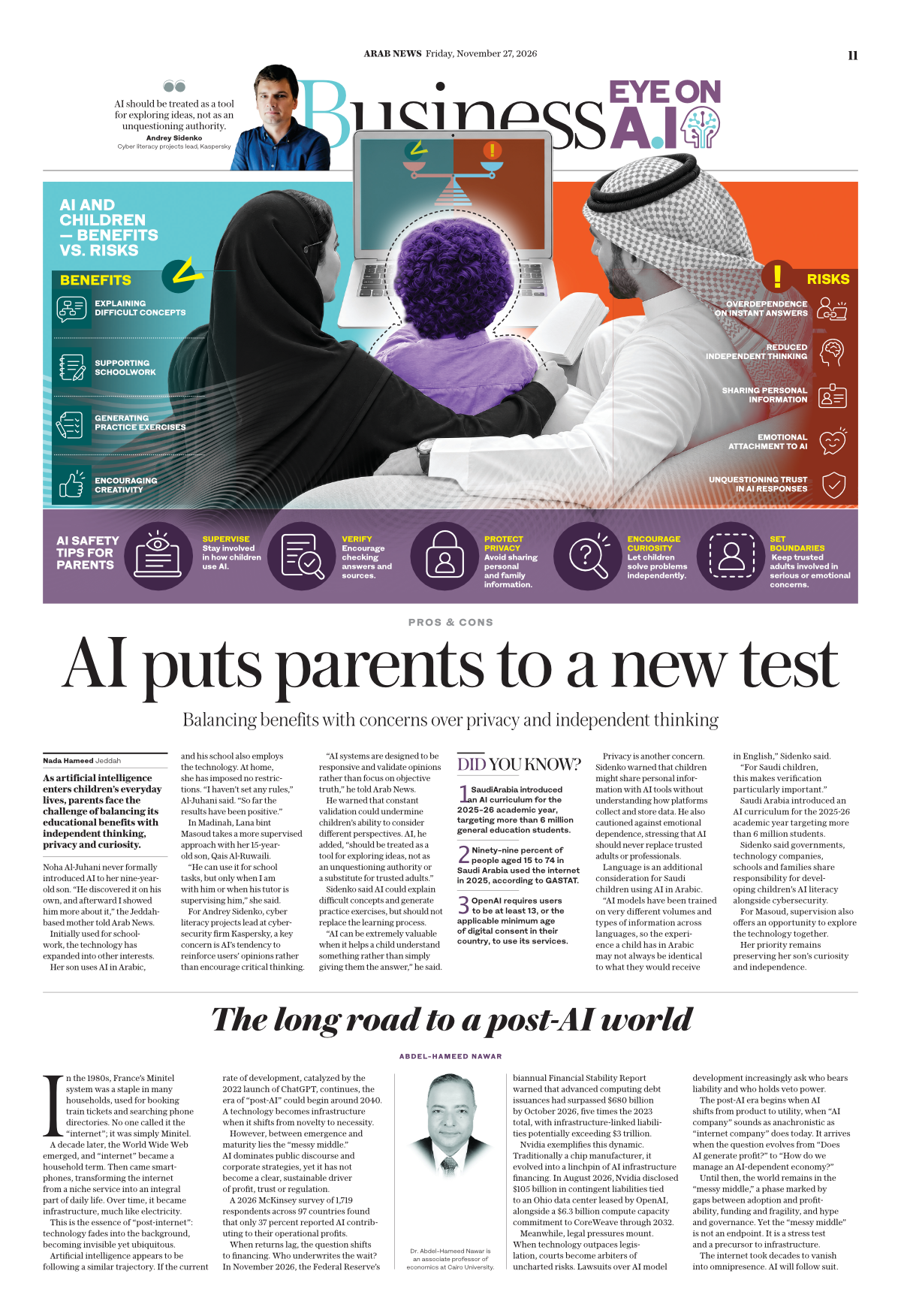
- Families weigh technology’s educational benefits against concerns over privacy, dependence and critical thinking
JEDDAH: As artificial intelligence becomes increasingly embedded in education and everyday life, parents face a new challenge: helping children benefit from the technology without becoming overly dependent on it.
For some families, that means allowing children to explore AI independently. For others, it involves setting clear boundaries, supervising its use and ensuring that technology does not replace curiosity, critical thinking or human interaction.
Noha Al-Juhani never formally introduced AI to her nine-year-old son. He discovered it himself.
“He discovered it on his own, and afterward I showed him more about it,” the Jeddah-based mother told Arab News.
What began as a resource for schoolwork has since expanded into a range of interests. “At the beginning it was for school questions,” she said. “Now he uses it in many areas, mainly for his studies, but also food, general knowledge, plants and animals.”
Her son uses AI in Arabic, and his school has also adopted the technology. At home, she has not imposed specific restrictions.
“I haven’t set any rules,” Al-Juhani said. “So far the results have been positive.”
In Madinah, Lana bint Masoud has adopted a more supervised approach with her 15-year-old son, Qais Al-Ruwaili, allowing him to use AI for schoolwork only under adult oversight.
“He can use it for school tasks, but only when I am with him or when his tutor is supervising him,” she said. “I want to know how he is using it and make sure he is learning from the process.”
She welcomes the opportunity for her son to become familiar with emerging technologies but believes that guidance is essential.
“Technology is becoming part of his world, and I want him to learn how to use it. But at his age, I believe that should happen with guidance and supervision.”
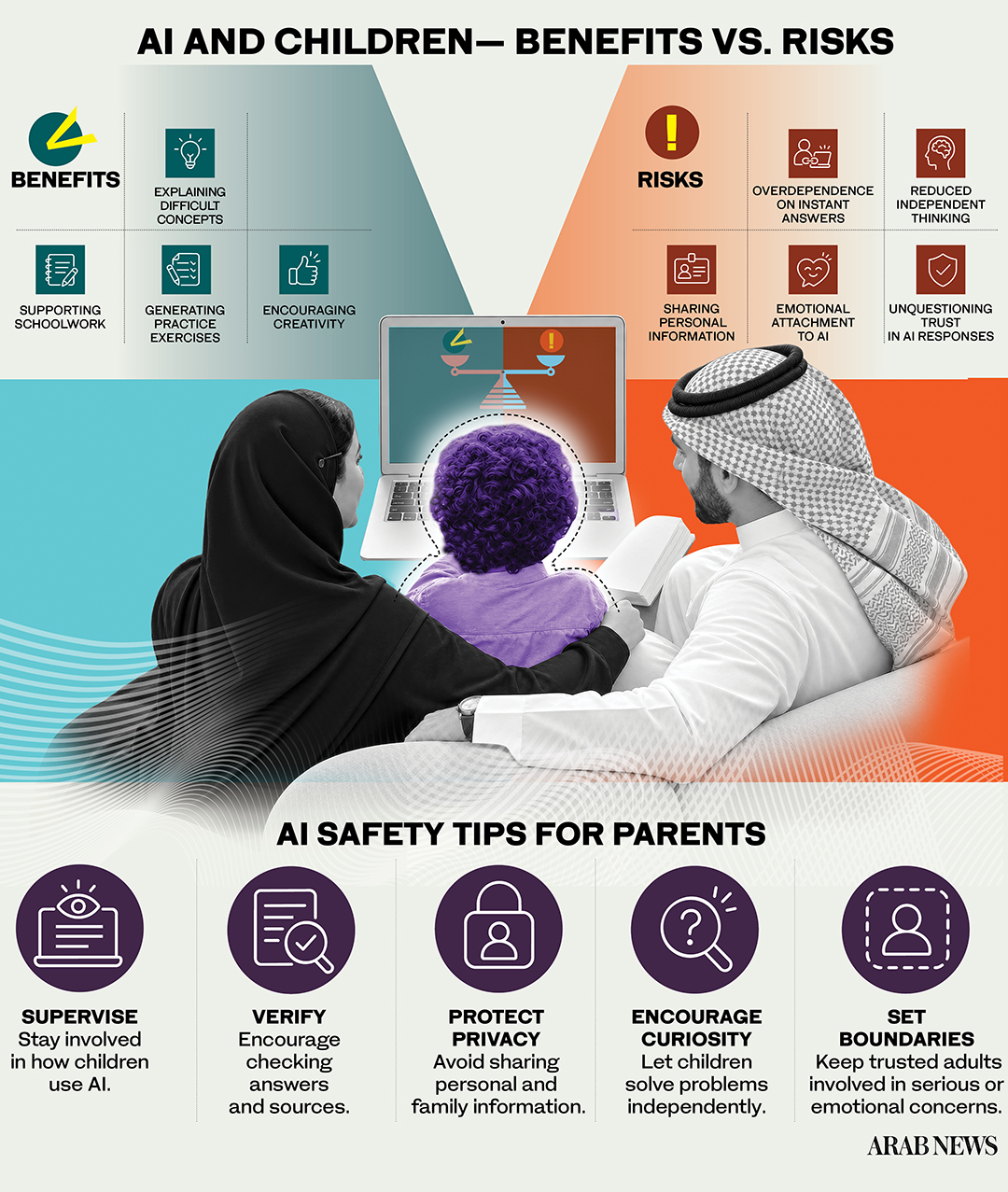
The contrasting approaches highlight a growing dilemma for parents as AI becomes more accessible to younger users: how to encourage its educational benefits while safeguarding children's ability to think independently, evaluate information and protect their privacy.
Age requirements also differ across services. OpenAI’s terms require users to be at least 13, or the minimum age required in their country to consent to using its services. Those younger than 18 need permission from a parent or legal guardian.
For Andrey Sidenko, cyber literacy projects lead at cybersecurity firm Kaspersky, one concern is the tendency of AI tools to reinforce users' opinions rather than challenge them.
“AI systems are designed to be responsive and validate opinions rather than focus on objective truth,” he told Arab News, describing responses as “structured to maximize user satisfaction.”
“This can sometimes create an experience where children feel that the technology is always on their side.”
Such interactions can be particularly influential for children who are still developing their ability to assess information and consider different perspectives.
“For children who are still developing their judgement, constant validation can be problematic. Children need to learn that it is healthy to encounter different opinions and sometimes be told that they are wrong.”
AI, he added, “should be treated as a tool for exploring ideas, not as an unquestioning authority or a substitute for trusted adults.”
The risk of overdependence is also a concern for Masoud, who wants to ensure that instant answers do not come at the expense of independent discovery.
“I do not want him to become dependent on getting an immediate answer,” she said. “Sometimes a question should lead him to search, read and explore. If the answer is always given to him straight away, he may miss the opportunity to discover something himself.”
She added: “There still needs to be room for curiosity, especially at his age.”
She encourages Qais to research questions, check sources and assess what he finds before turning to AI.
“AI can help him along the way, but I do not want it to take over that effort.”
Sidenko acknowledged the technology's potential to support education, particularly by explaining difficult concepts and generating practice exercises in subjects such as mathematics and languages.
“AI can be extremely valuable when it helps a child understand something rather than simply giving them the answer,” he said.
The distinction, he explained, lies in whether AI helps children develop skills or simply completes tasks on their behalf.
“If a child asks AI to solve every problem, write every assignment or make every decision, they may complete the task without developing the underlying skill.”
Children still need “opportunities to struggle with difficult problems, make mistakes, research independently and develop their own ideas,” he added. “These experiences cannot be automated.”
Beyond learning, the growing use of conversational AI raises concerns about children's privacy, particularly when they begin treating these tools as confidants.
“When a child treats an AI tool like a confidant, they may not know what they should and shouldn’t be sharing: personal details, family circumstances, school information, emotions or private conversations,” Sidenko said.
“Children may not understand that these platforms collect, process and store data.”
He advised parents to teach children to think carefully before sharing personal or sensitive information and to seek human support when dealing with serious or emotional issues.
“When a child is dealing with something serious or emotional, an AI companion should never replace a trusted parent, teacher or qualified professional.”
The conversational nature of AI can also encourage emotional attachment, he warned.
“When an AI is conversational, responsive and always available, that relationship can feel very real to them.”
He added: “The more a child trusts a digital service, the more likely they may be to share information with it or accept what it tells them without questioning it.”
Language is another consideration, particularly for children using AI in Arabic, as Al-Juhani’s son does.
“AI models have been trained on very different volumes and types of information across languages, so the experience a child has in Arabic may not always be identical to what they would receive in English,” Sidenko said.
“For Saudi children, this makes verification particularly important.”
These concerns are gaining relevance as Saudi Arabia expands the teaching of AI in schools. A curriculum developed by the National Curriculum Center in collaboration with the Ministry of Education, the Ministry of Communications and Information Technology, and the Saudi Data and AI Authority was introduced for the 2025-26 academic year, targeting more than 6 million general education students.
Internet access is also widespread across the Kingdom, with General Authority for Statistics data showing that 99 percent of people aged 15 to 74 used the internet in 2025.
“The earlier children interact with powerful technologies, the earlier they also need the skills to use them responsibly,” Sidenko said. “AI literacy should develop alongside cybersecurity and privacy awareness.”
He stressed that ensuring children's safe use of AI requires a collective effort involving governments, technology companies, schools and families.
“It cannot be the responsibility of one stakeholder alone,” he said, adding that companies “need to build safety and privacy into their products from the outset.”
For Masoud, supervision is not simply about setting limits. It also offers an opportunity to explore the technology together.
“Sometimes we have fun creating images and designs when there is an artistic element to something he is working on,” she said. “We explore ideas together.”
Ultimately, her priority is to ensure that AI complements rather than replaces her son's independent thinking.
“I keep coming back to curiosity. He is 15, and he needs space to wonder about things, explore them and reach his own understanding. AI can support that, but I do not want him to depend on it completely.”