- Businesses seek to balance faster automated responses with human judgment
- Companies weigh automation against accountability as algorithms take on critical decisions
AI models often need localization to account for Saudi Arabia’s traffic patterns and driving behavior.
As Saudi Arabia integrates artificial intelligence into transport, logistics and other critical sectors, a fundamental question is emerging alongside the drive to automate: how much decision-making authority should machines have?
The issue is becoming increasingly pressing as AI moves beyond chatbots and productivity tools into systems capable of influencing prices, allocating resources, responding to operational disruptions and, eventually, taking action with limited human intervention.
For companies deploying AI in environments where decisions affect safety, livelihoods or critical infrastructure, the challenge is no longer simply whether a system can operate autonomously, but when it should be permitted to do so.
Bilal Abu-Ghazaleh, founder and CEO of GCC-based AI company 1001, said organizations operating critical infrastructure should ultimately determine the limits of that autonomy.
“The operator defines exactly how much autonomy the system has, where it can act independently and where it must stop and ask,” Abu-Ghazaleh told Arab News.
“It is their operation, so the boundary is theirs to draw. Execution can be automated where the platform has proven itself and the customer has authorized it, and every action is logged and can be reversed.”
1001 develops AI systems for industries including energy, logistics, ports and aviation, where operational decisions can involve interconnected systems and carry significant financial or safety implications.
Abu-Ghazaleh cited the example of a delayed vessel arriving at a port, where a single disruption can affect berth availability, cranes, crews, trucks and trains.
Instead of assessing each component in isolation, he said, an AI system could evaluate the wider operation, simulate alternatives and recommend how resources should be reallocated.
“We evaluate the available options against the rules, safety requirements and parameters defined by the customer, then hand the operator the best recovery plan and rationale,” he said.
The distinction between recommending an action and exercising control is equally important in consumer-facing AI applications.
Yuri Misnik, chief technology officer at mobility platform inDrive, said the company follows a similar principle in deciding when AI should make decisions independently and when human involvement is necessary.
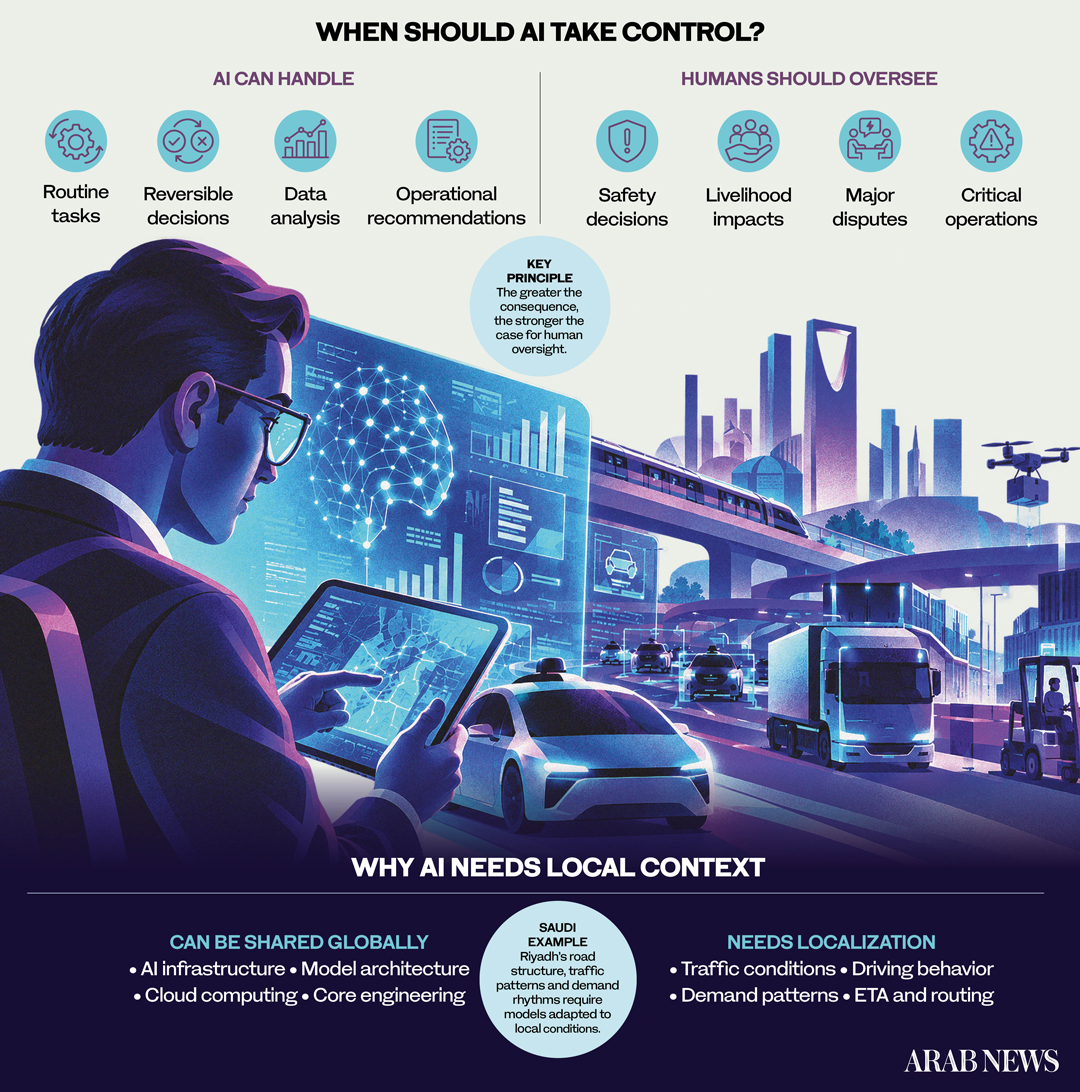
“Our operating principle is simple: automate the repeatable, create insights, and assist humans in making the final call on anything irreversible or significant,” Misnik told Arab News.
“If a decision is routine or easily reversible, we let AI handle it end-to-end. If it can destroy trust, impact someone's livelihood, or safety, human judgment and supervision stays critical, regardless of how sophisticated our models become.”
From suggested prices to consequential decisions
Ride-hailing provides a particularly visible example of the tension between automation and human control, as algorithms can influence what passengers pay, which drivers receive trips and how users are assessed by a platform.
At inDrive, AI can recommend a fare, but passengers can propose a different price, while drivers can accept, reject or counter the offer.
Misnik said preserving this choice is deliberate. “Our pricing model starts with an algorithm and ends with a human decision: riders propose a fare based on an ML-powered recommendation, and drivers accept, counter, or decline it in real time. Neither side is bound by what the algorithm calculates.”
He argued that transparency becomes increasingly important as algorithms shape decisions with direct consequences for users, including pricing, trip matching and account restrictions.
“Significant platform actions like permanent bans, disputes, and safety concerns should be supervised by a human, not just decided by a model, precisely because the person affected deserves to understand why and have a real chance to be heard,” he said.
The stakes differ between a ride-hailing platform and a port or energy network, but the underlying challenge is much the same. AI can process more variables and respond faster than humans, yet responsibility for the consequences cannot simply be delegated to a model.
For Abu-Ghazaleh, the issue is particularly relevant as Gulf states shift from building AI infrastructure to integrating the technology into physical operations.
“The next phase is about moving from trials to embedding AI into physical operations,” he said. “AI will play an integral role in shaping how critical industries perform and how decisions are made.”
Saudi Arabia is a key market for 1001, whose $30 million Series A funding round included participation from Sanabil Investments.
Abu-Ghazaleh said the opportunity lies in applying AI to the Kingdom’s expanding infrastructure and critical industries.
“There is no question that Saudi Arabia has built world-class physical infrastructure. The question now is how you make it smarter,” he said.
“The biggest opportunities sit in the Kingdom’s critical industries, where the scale of operations is growing faster than humans can manage. This is where real-time decision-making has the most to offer.”
AI for local conditions
The question of control also intersects with another challenge for Saudi Arabia: ensuring that AI systems developed elsewhere can accurately interpret local conditions.
Misnik said much of the underlying AI infrastructure can be shared across markets, but applications that depend on human behavior and local conditions need to be adapted.
“Where localization genuinely changes outcomes is anywhere the system has to learn a market's behavior,” he said.
“Local traffic conditions, ETA and routing are the clearest case: Riyadh’s road structure, traffic patterns, and demand rhythms are simply different from Lagos’ or Bogota’s, and a model trained on someone else's driving behavior will underperform if it’s dropped in unmodified.”
The challenge becomes more pronounced as systems move closer to full autonomy.
Misnik cited autonomous vehicles as an example of why technology developed for one environment cannot necessarily be transferred directly to another.
“Saudi Arabia’s traffic conventions and driving behavior are different enough from those environments, however, that a model built elsewhere can simply fail.”
For Saudi Arabia, the broader question is therefore not simply how widely AI can be deployed, but how decision-making authority and accountability should be structured around it.
As AI systems become capable of recommending prices, reorganizing physical operations and acting on behalf of users, companies will need to establish which decisions can be automated safely, which require human approval and who remains accountable when a system gets something wrong.
For Misnik, those boundaries should be determined less by the sophistication of the technology than by the consequences of its decisions.
“At inDrive, we treat AI as an assistant in the literal sense: it helps people make decisions faster, takes on the repeatable tasks and hands people better information to act upon,” he said. “It doesn’t decide on their behalf — whether internally or externally.”