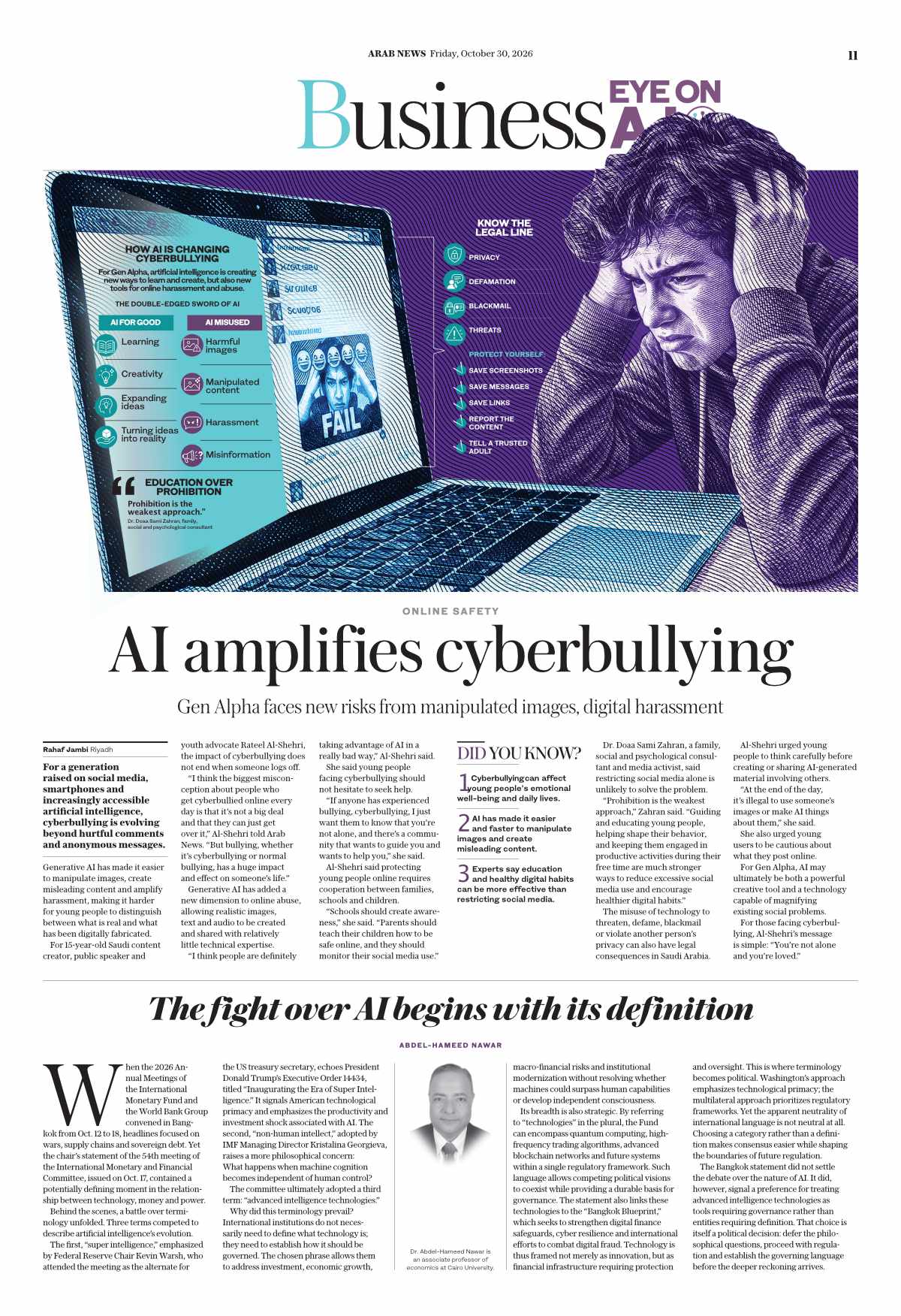

- Experts urge digital literacy and responsible AI use as manipulated content puts young people at risk
RIYADH: For a generation that has grown up with social media, smartphones and increasingly accessible artificial intelligence, cyberbullying is no longer confined to hurtful comments or anonymous messages.
Generative AI has introduced new ways to manipulate images, create misleading content and amplify harassment, making it increasingly difficult for young people to distinguish between what is real and what has been digitally fabricated.
For 15-year-old Saudi content creator, public speaker and youth advocate Rateel Al-Shehri, one of the biggest misconceptions about cyberbullying is that its impact disappears once someone logs off.
“I think the biggest misconception about people who get cyberbullied online every day is that it’s not a big deal and that they can just get over it,” Al-Shehri told Arab News. “But bullying, whether it’s cyberbullying or normal bullying, has a huge impact and effect on someone’s life.”
“You never know the struggles a person goes through on a daily basis,” she added.
For young people, that pressure can be particularly difficult to navigate when they do not know how to report abuse or feel uncomfortable discussing their experiences with adults.
“Especially with cyberbullying, because they’re online, some people don’t know how to deal with it because some families don’t know how to talk to their children about it,” Al-Shehri said.
When AI becomes a weapon
The emergence of generative AI has added another dimension to the problem. Tools capable of producing realistic images, altering photographs and generating text or audio can be used creatively and productively. But Al-Shehri said young people are increasingly aware that the same technology can be misused to target others.
“I think people are definitely taking advantage of AI in a really bad way,” she said.
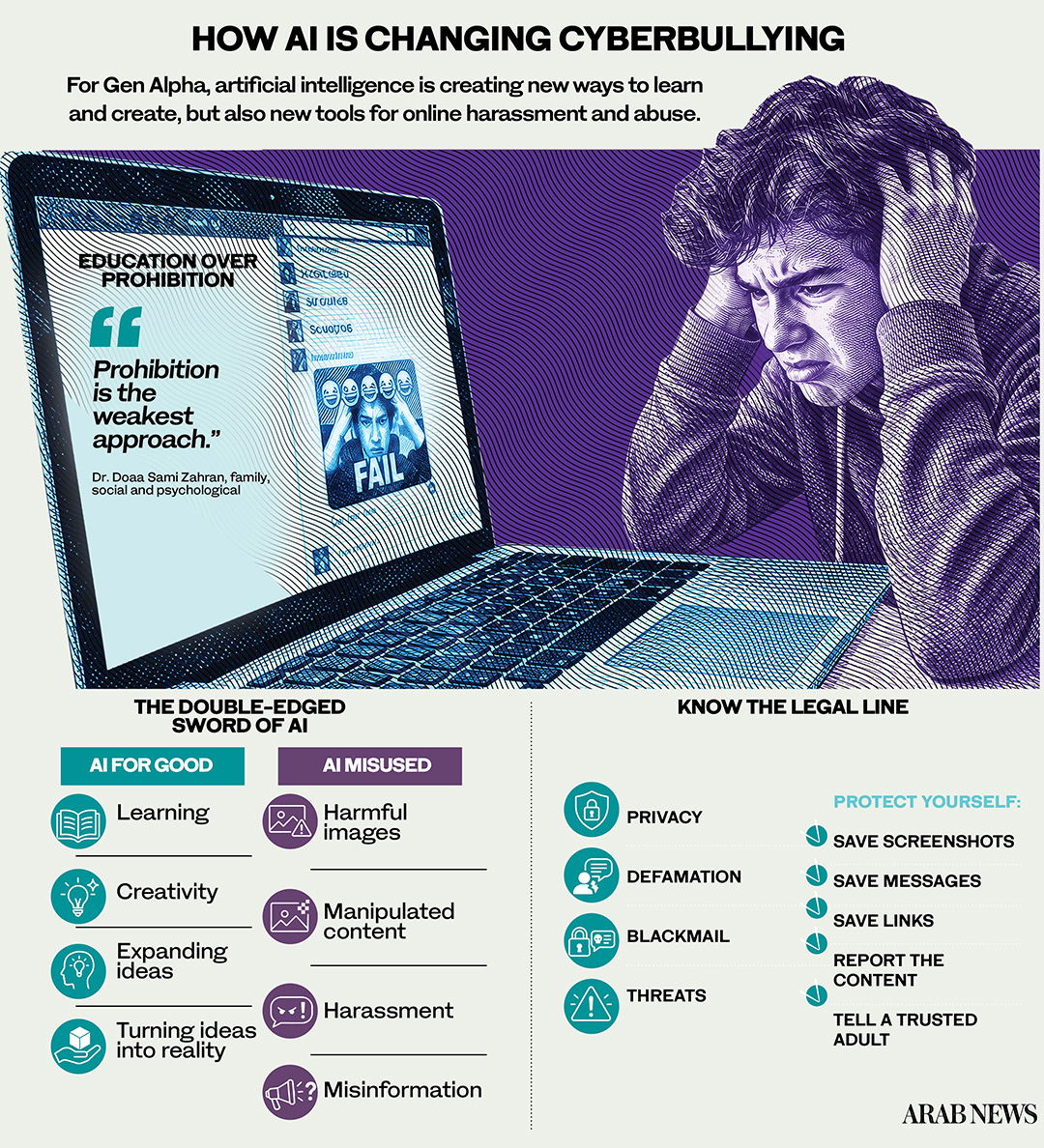
“At the end of the day, AI is good if you use it in a good way. You can use it as a learning method, to expand your thinking skills. But some people take advantage of that and use it to harm other people or create harmful images or tell it to do something bad to people, which is something that crosses the line.”
The speed at which AI-generated material can be created and shared also changes the scale of potential harm. Images that once required considerable technical expertise can now be manipulated with relatively little skill and distributed across multiple platforms within minutes.

For young users, Al-Shehri said, the response should begin with knowing when to ask for help.
“If anyone has experienced bullying, cyberbullying, I just want them to know that you’re not alone, and there’s a community that wants to guide you and wants to help you,” she said.
Shared responsibility
Protecting young people online, Al-Shehri believes, cannot fall solely on children or their parents.
“Schools should create awareness,” she said. “Parents should teach their children how to be safe online, and they should monitor their social media use.”
She stressed that parental monitoring should not necessarily be viewed as a question of trust.
“It’s not about trust, it’s more about making sure your child is safe, because you never know what someone uses AI against you, and you never know how someone can use it,” she said.
She also urged young people to be more selective about what they share online.
“Just be cautious of what they post on social media, because what you post on social media stays there forever,” she said.
Keeping social media accounts private where possible, avoiding unknown followers and involving a trusted adult in managing public-facing accounts are among the measures she recommends.
“If your account is public, then definitely just have a trusted adult that’s running the account with you, so they can help you if there’s anything bad,” she said.
When harassment occurs, Al-Shehri said reporting should be the first step, followed by seeking help if the platform does not respond.
“You can report it and say it’s spreading misinformation or bullying about me,” she said. “Then you can email the accounts or you can tell a trusted person that can help you.”
That person, she said, could be a parent, teacher, family member or older sibling.
Education over prohibition
Dr. Doaa Sami Zahran, a family, social and psychological consultant and media activist, said the rapid expansion of digital platforms has made the internet an unavoidable part of modern life.
Social media, she said, is a “double-edged sword,” providing young people with access to education, entertainment, information and different cultures while also exposing them to content and interactions that parents may struggle to control.
For Zahran, restricting access alone is unlikely to offer a lasting solution.
“As a social and psychological specialist, I believe that prohibition and deprivation are ineffective approaches when dealing with the younger generation of today,” she said.
Instead, she advocates accompanying young people, educating them and helping them develop healthier digital habits.
“Prohibition is the weakest approach,” Zahran said. “Guiding and educating young people, helping shape their behavior, and keeping them engaged in productive activities during their free time are much stronger ways to reduce excessive social media use and encourage healthier digital habits.”
Her approach places greater emphasis on digital literacy, communication between parents and children, and helping young people understand the consequences of their online behavior.
The legal line
The misuse of technology to threaten, defame, blackmail or violate another person’s privacy can also have legal consequences in Saudi Arabia.
Saudi Arabia’s legal framework includes provisions addressing cybercrime, harassment, privacy and abuse, meaning online conduct does not necessarily escape accountability simply because it takes place behind a screen or through an anonymous account.
Al-Shehri urged young people who create or share AI-generated material involving other people to consider the consequences before posting it.
“At the end of the day, it’s illegal to use someone’s images or make AI things about them,” she said.
Victims of online harassment should preserve evidence, including screenshots, messages and links, rather than deleting material that could help establish what happened when reporting an incident.
AI is not going away
Despite the risks, Al-Shehri does not see avoiding AI as an option.
“We all know AI is not going anywhere. It’s here and it will stay here,” she said. “So the only thing we can do is learn how to use AI in a good way, because it depends on how you use it. I can use AI in a bad way, and I can use AI in a good way.”
She also sees AI as a powerful tool for young people, particularly because it can lower the barriers between having an idea and turning it into reality.
“The good thing about AI is now, in this generation, the barrier between having an idea and actually making that idea happen is very small,” she said.
“A long time ago, we would have to hire a whole entire team to make the idea happen. So AI is changing the way the world is, technology, the way you think, everything.”
That duality may ultimately define how Gen Alpha experiences AI: as both a tool that can expand creativity and opportunity and a technology that can magnify existing social problems.
For Al-Shehri, the answer is not to reject the technology but to learn how to use it responsibly.
“If you use AI in a bad way, then first of all, you’re not harming other people, you’re harming yourself also, and you’re putting yourself in a really horrible situation,” she said.
And for young people facing cyberbullying, her message is simple: “You’re not alone and you’re loved.”