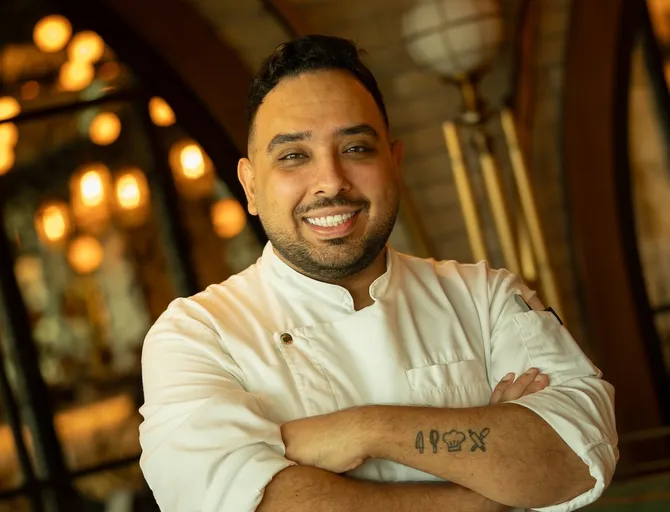
- Advice and a crispy duck salad recipe from the head chef of Sexy Fish Dubai
DUBAI: Pedro Coelho’s journey as a chef has been shaped by curiosity, experience and an enduring love of hospitality. Today, as head chef of Sexy Fish Dubai, Coelho draws on more than 14 years of international experience, including time in Michelin-starred kitchens.
Since joining the Dubai outpost in October 2024, the Portuguese chef has helped translate the globally recognized Sexy Fish concept to one of the world’s most competitive dining markets, balancing creativity with the operational demands of a high-volume luxury restaurant.
For him, what sets Sexy Fish apart goes beyond its striking interiors and theatrical atmosphere. “We focus strongly on presentation and on sourcing the best products we can find,” he tells Arab News. “We are constantly searching, tasting and improving; that process never really stops. The objective is always the same: to make sure the food lives up to the environment and contributes to the best possible experience for every guest.”
His own route to the kitchen was similarly rooted in discovery. After beginning his hospitality career at 16 in a family-owned restaurant, Coelho later enrolled in hospitality school and encountered a Michelin-starred kitchen under a French chef during an internship. “His respect for ingredients was unlike anything I had seen before,” he said. “That was the moment I found my place in the kitchen.”

When you started out, what was the most common mistake you made?
Making mistakes — I’ve made many — is an essential part of becoming a better chef. This profession is a constant apprenticeship. Experience doesn't mean you stop making mistakes; it means you become better at recognizing them, understanding why they happened and learning from them. I always say that the moment you become convinced that you cook the best steak, the best fish or make the perfect sauce, you have a problem. There will always be another technique to learn, another ingredient to understand and another way to improve. The day you think you know everything is probably the day you stop becoming a better chef.
What’s your top tip for amateur chefs?
Expensive equipment will not make you a better cook if you don't understand what you're cooking. My advice is simple: taste everything and respect every ingredient. Taste before, during and after cooking. Even something as simple as a bunch of parsley deserves your attention. Before you chop it and add it to a dish, ask yourself why it is there. Is it bringing freshness, aroma, flavor or color? Every ingredient should have a reason to be on the plate. And enjoy cooking. Make mistakes, experiment and don't be afraid to change things. You are cooking for yourself, your family or your friends — there should be pleasure in that.
What one ingredient can instantly improve any dish?
For me, it’s vinegar. Not because I necessarily want a dish to taste of vinegar, but because of what acidity can do to everything around it. A few drops can completely change the balance of a dish. Acidity can cut through richness, control sweetness and make other flavors feel sharper and more alive. Sometimes you taste a sauce and you know something is missing. It doesn't necessarily need more salt or more seasoning; it might simply need that small touch of acidity to bring everything together. That’s why I use vinegar in so many different ways: a drop to finish rice, a little in a salad, or a touch at the end of a sauce can completely lift the flavor without the guest necessarily knowing that vinegar is there.
I also love the world of vinegars because of fermentation. Different ingredients, ageing processes and types of fermentation create completely different levels of acidity, aroma and complexity. For me, vinegar is not just something sour; it’s a seasoning. When used correctly, it gives a dish balance, energy and life.
When you go out to eat, do you find yourself critiquing the food?
Of course I notice things - after spending so much of my life in restaurants, it would be impossible not to. But I don't go out looking for mistakes. I go out to enjoy myself. Having dinner in a restaurant is about much more than what is on the plate. It is about the people you are with, the atmosphere, the conversation and how you feel during those few hours.
And I would never judge an entire restaurant or its team based on one meal. Working in hospitality teaches you that sometimes things simply go wrong. A chef can have a difficult service, a waiter can be exhausted, or something unexpected can happen behind the scenes. It happens to everyone in this industry. Of course I recognize when something isn't right, but one bad evening doesn't tell me the whole story of a restaurant.
What’s your favorite cuisine or dish to order?
Being Portuguese, and having been born and raised by the sea, I naturally gravitate towards Mediterranean food and, of course, seafood. Those flavors are part of my roots, so there’s always an emotional connection to them. But I wouldn't say I have one favorite dish. After so many years working in different kitchens, travelling and living in different countries, what I want to eat really depends on how I feel that day. Sometimes it might be Asian food, sometimes Mediterranean, and sometimes I simply want a snack and nothing more complicated than that. What I always appreciate, though, is freshness and simplicity: beautiful seafood, a great salad, good olive oil, and some really good bread. I'm actually addicted to bread, so that’s something I will almost never say no to. For me, eating out is ultimately about how the food makes you feel — while you are eating it, but also afterwards. I love food that is fresh, honest and enjoyable, without necessarily needing to be complicated. Mediterranean food naturally gives me that feeling because it takes me back to my roots.
What’s your go-to dish if you have to cook something quickly at home?
At home, I like to keep things very simple. I love eggs. I eat them almost every day and could probably have them cooked in any way. But if I want something quick and satisfying, it would probably be a good sandwich. Give me some good bread, eggs, or whatever I can find in the fridge, and I'll make something out of it. That's actually how I enjoy cooking at home: no recipes, no complications. Open the fridge, see what is there and cook something simple. Sometimes the best food doesn't need more than a few minutes.
What customer behavior most frustrates you?
Guests today are increasingly knowledgeable about food. They travel, they research, they know ingredients and techniques, and very often they walk into a restaurant already knowing exactly what they want. For a chef, that can be challenging, particularly when a request means adapting something you’ve created in a very specific way. But as you grow into a management role, you learn that you cannot take these things personally. You need to listen, understand the situation and make decisions quickly. Sometimes you make the right decision; sometimes you go home, think about it again and realize you could have handled it differently. That is also part of learning.
Of course, as chefs, we have recipes, standards and an identity that we want to protect. But hospitality is ultimately about people. If adapting something within reason means that a guest leaves the restaurant happy and satisfied, I don't see that as an annoyance. I see it as part of our job.
What’s your favorite dish to cook?
I love cooking whole fish. The bigger, the better. There’s something special about putting a beautiful, massive fish over the grill and cooking it whole. I love the fire, the simplicity of it and the respect you need to have for the product. Maybe it also connects naturally with where I come from — fish and seafood have always been part of my life. Give me a beautiful whole fish, good fire, some olive oil, salt and a few simple ingredients, and I'm happy.
At the same time, I'm a very curious cook. Tomorrow I might become obsessed with pasta, bread ,or a completely different technique and spend weeks reading and experimenting with it.
What’s the most difficult dish for you to get right?
Probably sushi. Working at Sexy Fish has given me the opportunity to observe it much more closely, and the more I watch and learn, the more respect I have for the craft. Sushi can look incredibly simple, but that simplicity demands enormous precision. Slicing sashimi beautifully, preparing a perfect nigiri, getting exactly the right amount and temperature of rice, cutting the fish correctly and understanding how each element should come together… There is nowhere to hide. Every small detail matters.
I genuinely see great sushi chefs as artists. It is a very specialized craft that takes years of repetition, discipline and sensitivity to master. Our Sushi head chef is a perfect example of that; watching him work makes me appreciate just how much knowledge and skill sits behind something that can appear so effortless to the guest.
So, if you ask me what would genuinely challenge me and make me want to stop, watch, learn and practice, it would be sushi. And I think that’s a good feeling to have as a chef — to still be surrounded by things that remind you how much there is left to learn.
What are you like as a leader?
The chef I am today is very different from the chef I was five years ago, and I'm sure I will be different again five years from now. I am demanding when it comes to consistency and standards. I want people focused, I want the quality to be there every day, and I want the team to understand what we are trying to achieve together. Do I shout sometimes? Of course. Kitchens can be intense places. But I don't believe shouting makes you a strong leader. Sometimes you need to raise your voice; sometimes you need to sit down, listen and understand what is happening with someone. Especially in Dubai, that is incredibly important. You can have people from 10 or 15 different countries working together in the same kitchen, all with different cultures, backgrounds and ways of communicating. You cannot lead every person in exactly the same way. You have to learn how to read people.
I like to observe my team, speak with them and learn about where they come from. I listen to their stories, I want to know about their cultures, and I love when they bring me food from home to taste. Those moments might seem small, but they create relationships and teach you a lot about the people standing beside you every day.
When you lead a team, you also have to remember that people are watching you. You become an example, even when you are not always the perfect one. My responsibility is not only to get today's service right; it is also to give people the tools, knowledge and opportunities to become better than they were yesterday.
Today I’m the head chef. Tomorrow, one of the young chefs in my kitchen could be sitting in my position. And I hope they are.
Ultimately, I don't believe people work for me. They work with me. That’s probably the most important thing I have learned about leadership.
Recipe: Crispy duck salad with pickled watermelon

INGREDIENTS
For the duck:
2 large duck legs
4 g fine sea salt
3 g coriander seeds, lightly crushed
2 g fennel seeds, lightly crushed
2 g Sichuan pepper, lightly crushed
1 ground cinnamon
1 ground star anise
1 g ground cumin
For the quick-pickled watermelon:
300 g watermelon, cut into 3 cm cubes
46 g fresh lemon juice
28 g fresh lime juice
22 g caster sugar
4 g green yuzu kosho
For the dressing:
150 g hoisin sauce
36 g honey
26 g mirin
14 g sesame oil
14 g sesame seeds
36 g pomegranate molasses
5g rice vinegar
36g light soy sauce
2 g garlic, crushed
2 g mixed aromatic spices: clove, star anise, fennel, black pepper, cinnamon and bay leaf
For the Green Goddess sauce:
14 g tarragon
12 g basil
10 g mizuna
10 g mint
15 g parsley
5 g garlic
32 g shallot
30 g firm tofu
2 g caster sugar
5 g lemon juice
50 g rice vinegar
80 g olive oil
To assemble
2 spoons Green Goddess sauce
3 g mint leaves
3 g coriander leaves
5 g long shallot, very thinly sliced
5 g long red chilli, thinly sliced
8 g pomegranate seeds
10 g pea shoots
6 g roasted salted cashews, roughly crushed
METHOD
1. Season the duck. Mix the salt and spices and rub over the duck legs. Cover and refrigerate for 1 hour.
2. Slow-cook until tender. Heat the oven to 150°C/130°C fan. Put the duck legs skin-side up in a small roasting dish and cover tightly with foil. Roast for 4-5 hours, until the meat pulls easily from the bone.
3. Pickle the watermelon. Mix the lemon juice, lime juice, sugar, yuzu kosho and salt until dissolved. Add the watermelon and chill for 45-60 minutes. Drain and dry.
4. Make the dressing. Toast the aromatic spices in a saucepan. Add the remaining dressing ingredients and warm gently without boiling. Infuse for 20 minutes, then strain.
5. Make the Green Goddess sauce. Blend all ingredients except the olive oil until finely chopped. Slowly add the olive oil and blend until smooth.
6. Crisp the duck. Rest the cooked duck for 10 minutes, remove the bones and pull the meat into large pieces. Dust lightly with rice flour and fry in a hot dry pan for 4-6 minutes, until golden.
7. Toss the salad. Combine the warm duck chopped, shallot, chilli, pomegranate, mint and coriander. Add the dressing and toss gently.
8. Plate and serve. Spread the Green Goddess sauce on a plate. Add the duck salad and pickled watermelon. Finish with pea shoots and cashews. Serve immediately.