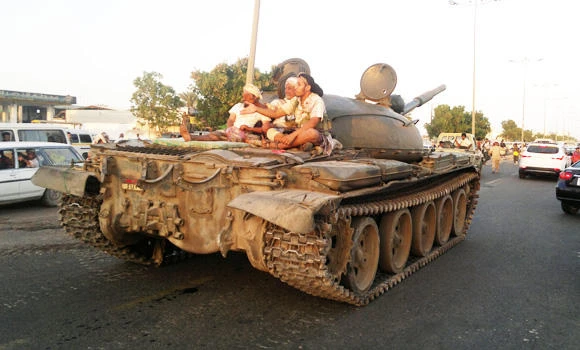
ADEN/SANAA: Al-Qaeda fighters captured Houta, the capital of a province in southern Yemen, killing about 20 soldiers, before they were driven out by the army late on Friday, officials and residents said.
The fighting came hours after suicide bombers killed scores in Sanaa, in coordinated attacks claimed by Islamic State.
Clashes also took place in the country’s north on Friday between local tribes and the Houthi militia, which controls Sanaa, illustrating the wide-ranging nature of Yemen’s security crisis.
There were no reports of any militant casualties.
Houta is only 30 km from the Indian Ocean port of Aden, where President Abed Rabbo Mansour Hadi has temporarily based the government since he escaped from weeks of house arrest in Sanaa by Houthi militia.
The clashes in the north on Friday took place on the borders of Marib and Al-Baydha provinces, a government official said, but there were no immediate reports of casualties.
Meanwhile in Taiz, a Sunni city in southern Yemen, Houthi forces on Saturday fired on hundreds of people protesting against their advance across the country, but there were no immediate reports of casualties.
The Interior Ministry, which is dominated by Houthis, denied it had sent security forces to Taiz to help quell unrest.
Houthis have called for an offensive against state bodies controlled by Hadi. In a statement Saturday, the rebels called for a general mobilization against the country’s security and military institutions, describing it as a battle against extremists.
The appeal comes just minutes after the president gave a defiant speech against the Houthis, his first address broadcast to the public since fleeing the capital, Sanaa, last month. He described the rebels’ rule in Sanaa and elsewhere in Yemen as “a coup against constitutional legitimacy.”
Hadi also pledged Saturday to fight Iran’s influence in his violence-wrecked country, accusing the Houthi militia of importing Tehran’s ideology.
Hadi said he would ensure that “the Yemeni republic flag will fly on the Marran mountain in (the northern Houthi stronghold) Saada, instead of the Iranian flag.”
“The Iranian Twelver (Shiism) pattern that has been agreed upon between the Houthis and those who support them will not be accepted by Yemenis, whether Zaidi (Shiites) or Shafite (Sunnis),” he said.
The Houthis, who belong to the Zaidi sect, an offshoot of Shiism, are believed to have converted to Twelver Shiism which is followed by Iran and insist that Tehran does not meddle in Yemeni affairs.
Al-Qaeda driven out of Houta after it slew 20 soldiers