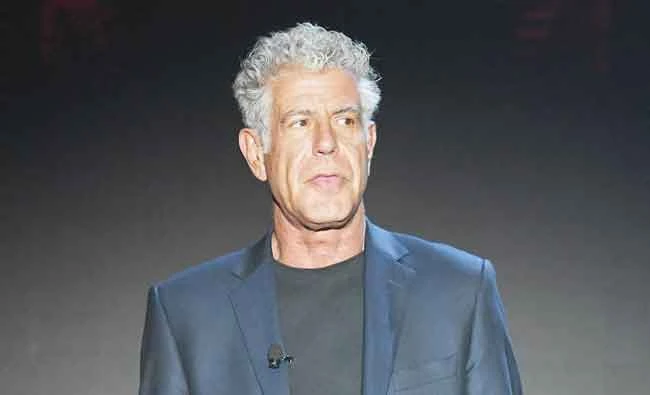
- Anthony Bourdain's visit to Palestine threw him into one of the world’s most protracted conflicts and appeared to be an awakening to the brutality of the occupation
- “His show about Palestine was exceptional and appreciated by all of us who struggle to share the truth about the humanity, kindness and hospitality of Palestinians”
AMMAN: In 2013, Anthony Bourdain visited the occupied Gaza Strip and West Bank. He spoke with unique honesty about his experience and expressed dismay at what he witnessed.
He introduced the “Parts Unknown” show on CNN with the warning: “By the end of this hour, I’ll be seen by many as a terrorist sympathizer, a Zionist tool, a self-hating Jew, an apologist for American imperialism, an Orientalist, socialist, a fascist, CIA agent, and worse.”
Tributes poured in from Palestinians this weekend for the American chef and TV presenter who took his own life at his home in France on Friday, praising his ability to relate to people on a human level during his multiple trips to the Middle East.
He had a particular affinity for Beirut and Lebanon where he fell in love with the people and their cuisine.
He was also remembered fondly in Jeddah, where he visited in 2008 to film an episode for the US travel and food show “No Reservations.”
Danya Al-Hamrani, a Jeddah based filmmaker, who spent the week showing Bourdain around the city, described him as sweet, kind and shy.
“He knew food was about telling a story, and he let the food, and the people who made it, speak for themselves,” Al-Hamrani wrote in an article for the website of Elle magazine.
His visit to Palestine threw him into one of the world’s most protracted conflicts and appeared to be an awakening to the brutality of the occupation. He went to Gaza, a territory that rarely receives high-profile overseas visitors.

After tweeting a photo of children killed on a Gaza beach in 2014 by an Israeli airstrike, he received a barrage of attacks.
In response, he wrote: “The willingness of people to not see what is plainly apparent, right there, (is) enormous and frankly, hideous. Unfortunately, we live in a world where it’s nearly impossible to even describe reality, much less deal with it. It’s utterly heartbreaking.”
Diana Butto, a Palestinian former adviser to President Mahmoud Abbas, told Arab News that she wished that he could have known how much people loved and respected him, because he respected and loved so many people in Palestine.
She praised his ability to tell a story “without being bogged down or lured in or captivated or held hostage by the various narratives.”
“He had this capacity to really listen and you can tell that food is about humanity and you can see that he was passionate about the underlying humanity.”
Butto said that in Palestine he looked at people as human beings and not as numbers. She said the fact he came to the region as primarily a chef by training, ahead of being a journalist, meant he appreciated the contribution of culture and food to humanity.
“You don’t understand people unless you live with them, going beyond just breaking bread with them, but going from field to table.”
Hazem Shunar, a Palestinian from Nablus on the West Bank, wrote on his Facebook that “Anthony Bourdain stood up for Palestinians and showed the world their just cause and national humanity, as well as the injustice that is facing them.”
Anize Naser, a Palestinian student of dentistry at the University of the Pacific in Stockton, California, praised Bourdain.
“You did what many in the media failed to do: listen and dare to tell the real, human stories of Palestinians,” he said. “You had a style of your own and treated everyone with respect, minus the big ego and superficiality that heavily pervades the industry.
“You cared for the little people and you broadened our hearts toward our neighbors.
“For this, you gave your audience hope that peace could exist through meals and simple conversations.”
Leila El-Haddad, a mother from Gaza and co-author of the book “The Gaza Kitchen,” recalled how Bourdain rocked her seven-month old baby to sleep in the middle of shooting the episode.
He was “a master storyteller and a master baby whisperer,” El-Haddad said on Facebook.
“Upon first setting foot in Gaza where we met, the first thing he said to me was that he was absolutely dumbfounded at what he’d witnessed in the West Bank and Jerusalem.”
El-Haddad said that he had told Israelis: “You are not gonna like the cake you’re baking — it’s only a matter of time before it implodes.”
She said that Bourdain also later confided with her that the episode almost didn’t air.
On her Facebook account, El-Haddad appealed for donations to the American Foundation for Suicide Prevention.
Donna Nassor, author of “Peace with Justice through the Eyes of Palestinians Living in their Historic Homeland” told Arab News that Bourdain helped to humanize Palestinians “by going into their homes, sitting at their tables, eating the food they cook for their families and spending time in places few others have bothered to visit.”
She said his program helped many shake off the fear and misinformation that they were presented with from the mainstream media.
“His show about Palestine was exceptional and appreciated by all of us who struggle to share the truth about the humanity, kindness and hospitality of Palestinians.”