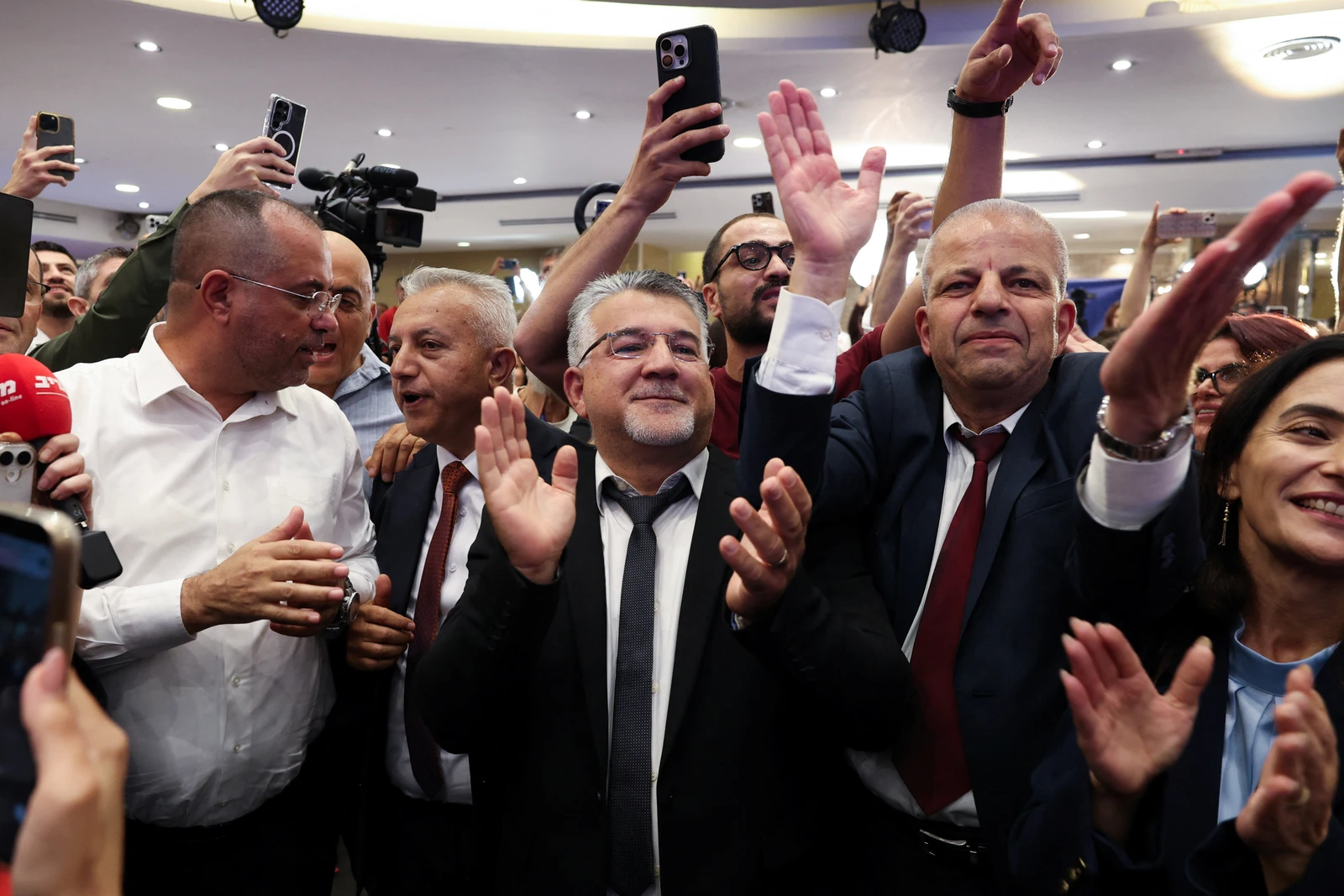
- Joint List’s Yousef Jabareen said it would be possible to support an alternative government from outside the coalition "with the aim of bringing down Netanyahu"
- Prime minister's Likud accuses Arab parties of "stealing election" after they made strong gains
NAZARETH: The leader of a key Arab party said on Wednesday that he was willing to cooperate with an opposition-led Israeli government to unseat Prime Minister Benjamin Netanyahu, but was not open to joining such a coalition outright.
“We do not see the possibility of being part of an Israeli government coalition under the current political circumstances, particularly given the ongoing war in Gaza, the settlements in the West Bank” and other issues, the Joint List’s Yousef Jabareen told AFP.
“However, with the aim of bringing down this government, it would be possible for us to support an alternative government from outside the coalition.”
Results from Israel’s election pointed Wednesday to no clear winner with Netanyahu’s right-wing bloc slightly ahead but still short of a majority with more than 85 percent of ballots counted.
The two Arab groupings, Joint List and Raam, find themselves in a potentially decisive position, with a projected 19 seats between them.
Both Netanyahu, Israel’s longest-serving prime minister who is allied with far-right and ultra-Orthodox Jewish parties, and Gadi Eisenkot, a former military chief leading a broad opposition bloc, vowed that they would seek to form the next government.
Voters from the Arab community, descendants of Palestinians who stayed after Israel’s creation and who make up around 20 percent of the population, have been enraged by the Netanyahu government’s ultra-nationalist Jewish vision for the country and the Palestinian territories.
Jabareen said earlier that the Israeli public had voted for new leadership, and “anyone who wants to offer a substantive and genuine alternative to Netanyahu’s blood-soaked government will have to talk to us.
“It’s either the continuation of racism, the continuation of exclusion and the continuation of supremacy, or a genuine Jewish-Arab partnership,” he said.
Netanyahu’s Likud accused Arab parties on Wednesday of having stolen the country’s election.
The premier had leveled a similar accusation while voting was underway on Tuesday, urging his own supporters to turn out in force.
His Likud party said in a statement that the election was “stolen by Arab parties who support terrorism and the annihilation of the Jewish state,” accusing them of “corruption, threats, violence, falsehoods and the use of prohibited software” to encourage voter turnout.
It added that it was submitting testimonies and evidence to the authorities, alleging “thousands of envelopes filled with cash and Raam ballots, threats and violence against polling station officials,” and other irregularities.
Netanyahu on Tuesday had accused Arab parties, and Raam in particular, of “trying to steal the election,” citing reports of individuals being arrested with envelopes of cash.
Acting Central Elections Committee director general Dean Livne referred to the incident as “unusual,” saying that “police, even before people arrived at the polling stations, caught individuals who tried to bribe voters.”
He added that the unidentified suspects were caught near their homes, and that the case was isolated and under investigation.
Police confirmed three people had been arrested overnight on suspicion of trying to buy votes for Raam, saying envelopes and more than 24,000 shekels (around $7,900) in cash were seized.
Raam leader Mansour Abbas accused Netanyahu of “lying and inciting against” his party, and using it “to mobilize right-wing voters.”
The party of Netanyahu’s main challenger, Eisenkot, accused the premier at the time of “laying the groundwork to challenge the results.”
Eisenkot has resisted allying with Arab parties.
Netanyahu during the campaign relentlessly attacked the opposition by saying it would put Arabs in power, running on the slogan: “Either the Right or Palestine.”
Yair Golan, the head of Israel’s main left-wing party and a member of Eisenkot’s camp, became the first member of the opposition camp to call for an alliance with Arab parties.
“Netanyahu lost. I know how to count to 120,” Golan said in a social media post.
“We must no longer accept Netanyahu’s racist division between Jewish votes and Arab votes.”
But Eisenkot’s camp also includes right-wingers who share many of Netanyahu’s hawkish views and have adamantly rejected working with Arab lawmakers.