- Trump describes the ICC as a ‘rogue institution,’ urges UN member states to withdraw and says US will never permit its service members to face trials there
- Experts say US president’s calls have no legal effect on obligations of ICC member states under the Rome Statute, despite the political implications
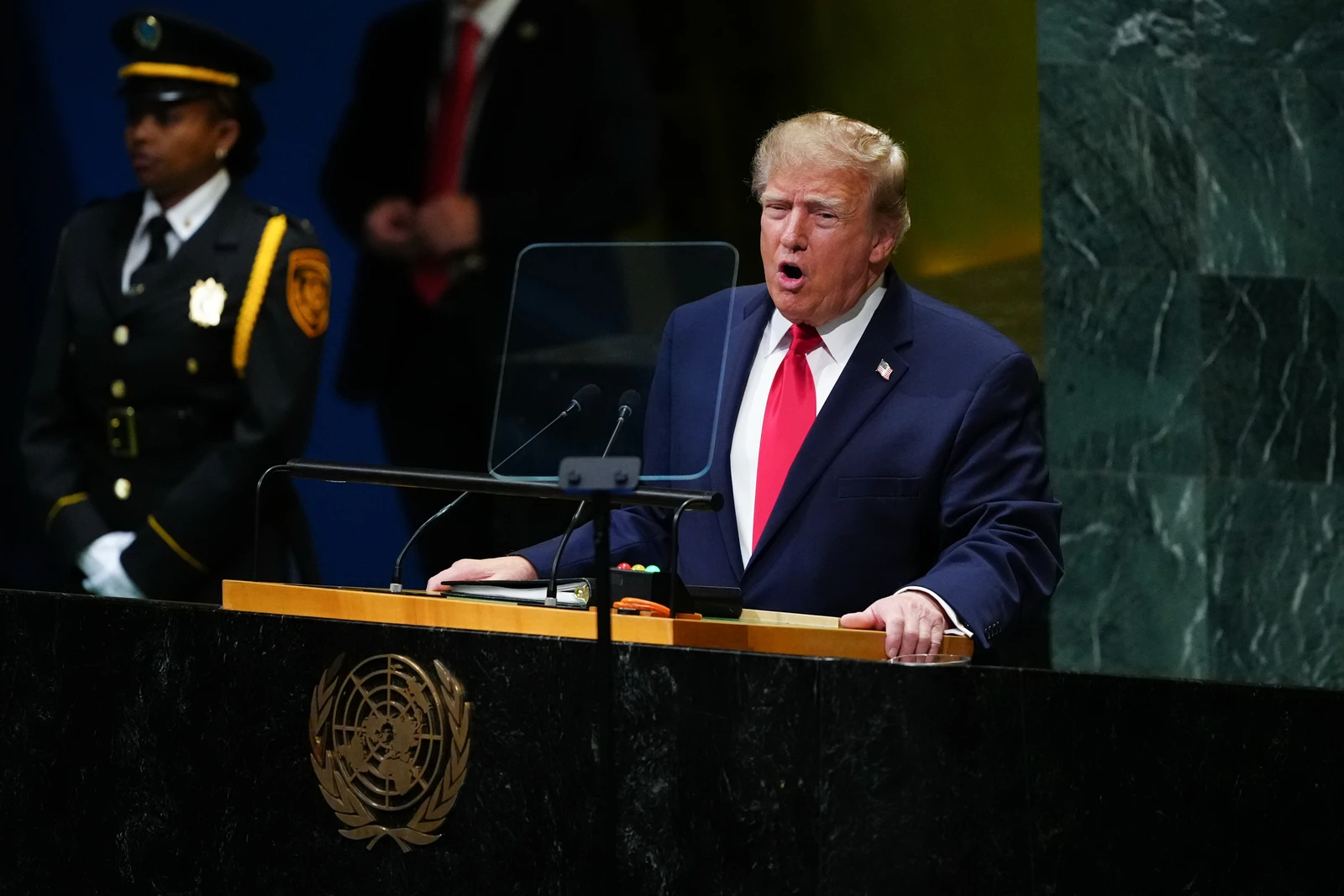
LONDON: The US president, Donald Trump, stood before world leaders at the UN on Tuesday and urged states that are members of the International Criminal Court to withdraw from it, escalating his administration’s campaign against an institution it accuses of overreach.
He described the ICC, which is based in The Hague, as a “rogue institution” as he called on its members to “officially resign” immediately, and said Washington would never allow American service members or their allies to face what he described as “show trials” before an “anti-American tribunal with no jurisdiction over us.”
His remarks followed a UN fact-finding mission that concluded there were reasonable grounds to believe US forces had committed war crimes during strikes on Iran during the continuing conflict between the countries. The mission said two strikes in February, including one that hit a school in Minab, constituted such crimes.
Trump’s comments do not alter the legal obligations of ICC member states, said Harout Ekmanian, a lawyer in New York who specializes in international disputes and public international law.
“President Trump’s call for states to withdraw from the ICC carries political significance but has no legal effect on their obligations under the Rome Statute,” the international treaty that established the court, Ekmanian told Arab News.
States retain the sovereign right to leave the court but must follow the Rome Statute’s withdrawal procedures and their own constitutional rules, he added.
Trump’s claim that the ICC had no jurisdiction over the US was “legally overbroad,” Ekmanian said.
“Although the US is not a party to the Rome Statute, the ICC’s jurisdiction is not exclusively dependent upon the accused individual’s nationality or their state’s consent,” he added.
Under Article 12(2) of the statute, the court can exercise jurisdiction over citizens of nonmember states when alleged crimes are committed on the territory of an ICC member state, or a state that has accepted the court’s jurisdiction.
“Nonmembership, therefore, does not confer categorical immunity from the ICC’s jurisdiction,” Ekmanian said. “It does, however, mean that the US is generally not subject to the Rome Statute’s treaty-based cooperation obligations.”
The bigger question is whether the pressure from Trump, combined with the possibility of fresh US sanctions against the court, might weaken international political support for the ICC.
The Trump administration is preparing sanctions targeting the institution itself, according to sources cited by Reuters, in a move that could restrict its access to US financial services and other resources. Washington has previously sanctioned ICC judges and prosecutors.
Timothy Kaldas, deputy director of the Tahrir Institute for Middle East Policy, said member states should not dismiss the threat.
“They should take very seriously Trump’s threats to try to destroy the court,” Kaldas told Arab News. “That said, I think they should unite to defend it because the more unified the members are, the more pressure they can push back on the US to try to protect the court from US actions.”
European officials have expressed concern. The EU’s foreign policy chief, Kaja Kallas, said the ICC was under “immense pressure” and warned that this pressure on the court and its judges raised questions about commitments to the international legal order.
The Netherlands called on the EU to invoke its Blocking Statute, which is designed to protect European businesses and individuals from the effects of certain extraterritorial sanctions. But Kaldas said this measure alone might not protect European banks that have significant exposure to the US financial system.
“I think that the EU, in order to defend the ICC, would have to probably confront the United States,” he said. “The blocking statute alone … isn’t guaranteed to protect European banks that could be implicated in US sanctions on the ICC.”
Ekmanian said the EU could update the Blocking Statute to prohibit European firms from complying with ICC-related US sanctions and allow them to seek damages. It could also develop payment channels less dependent on the dollar.
But such measures would still not fully protect transactions involving US dollars, US banks or US individuals. Financial institutions with major US exposure could still face conflicting legal requirements.
“History suggests many would de-risk regardless, as they did with Iran after 2018,” Ekmanian said. “Full protection would require either a US license or arrangements that stay entirely outside US jurisdiction.”
Even if countries heeded Trump’s call and began withdrawal proceedings, leaving the ICC would not erase obligations arising from the time when they were members, Ekmanian said.
“Crucially, withdrawal does not operate retroactively,” he said. “It neither extinguishes the court’s jurisdiction over crimes committed while the state was bound by the statute, nor terminates investigations and proceedings already under consideration.”
Recent withdrawals have nevertheless added to concerns about the future of the court. Venezuela and Chad began withdrawal procedures in July, a month after similar moves by Burkina Faso, Burundi, Mali and Niger. The ICC’s Assembly of States Parties has warned that such withdrawals risk weakening international efforts to end impunity.
Kenneth Roth, former executive director of Human Rights Watch, said Trump’s campaign against the court was aimed at shielding US and Israeli officials from accountability for their actions.
“Trump’s attacks on the International Criminal Court reflect an effort to make the world safe for war criminals, if they are American or Israeli,” he told Arab News. “It will fail.”
The next major test could be the selection of the ICC’s next chief prosecutor, Roth said. The Trump administration could seek to influence the process in an attempt to ensure a prosecutor is chosen who is more receptive to its views on accountability.
“It is essential that ICC member states not bow to Trump’s quest for impunity,” Roth said.