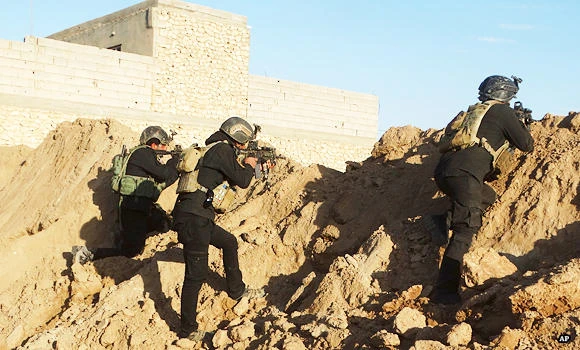
BAGHDAD: Iraqi security forces have made advances on two fronts in the city of Ramadi, clearing Daesh militants from a key military command base and a sprawling neighborhood on its western edge, army officials said.
Capture of the sprawling western Ramadi district of Al-Taamim and the Anbar Operations Command headquarters on Wednesday could advance government efforts to retake Ramadi which fell to Daesh in May.
“Army troops and counter-terrorism forces launched simultaneous offensives from the northern and western fronts and succeeded in making a striking advance,” joint operations spokesman Brig. Gen. Yahya Rasool told Reuters.
The center of Ramadi remains under Daesh control, but Rasool said the militants, which Iraqi intelligence estimates number between 250 and 300 fighters, are losing the initiative and suffering food and ammunition shortages after government forces cut their last supply line into the city last month.
“We can hear their radio call we intercepted complaining about lack of food and ammunition,” Rasool said. “It’s quite clear they are desperate and collapsing.”
“Retaking Taamim after a striking offensive prevented terrorists from evacuating large stockpiles of ammunition which they left behind. It’s a severe blow to their morale,” said Sabah Al-Numani, spokesman for Iraqi counter-terrorism forces.
Local officials and tribal leaders estimate between 1,200-1,700 families remain trapped inside the city by the militants.
Besieged Daesh militants, meanwhile, destroyed a lock on the Euphrates River that served as a bridge.
Since Iraq’s military launched its push on Ramadi earlier this month, the militants had destroyed all other bridges leading into the city, both on the Euphrates and its tributary, the Warar River.
Iraqi Maj Gen. Ismail Al-Mahlawi, the head of military operations in the western Anbar province, said the lock destroyed Wednesday was the last remaining bridge from the city center to the northwest. “Daesh forces trying to stop our progress bombed the last bridge which connects the city center,” he said.
The locks’ destruction leaves some 300 Daesh fighters trapped in the center of the city, he added.
Col. Steven Warren, the spokesman for the US-led coalition in Baghdad, said the destruction of the bridge may prove to be a tactical mistake for Daesh. “What they’ve also done now is they’ve really cut themselves off,” he said.
“So the fighters left on the north side of the river can’t retreat and the fighters on the south side of the river can’t send reinforcements.”
Muhannad Haimour, the spokesman for the Anbar governor’s office, said he received reports from residents still inside Ramadi that Daesh was also destroying buildings and radio towers.
“We’ve seen this before; they tend to blow up not just bridges, but a lot of infrastructure inside the city,” Haimour said.
Haimour added that according to reports he received, about two months ago Daesh fighters began moving their families out of Ramadi and toward the town of Hit northwest of Ramadi. That, he said is when he believes the tide began to turn against Daesh in the Anbar provincial capital.
A key factor that changed the sluggish pace of the battle for Ramadi, Haimour said, was a decision by the central government in Baghdad to arm Sunni tribal fighters from the Ramadi area to fight against Daesh.
“They didn’t feel like they had enough support from the coalition and the central government, but all of that changed a few months ago,” Haimour said. Now, there are 8,500 members from Anbar mobilized, trained, armed and receiving salaries.
Iraqi forces deal blow to Daesh