KIRKUK: More than 200 elderly and infirm Yazidis were freed on Wednesday by Islamic State militants who had been holding them captive since overrunning their villages in northwestern Iraq last summer.
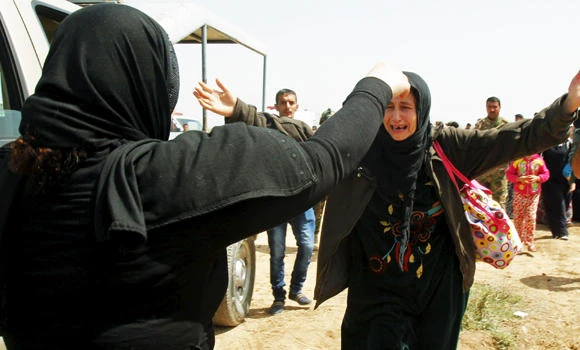
A Reuters reporter saw the group of 216 people, which included two Christians, handed over to Kurdish forces near the city of Kirkuk. Some were too exhausted and disoriented to speak.
One elderly woman said she had been captured by the insurgents last August when they overpowered Kurdish forces in the Sinjar area and proceeded to purge its Yazidi population, killing hundreds and taking thousands captive.
The woman, who asked not to be named, said she had told her son and two young daughters to run away as the militants closed in, but stayed behind herself because she was unwell and did not want to slow them down.
“I had lost hope of seeing my children again, but today it has happened,” she said as they embraced her and wept.
It was not clear why the radical militants had decided to release the Yazidis, whom they consider devil-worshippers, but the group previously freed 200 more it was holding under similarly mysterious circumstances.
Some of the Yazidis said they had been held in the Islamic State stronghold of Tel Afar most of the time, but in the days leading up to their release, they were moved from one town to another in Islamic State’s self-proclaimed caliphate.
The Yazidis thought they were being led to their execution, but instead, were piled onto a minibus that drove them to peshmerga positions in batches. Yazidi community leaders were there to receive them and an ambulance was on standby.
The Yazidis are an ancient, predominantly Kurdish people who follow their own religion derived from Islam, Christianity and Zoroastrianism.
Separately, the International Criminal Court’s prosecutor said the terror group has committed “crimes of unspeakable cruelty” in Syria and Iraq, , but added that she does not have jurisdiction to open an investigation.
“Crimes of unspeakable cruelty have been reported, such as mass executions, sexual slavery, rape and other forms of sexual and gender-based violence, torture, mutilation, enlistment and forced recruitment of children and the persecution of ethnic and religious minorities, not to mention the wanton destruction of cultural property,” Fatou Bensouda said. “The commission of the crime of genocide has also been alleged.”
But Bensouda added that “the jurisdictional basis for opening a preliminary examination into this situation is too narrow at this stage.”
The court does not have jurisdiction because neither Syria nor Iraq is a member of the court and the United Nations Security Council has not asked for an investigation.
She said that there is not yet a sufficiently strong foundation for opening an investigation even though she has information that “several thousand foreign fighters,” including citizens of countries that are members of the court, have joined IS and “may have been involved in the commission of crimes against humanity and war crimes.”
IS frees over 200 Yazidis in Iraq