- A record Arab surge has made them the balance of power in Israel’s election, but the day after reveals hard limits on any coalition role
- Claims about foreign interference and deep political mistrust threaten to limit the influence of newly empowered Arab lawmakers
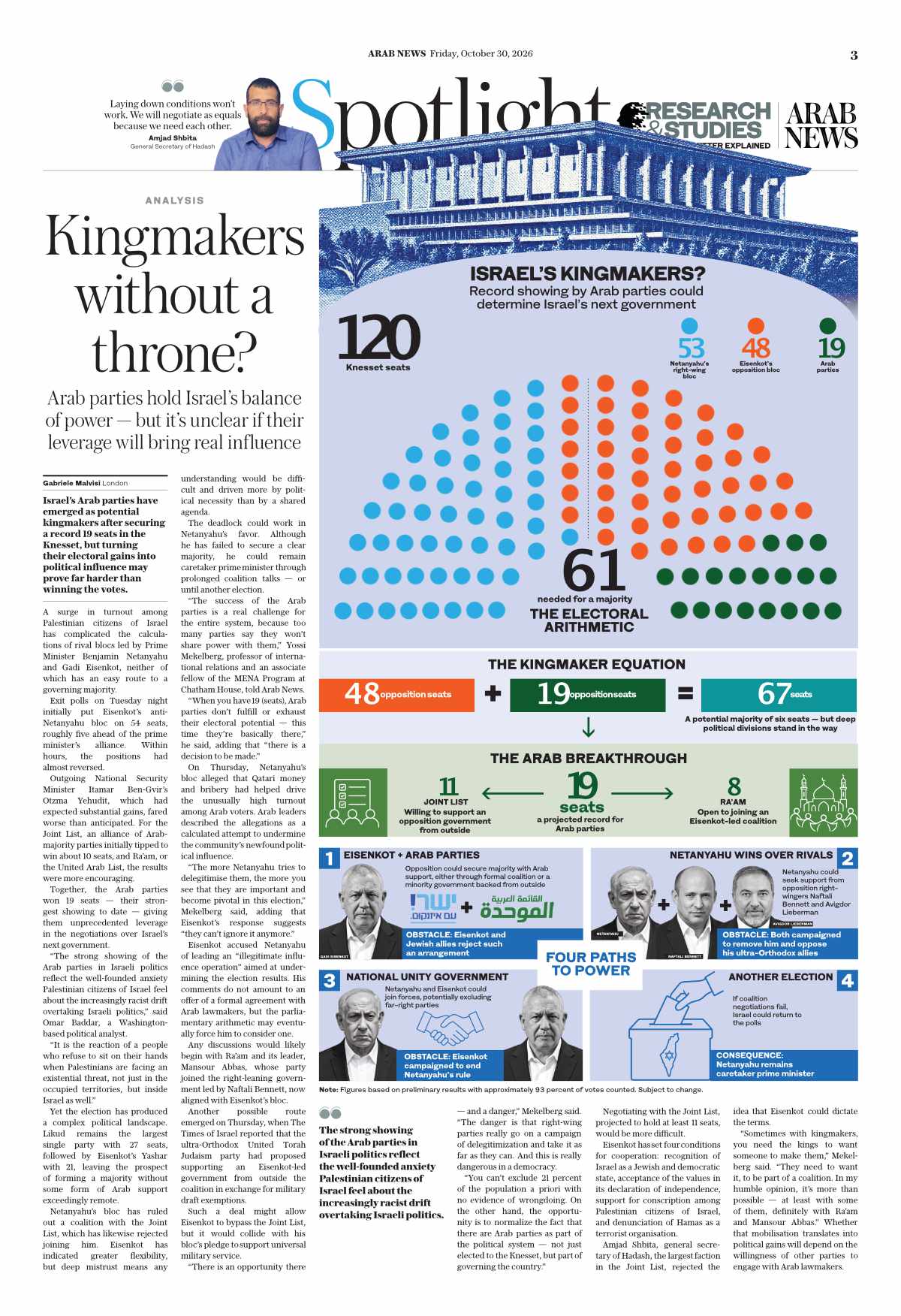
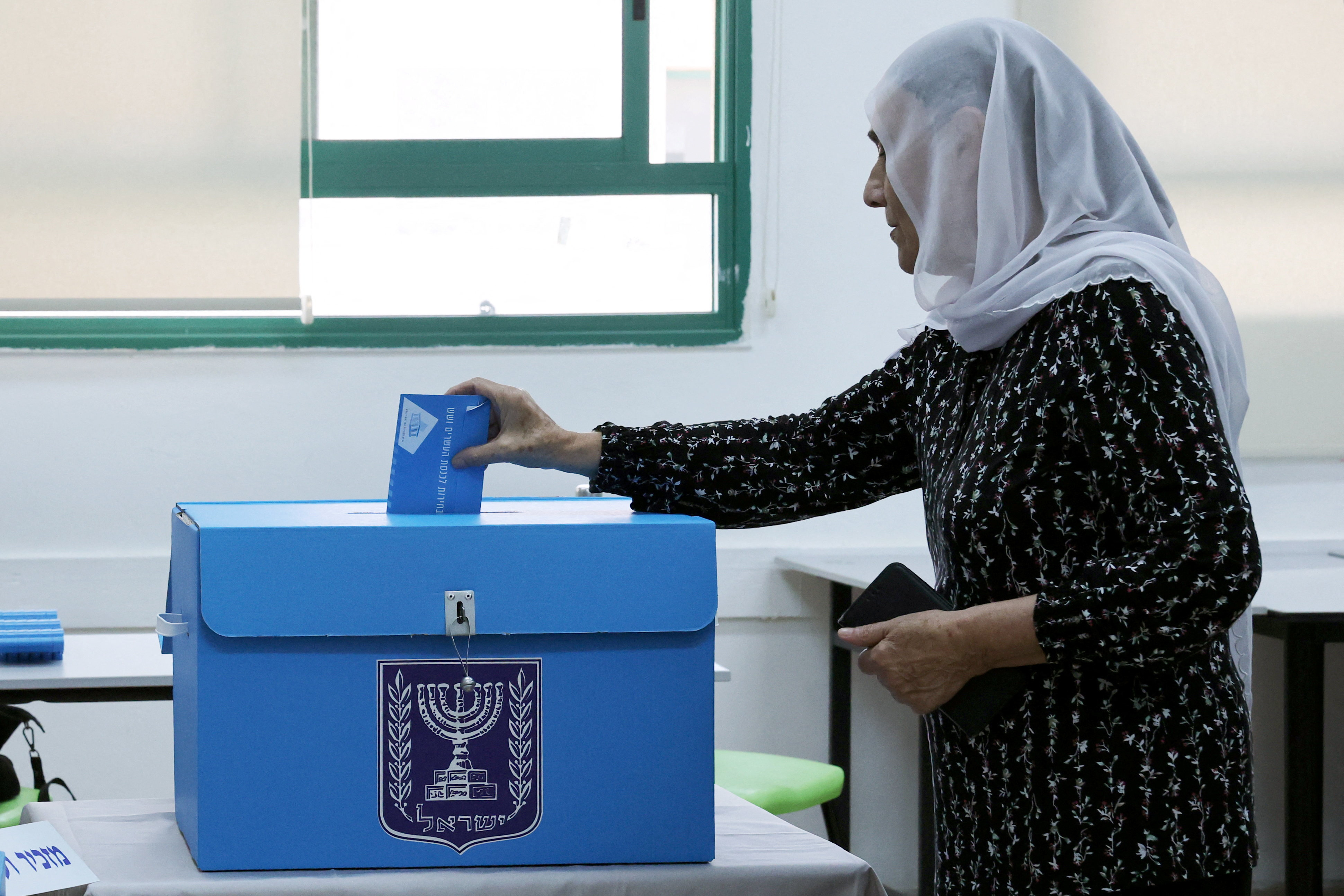
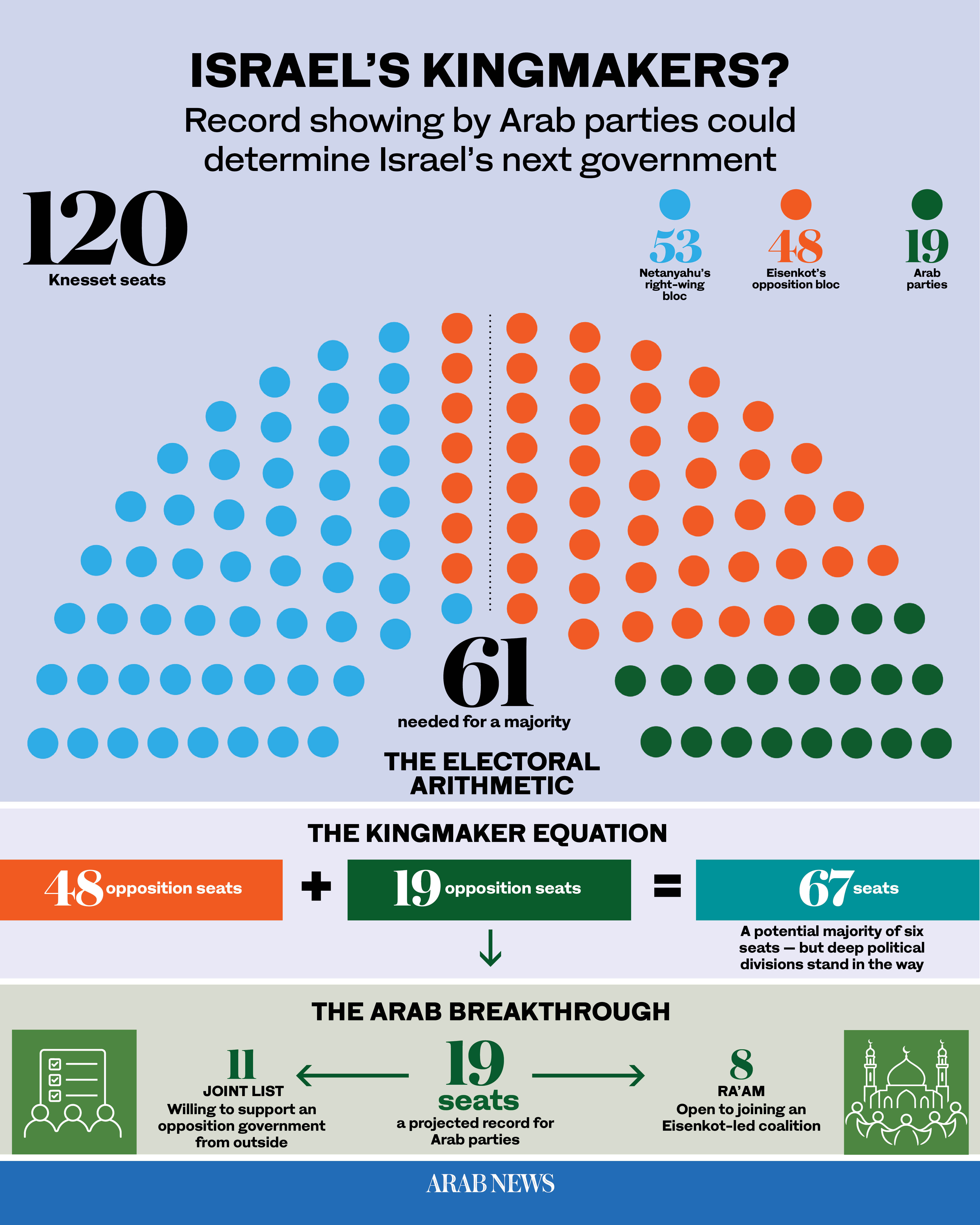
LONDON: Israel’s Arab parties have emerged as potential kingmakers after securing a record 19 seats in the Knesset, but turning their electoral gains into political influence may prove far harder than winning the votes.
A surge in turnout among Palestinian citizens of Israel has complicated the calculations of rival blocs led by Prime Minister Benjamin Netanyahu and Gadi Eisenkot, neither of which has an easy route to a governing majority.
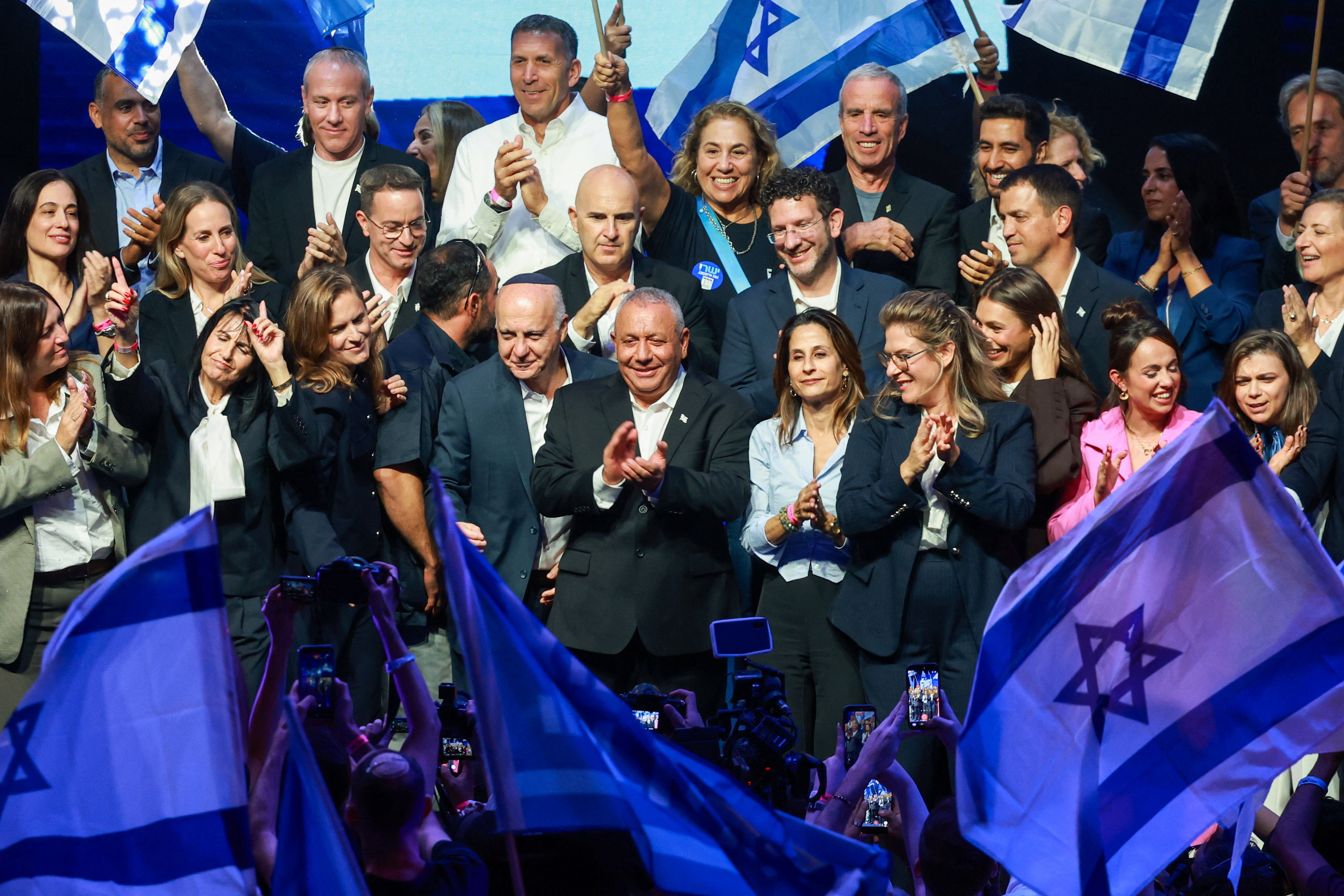
Exit polls on Tuesday night initially put Eisenkot’s anti-Netanyahu bloc on 54 seats, roughly five ahead of the prime minister’s alliance. Within hours, the positions had almost reversed.
Outgoing National Security Minister Itamar Ben-Gvir’s Otzma Yehudit, which had expected substantial gains, fared worse than anticipated. For the Joint List, an alliance of Arab-majority parties initially tipped to win about 10 seats, and Ra’am, or the United Arab List, the results were more encouraging.
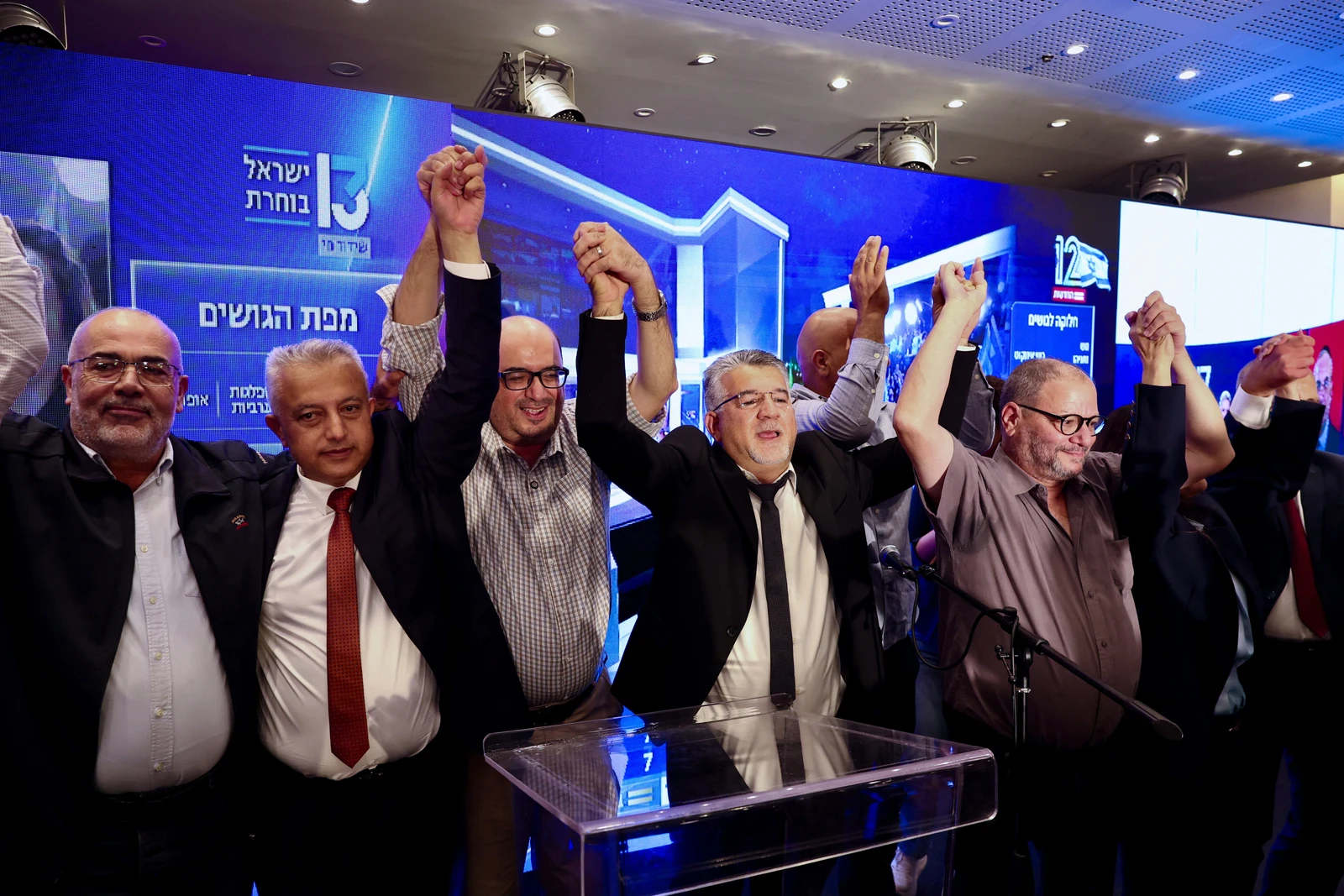
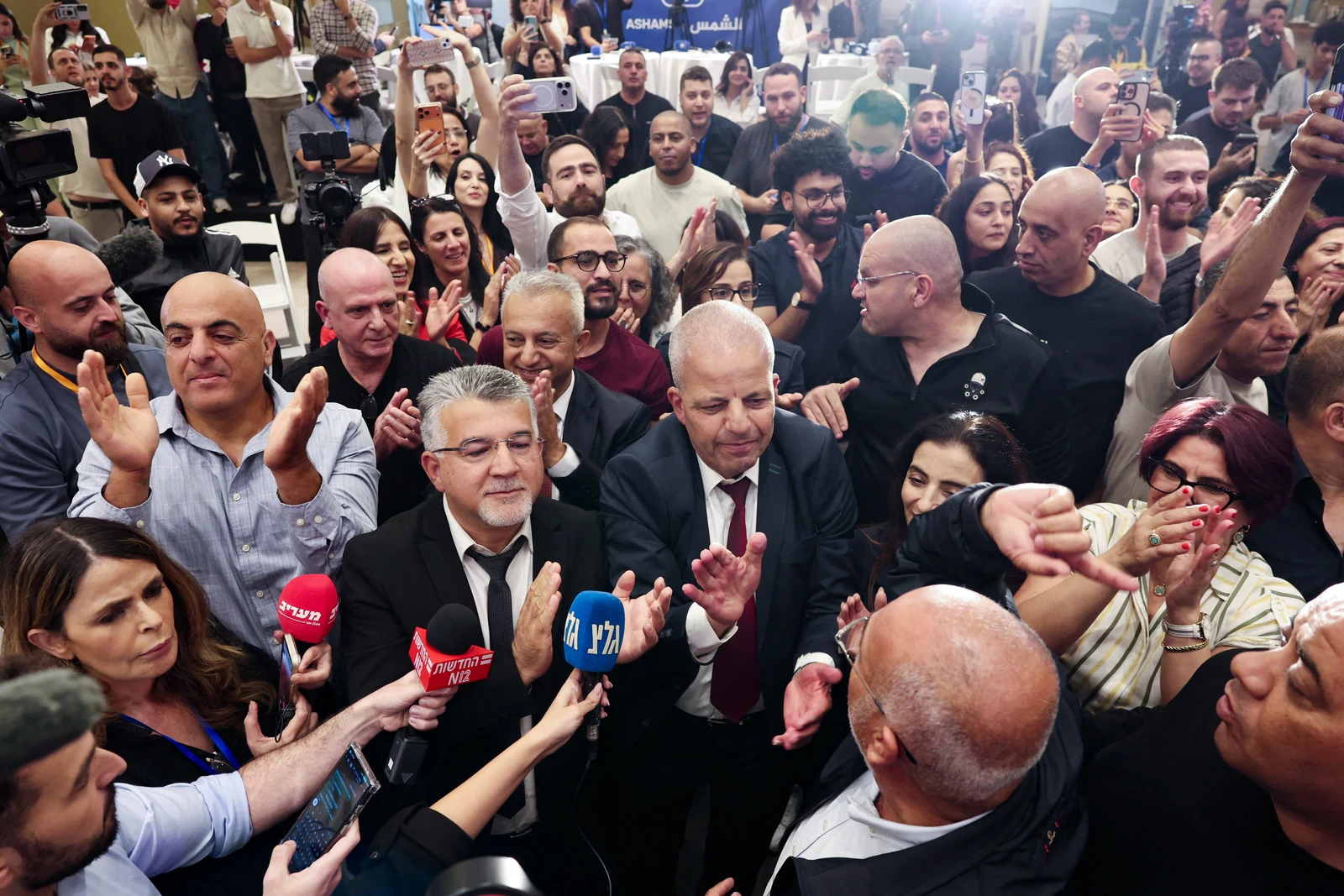
Together, the Arab parties won 19 seats — their strongest showing to date — giving them unprecedented leverage in the negotiations over Israel’s next government.
Palestinian citizens of Israel, largely descendants of Palestinians who remained after the state’s creation and accounting for about one-fifth of the population, have grown increasingly frustrated with Netanyahu’s ultranationalist approach to Israel and the Palestinian territories.
“The strong showing of the Arab parties in Israeli politics reflect the well-founded anxiety Palestinian citizens of Israel feel about the increasingly racist drift overtaking Israeli politics,” said Omar Baddar, a Washington-based political analyst.
“It is the reaction of a people who refuse to sit in their hands when Palestinians are facing an existential threat, not just in the occupied territories, but inside Israel as well.”
Yet the election has produced a complex political landscape. Likud remains the largest single party with 27 seats, followed by Eisenkot’s Yashar with 21, leaving the prospect of forming a majority without some form of Arab support exceedingly remote.
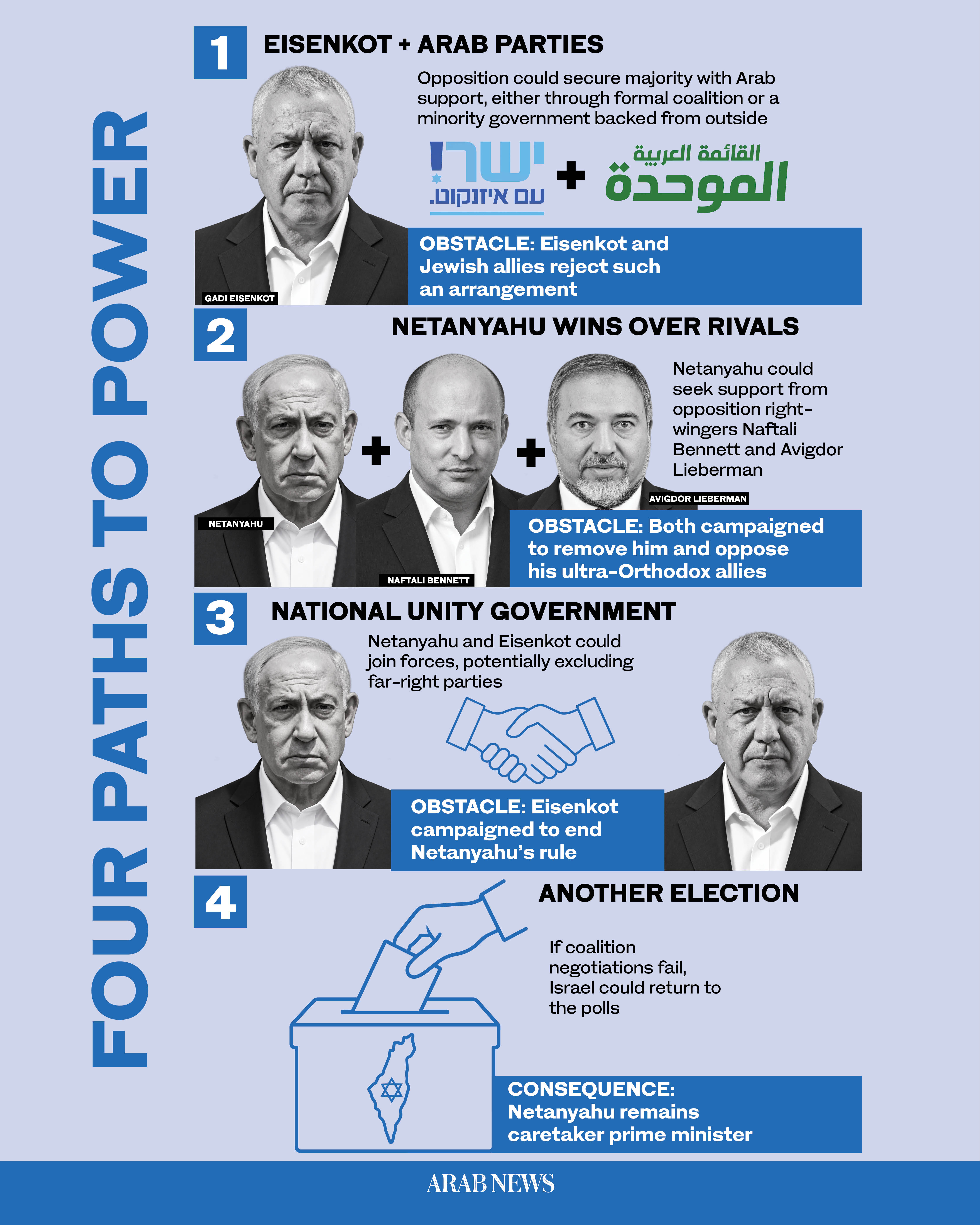
Netanyahu’s bloc has ruled out a coalition with the Joint List, which has likewise rejected joining him. Eisenkot has indicated greater flexibility, but deep mistrust means any understanding would be difficult and driven more by political necessity than by a shared agenda.
The deadlock could work in Netanyahu’s favor. Although he has failed to secure a clear majority, he could remain caretaker prime minister through prolonged coalition talks — or until another election.
Baddar said the impasse exposed a contradiction in the opposition’s approach to Arab political representation.
“Because the Israeli electorate is deeply anti-Palestinian, we find ourselves in an ironic situation where the anti-Netanyahu bloc is perfectly capable of ousting him, but are held back by their refusal to form a coalition with Palestinian parties in the Knesset. Treating these parties as a legitimate part of the system may be a scarier prospect for some than the continued reign of Netanyahu's corruption and terror,” he said.
“The success of the Arab parties is a real challenge for the entire system, because too many parties — with the exception of the Democrats — say they won’t share power with them,” Yossi Mekelberg, professor of international relations and an associate fellow of the MENA Program at Chatham House, told Arab News.
“When you have 19 (seats), Arab parties don’t fulfil or exhaust their electoral potential — this time they’re basically there,” he said, adding that “there is a decision to be made.”
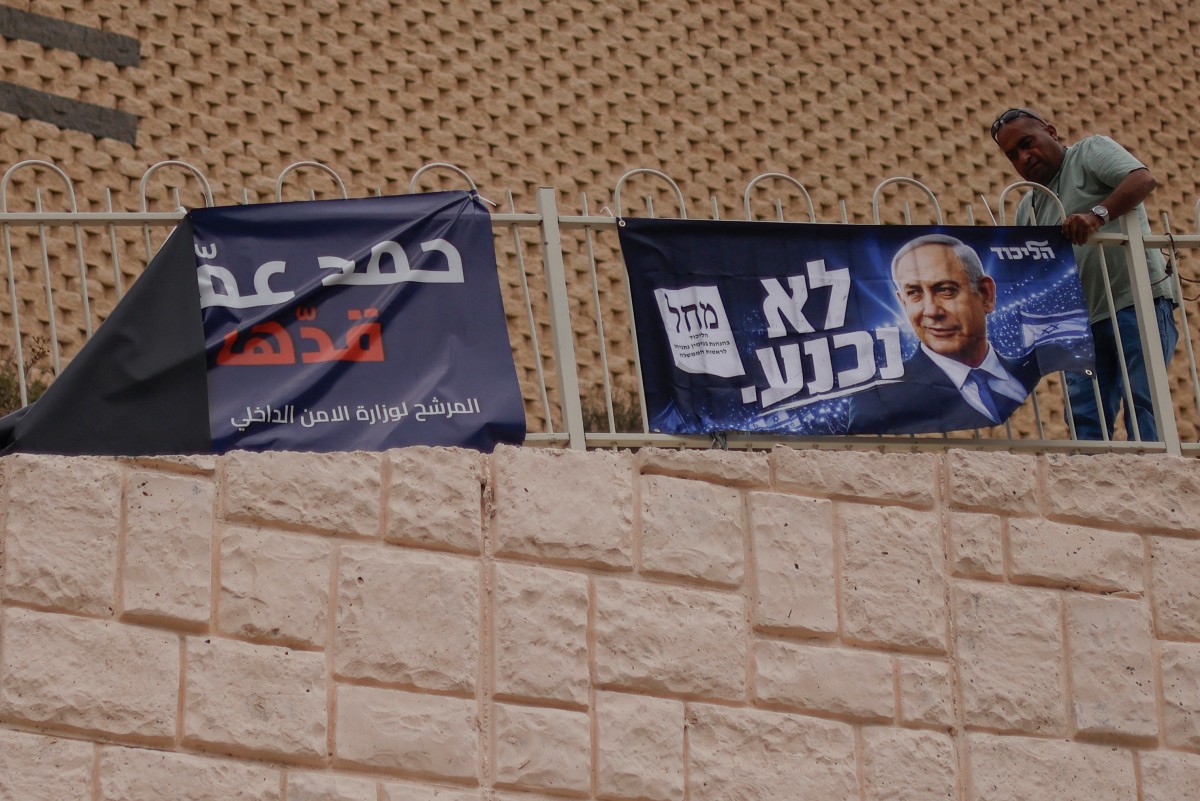
On Thursday, Netanyahu’s bloc alleged that Qatari money and bribery had helped drive the unusually high turnout among Arab voters. Arab leaders described the allegations as a calculated attempt to undermine the community’s newfound political influence.
Qatar dismissed the accusations as “ridiculous and dangerous,” while Election Committee officials said claims of systematic fraud were likely baseless. President Isaac Herzog called for an investigation, but warned against stigmatizing the Arab Israeli community as a whole.
Critics see the allegations as part of Netanyahu’s long-running effort to delegitimize Arab parties and make them politically unacceptable as potential partners for Eisenkot.
“The more Netanyahu tries to delegitimize them, the more you see that they are important and become pivotal in this election,” Mekelberg said, adding that Eisenkot’s response suggests “they can’t ignore it anymore.”
Eisenkot accused Netanyahu of leading an “illegitimate influence operation” aimed at undermining the election results. His comments do not amount to an offer of a formal agreement with Arab lawmakers, but the parliamentary arithmetic may eventually force him to consider one.
Any discussions would likely begin with Ra’am and its leader, Mansour Abbas, whose party joined the right-leaning government led by Naftali Bennett, now aligned with Eisenkot’s bloc.
Abbas, who has a Jewish Zionist deputy and has shown a willingness to compromise, said his priority was to “bring down Benjamin Netanyahu, (Bezalel) Smotrich, and Ben-Gvir in this election.”
Ra’am is the smaller of the two main Arab groupings, with eight seats, raising doubts about whether an arrangement with Abbas alone could give Eisenkot a stable majority.
Another possible route emerged on Thursday, when The Times of Israel reported that the ultra-Orthodox United Torah Judaism party had proposed supporting an Eisenkot-led government from outside the coalition in exchange for military draft exemptions.
Such a deal might allow Eisenkot to bypass the Joint List, but it would collide with his bloc’s pledge to support universal military service.
“There is an opportunity there — and a danger,” Mekelberg said. “The danger is that right-wing parties really go on a campaign of delegitimization and take it as far as they can. And this is really dangerous in a democracy.
“You can’t exclude 21 percent of the population a priori with no evidence of wrongdoing. On the other hand, the opportunity is to normalize the fact that there are Arab parties as part of the political system — not just elected to the Knesset, but part of governing the country.”
Negotiating with the Joint List, projected to hold at least 11 seats, would be more difficult.
Eisenkot has set four conditions for cooperation: recognition of Israel as a Jewish and democratic state, acceptance of the values in its declaration of independence, support for conscription among Palestinian citizens of Israel, and denunciation of Hamas as a terrorist organisation.
Amjad Shbita, general secretary of Hadash, the largest faction in the Joint List, rejected the idea that Eisenkot could dictate the terms.
“Laying down conditions won’t work with the Joint List,” he said. “We will negotiate as equals because we need each other.”
The Joint List is seeking full civic and national equality for Palestinian citizens of Israel; recognition of their collective rights as part of the Palestinian people; an end to the war in Gaza; opposition to settlement expansion and occupation; and a political path to an independent Palestinian state along the 1967 borders, with East Jerusalem as its capital.
Those demands are unlikely to be fully accepted by Eisenkot and his allies. Ra’am also supports Palestinian statehood and an end to the conflict, but has taken a more pragmatic approach, emphasising improvements in the lives of Arab citizens through participation in government.
“Sometimes with kingmakers, you need the kings to want someone to make them,” Mekelberg said. “They need to want it, to be part of a coalition. In my humble opinion, it’s more than possible — at least with some of them, definitely with Ra’am and Mansour Abbas.”
Whether that mobilization translates into political gains will depend on the willingness of other parties to engage with Arab lawmakers.
As of Thursday, one possible outcome was a government formed to remove Netanyahu from office, with the Joint List prepared to support an opposition-led administration without formally joining it.
“We do not see the possibility of being part of an Israeli government coalition under the current political circumstances, particularly given the ongoing war in Gaza, the settlements in the West Bank and other issues,” bloc leader Yousef Jabareen said.
He argued that Israelis had voted for a change in leadership and that “anyone who wants to offer a substantive and genuine alternative to Netanyahu’s blood-soaked government will have to talk to us. It’s either the continuation of racism, exclusion and supremacy, or a genuine Jewish-Arab partnership.”
Although the election was widely portrayed as a referendum on Netanyahu, Mekelberg cautioned that “the situation is way more complicated than this.” Removing him, he said, would require skilful political manoeuvring.
Economic and social pressures facing Israel were largely overshadowed during the campaign by security concerns, a pattern Mekelberg said had allowed Netanyahu to shape the opposition’s priorities.
“Unfortunately, the opposition usually follows the agenda set by Netanyahu — on security, about Iran, forgetting Gaza,” he said.
For Palestinians, the coalition talks offer little immediate clarity about whether policy on the ground will change.
“First you need to see the composition of the government, and then where you take it from there,” Mekelberg said. “Because the voters ended up basically with a mess, and this mess can be organised in different ways. It’s a bit of a Lego. It depends what you do with it; it can be beautiful, or it can be not so beautiful.”