- Crown Prince Al-Hussein bin Abdullah II denounces ‘cowardly and treacherous act’
- Killings happened in village known for closeness of its Christian, Muslim communities
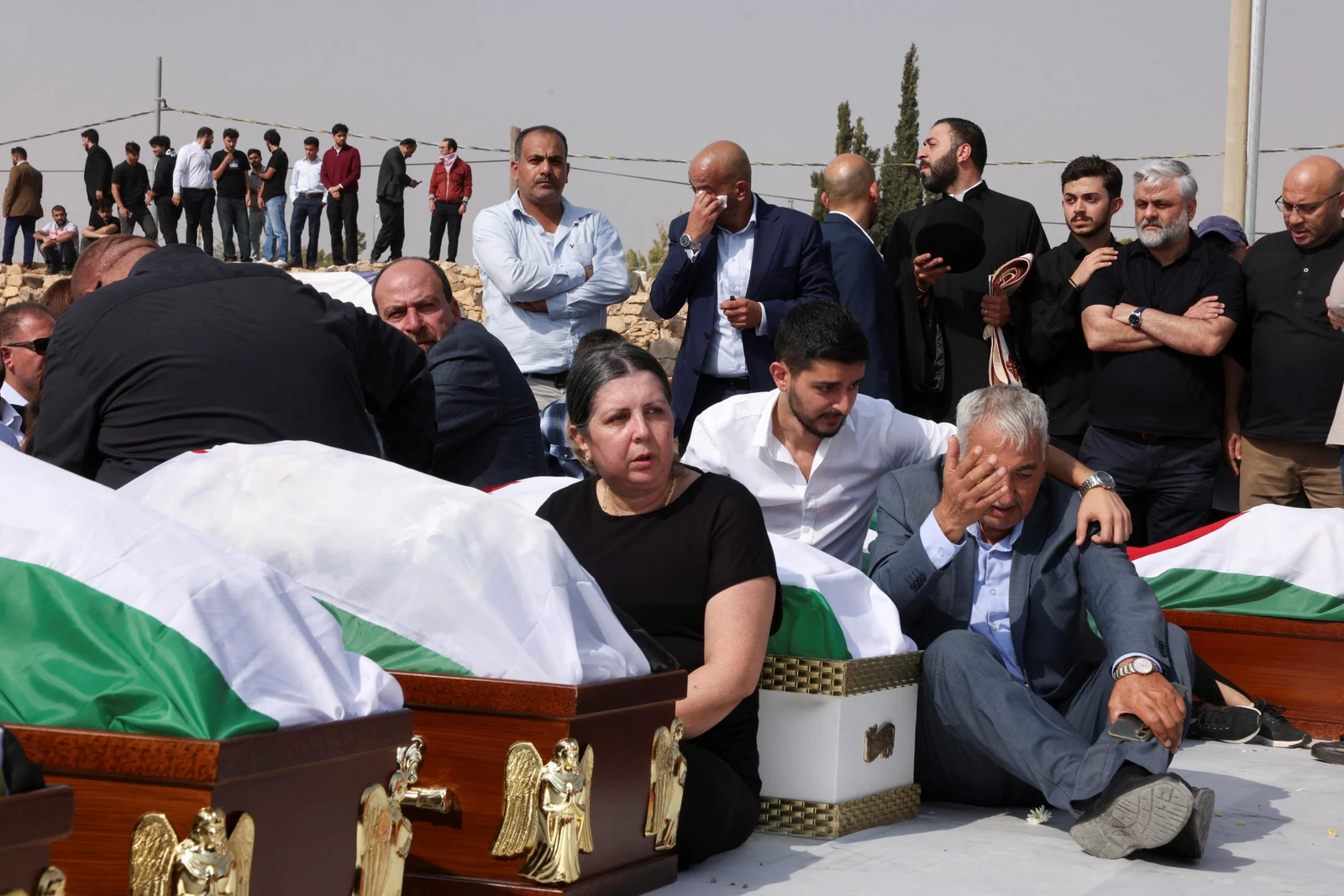
KARAK: Thousands of Jordanians gathered in the southern governorate of Karak on Sunday to bury the victims of the terrorist attack on St. George Greek Orthodox Church, in a solemn display of solidarity as the country vowed to confront extremism.
The funeral ceremonies brought together mourners from across the country, including government officials, ministers, community leaders and representatives of social and religious groups.
The coffins, draped in Jordanian flags, were carried by Public Security Directorate personnel as the procession moved from Karak Government Hospital to the church, where prayers were held before the burials at a site opposite.
The victims had been attending a funeral at the church in the village of Hamoud on Friday when they were attacked. The deaths prompted an outpouring of grief across the Kingdom.
The scale of public participation on Sunday was a powerful expression of national solidarity, with mourners rejecting attempts to sow division between Muslim and Christian communities.
During a visit to Hamoud Crown Prince Al-Hussein bin Abdullah II offered his condolences to the families of those killed, describing the attack on citizens in a place of worship as a “cowardly and treacherous act.”
He expressed his sympathy to the victims’ families and referred to King Abdullah II’s directives to deal firmly with terrorists and respond decisively to anyone seeking to undermine the unity of Jordanians.
The attack, he said, was an assault on Jordan and all Jordanians, adding that Karak would remain steadfast and proud through the determination of its people.
The crown prince said that he and the King were committed to holding the perpetrators accountable and that all state resources were being mobilized to apprehend them.
Prime Minister Jafar Hassan attended the funeral on behalf of King Abdullah II, accompanied by ministers and civilian and military officials.
After the event he said that state institutions were working to apprehend those responsible and ensure that they received the punishment they deserved. He also expressed the government’s condolences to the victims’ families and wished the injured a speedy recovery.
Hassan also called for intensified efforts to eradicate extremism and takfiri ideology at their roots and said that there was no place for such thinking in Jordanian society.
Countering extremism was not merely a security battle but also a struggle over awareness and ideas, he said. Sectarianism, fanaticism, racism and extremism threatened social cohesion and stability, while diversity, openness and solidarity were essential to the country’s development.
Government Communications Minister Mohammad Momani said that those responsible would not escape punishment and that the funerals reflected the unity and cohesion of Jordanians, who remained resilient in the face of terrorism, sedition and extremism.
“The protection of Jordanians’ lives, security and dignity is a national responsibility that allows no complacency,” he said.
Former lawmaker Ayman Mdanat, who was injured in the attack, said that the fact that both Muslims and Christians had been wounded outside the church carried a message about Jordan’s identity.
“Jordan is brotherhood, Jordan is history, Jordan is coexistence, Jordan is love,” he said.
The attack would not weaken the bonds between Jordanians but would strengthen their determination to stand together, he said.
A relative of Mdanat’s described the incident as “a wound in the chest of every Karaki and every Jordanian,” adding that the crime did not represent Karak or Jordanian society.
The remarks reflected a broader response across the country, where public institutions, universities, professional associations and community groups issued condemnations and held solidarity gatherings. Those taking part reaffirmed their rejection of violence and extremism and expressed support for the victims’ families.
In Hamoud, the response carried particular significance. The village has long been regarded as an example of close relations between Muslim and Christian residents, whose shared history is rooted in everyday life, education, family ties and community traditions.
Father Theodoros Sweis, priest of St. George Greek Orthodox Church, said that the attack had provoked grief and anger across Jordan. Targeting places of worship and peaceful civilians, he said, was incompatible with every religion, moral principle and human value.
He described Hamoud as a model of coexistence and affection between Muslims and Christians, saying that the crime was alien to the history and traditions of Karak. He also warned against the role of digital platforms in spreading extremist ideas, incitement and hatred and urged Jordanians to remain united and reinforce the values of respect and mutual understanding.
The Ministry of Local Administration called for streets across the Kingdom to be named after the victims. The initiative was presented as a tribute to those killed and a reminder of the country’s collective rejection of terrorism.