- Minister says gathering could help recast countries’ economic relationship as partnership based on mutual interests, voluntary cooperation
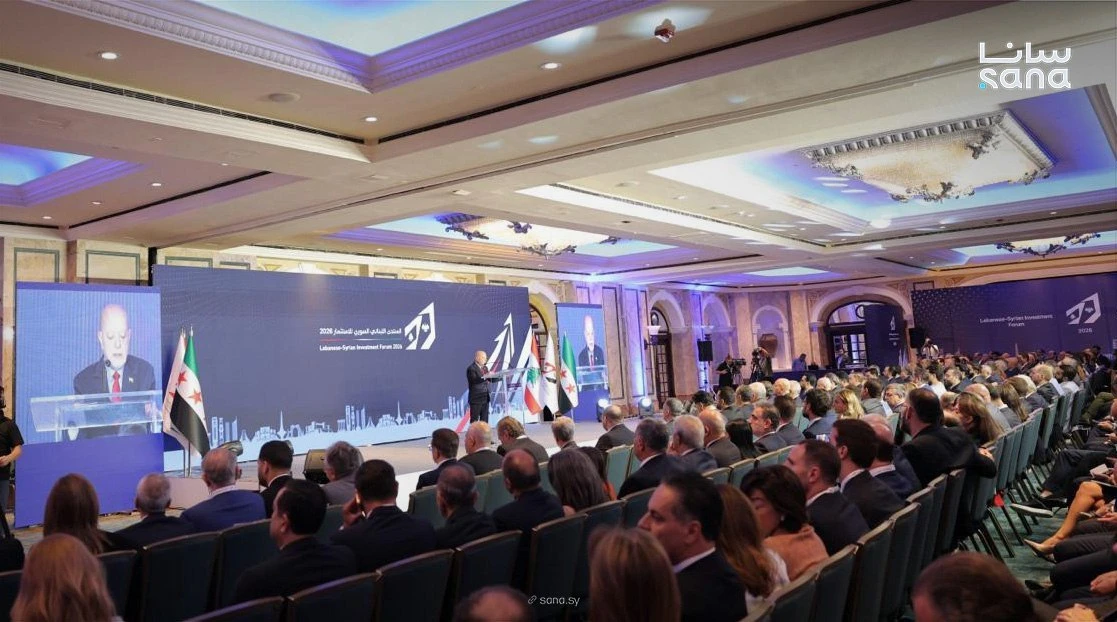
LONDON: The first Syrian-Lebanese Investment Forum was held on Wednesday in Beirut, bringing together government officials and business leaders from the two neighboring countries to discuss reconstruction, investment and closer economic cooperation.
The forum’s sessions focused on investment opportunities, sustainable development, transportation, and broader efforts to expand trade and business ties, according to the Syrian Arab News Agency.
Syrian Economy and Industry Minister Nidal Al-Shaar said the gathering could help recast the two countries’ economic relationship as a partnership based on mutual interests and voluntary cooperation.
This partnership, he said, must rest on “clear and balanced foundations” that respected each country’s sovereignty, independent decision-making and national interests.
Al-Shaar said deeper economic cooperation could also foster lasting trust, moving the Syrian Arab Republic and Lebanon beyond their longstanding geographic and historic connections toward a more structured institutional relationship.
He said the Syrian delegation was the largest to visit Lebanon since December 2024, when the regime of longtime President Bashar Assad was ousted in a rebel offensive led by President Ahmad Al-Sharaa.
However, Al-Shaar insisted that proximity alone would not produce economic integration.
Stronger ties, he said, required efficient border crossings, dependable institutions, banks able to finance trade, companies prepared to receive investment and capital capable of assessing risks.
Al-Shaar said Lebanon and Syria brought complementary advantages to a potential economic partnership.
He identified transportation, ports, logistics, agriculture, food processing, tourism, healthcare and technology as areas where the countries could develop joint value chains.
For Lebanese businesses, stronger ties with Syria could provide access to a nearby market, overland routes to the region and new opportunities in investment, production, services and logistics, he said. Lebanon, in turn, could offer Syria commercial networks, services and expertise that complemented its productive capacity.
Al-Shaar said Syria’s economic model was being reshaped around a free-market system, competition and partnerships with the private sector. Under that approach, he added, the government would serve primarily as a regulator and facilitator rather than compete with investors.
“An economically strong Syria is in Lebanon’s interest, and a stable and economically prosperous Lebanon is in Syria’s interest,” he said, calling for a new economic relationship that reinforced both countries while preserving their sovereignty and independence.