- Mike Waltz says the Lebanese armed forces should be central to restoring Lebanon's sovereignty
- He discussed with President Aoun security arrangements after UNIFIL's mandate expires on Dec. 31
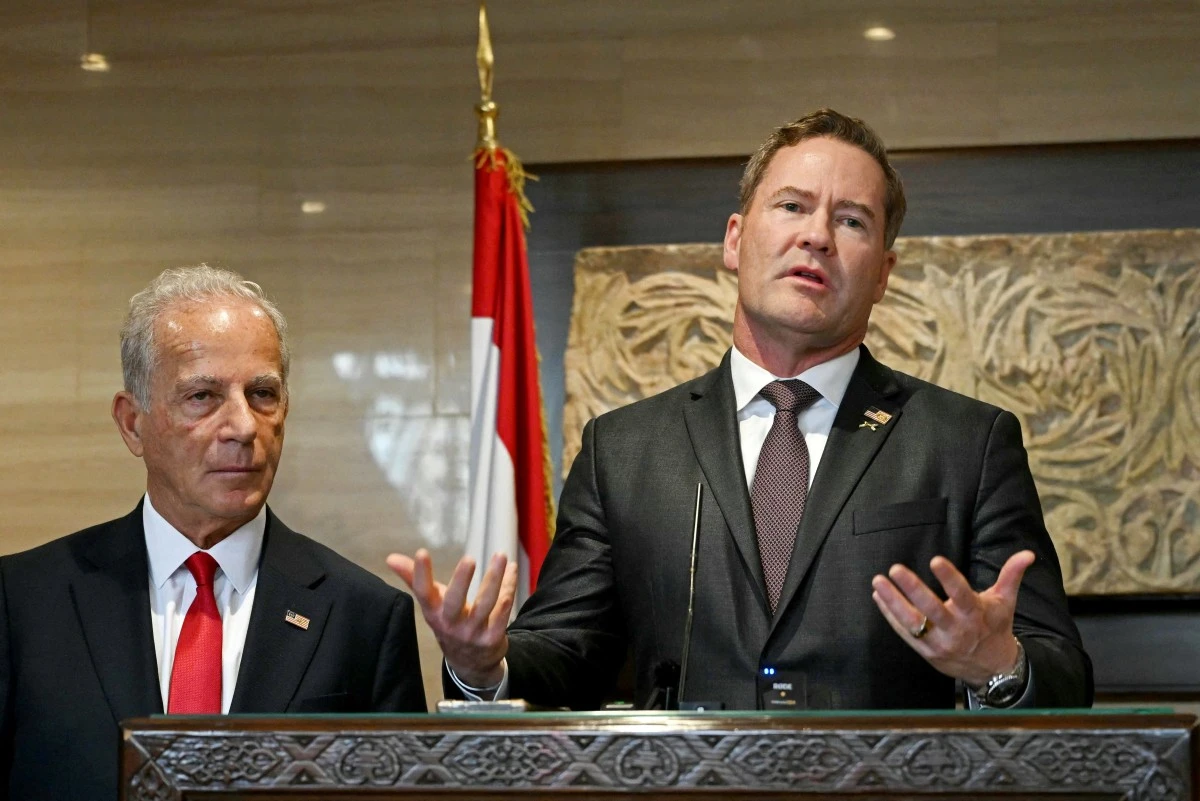
LONDON: Hezbollah should voluntarily surrender its weapons to the Lebanese state, US Ambassador to the UN Mike Waltz said on Monday during a visit focused on disarming the Iran-backed militant group and security arrangements for southern Lebanon after the UN peacekeeping force’s mandate ends in December.
“No country can have two armies,” Waltz told reporters in Beirut. “I hope and pray Hezbollah will disarm. They should do that voluntarily.”
Speaking after talks with Lebanese leaders, Waltz said the Lebanese armed forces would be central to restoring state authority, Agence France-Presse reported.
“I think the message should be loud and clear, that Lebanese sovereignty must be fully restored,” he said. “And the mechanism to do that will be the Lebanese armed forces.”
Hezbollah, which has fought successive wars with Israel, faces pressure to disarm. It was the only armed group that refused to surrender its weapons after Lebanon’s civil war ended in 1990.
Waltz praised Lebanese soldiers for their role in defending the country and described the effort to restore its sovereignty as “a unique opportunity in history.”
His visit also focused on security arrangements after the mandate of the UN peacekeeping force in southern Lebanon expires on Dec. 31.
Waltz said he discussed options for replacing the force and visited its headquarters in Naqoura, near the Israeli border.
Earlier on Monday, President Joseph Aoun and Waltz discussed plans for the south after the peacekeeping mission ends, the Lebanese presidency said. Their talks also covered continuing Israeli attacks and what the presidency described as Israel’s failure to comply with a US-mediated framework agreement signed in June.
Michel Issa, the US ambassador to Lebanon,and Simon Karam, a former diplomat who leads Lebanon’s delegation to tripartite negotiations, also attended.
Waltz separately met with Prime Minister Nawaf Salam at the Grand Serail and Parliament Speaker Nabih Berri at his Ain Al-Tineh residence in the capital, according to a statement by Berri’s media office.
The diplomatic discussions come as Lebanon prepares for the departure of the UN Interim Force in Lebanon, or UNIFIL, which has been deployed in the south since 1978.
The UN Security Council adopted Resolution 2790 on Aug. 28, 2025, extending the force’s mandate for a final time and providing for a gradual withdrawal during 2027.
Its mandate was significantly expanded under Security Council Resolution 1701, adopted in 2006, to include monitoring the cessation of hostilities, supporting the Lebanese army’s deployment south of the Litani River and reporting violations along the Blue Line separating Lebanon and Israel.
The planned withdrawal has raised questions about the Lebanese army’s ability to assume broader security responsibilities in the south and the international support it will receive once the peacekeepers leave.
Under the US-sponsored framework agreement signed in June, Israel is to withdraw gradually from occupied Lebanese territory as the Lebanese army deploys and takes responsibility for security.
Israel, however, continues to occupy parts of southern Lebanon, including territory it has held for decades and positions seized during the latest conflict. It has conditioned its withdrawal on Hezbollah’s disarmament.