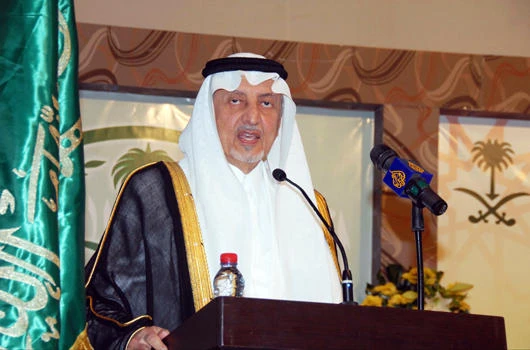
Makkah Gov. Prince Khaled Al-Faisal recently called for a final review of a study led by the King Abdulaziz University’s Research Unit to develop the historic Ain Zubaida site.
The prince also called for the review to be complete within a week for swift implementation.
The study was carried out by a team from King Abdulaziz University and included the undersecretary of the Makkah region and representatives from the Ministries of Finance, Water, Electricity and Islamic Affairs.
Ain Zubaida, considered one of the Hijaz’s historical wonders, is a traditional “qanat,” or water channel, that was built to provide reliable supplies of water to Haj sites and the city of Makkah. Ain Zubaida was commissioned by Zubaida Al-Abbasi, the philanthropic wife of the Abbasid Caliph Haroon Al-Rasheed in the eighth century.
The project to renovate the qanat was commissioned by Custodian of the Two Holy Mosques King Abdullah. Prince Khaled also spent time listening to a report by the University’s Research Unit on developing the system and establishing a strategic reservoir to supply water to Makkah and the holy sites during emergencies.
The report also stated that the recommendations of 13 official parties must be taken into account. These recommendations include the setting up of a nature reserve in Wadi Numan and protecting the plain of Arafat, Umm Al-Qura University and other nearby residential areas.
A masterpiece of engineering, Ain Zubaida was completed in 801 AD to provide a permanent water supply for the pilgrims and residents of Makkah. The project took ten years to complete and was 38 km in length, stretching from Wadi Numan to the present day Al-Aziziyyah district of Makkah.
Only estimates remain as to the cost, which is estimated in the region of 1.7 million dinars. At that time, one dinar was equivalent to ten grams of 24-karat gold. The spring remained a major source of water for Makkah and its holy sites for 1,200 years and is fondly remembered as a masterpiece of engineering and an enduring symbol of the golden era of Arab culture.
Qanats were constructed across the Islamic world to deliver large quantities of water to the surface without a need for pumping; they were also used to transport water over long distances in hot climates.
Queen Zubaydah commissioned two qanats for the water supply to Makkah. One was from Wadi Hunayn and the other from Wadi Numan, 10 km southeast of Arafat.
By the 1950s, modern pumping and increased consumption eventually depleted the well at the source.
Ain Zubaida passes from Wadi Numan through the plain of Arafat and along the hills of Muzdalifah. The qanat stands 10 feet above the ground at Jabal Al-Rahmah.
Alongside the main qanat, an additional channel was made forming a water tank for a “sabil,” or drinking fountain, the remains of which still exist at the foot of Jabal Al-Rahmah. Three tanks were built at Jabal Al-Rahmah and would be filled with fresh water during the Haj season for the use of pilgrims.
Makkah governor orders development of Ain Zubaida