

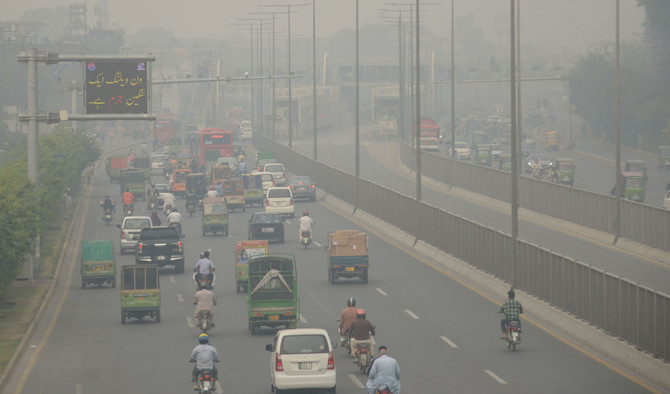
LAHORE: Analyzing the factors responsible for the worsening air quality in Lahore, the Punjab government acknowledged on Monday that traffic, disposal of solid waste and burning of crop residue by neighboring India were some of the reasons for the manifold increase in pollution levels in the province.
“The current situation clearly reflects that transboundary air pollution is contributing to the smog phenomenon in Punjab. Few scattered stubble burnings were visible in some patches of certain districts. However, India’s Punjab is massively involved in it,” Muhammad Riaz, Chief Meteorologist of Punjab said, adding that the phenomenon would continue for a few more days causing “visibility limits to go down and making it difficult for commuters”.
Riaz said that the burning of stubble or crop residue by India had not only affected the climate in New Delhi and its neighboring states of Haryana and Uttar Pradesh, but it had also impacted daily life in major areas of the Punjab province as well.
Worst among these is the city of Lahore which has been suffering from smog-related issues for the past three years, with a World Health Organization report estimating that nearly 60,000 Pakistanis died from exposure to advanced levels of fine particulate matter (PM 2.5) in 2015 alone.
The highly-toxic smog – a mixture of smoke and fog — is not a natural phenomenon and is caused by pollutants containing nitrogen oxide, carbon monoxide, sulfur dioxide, and other aerosols that are hazardous to human health and known to have an adverse impact on the lungs, eyes, and nose.
Since enveloping several major cities of Pakistan from mid-October, the smog had subsided considerably due to rainfall on Sunday, only to return denser than before. In the first week of November alone, seven people were reported dead and 37 injured due to poor visibility on the roads.
Other issues included worsening health conditions among residents, particularly children. “The smog is also becoming a cause for children to miss school. On an average, nearly five children are calling in sick and missing their classes because of health issues,” Samina Sayed, a government school teacher told Arab News.
Data collected by the Directorate General of Health in Punjab showed that, last month, 16,000 patients were admitted to hospitals across the province for smog-related health issues, with more than 150 patients visiting the facilities every day to get medical attention.
Punjab’s Environmental Protection Agency (EPA) added that while the rate of pollution is worsening by the day, it hasn’t reached alarming levels yet. “Smog has increased the air pollution level. It is unhealthy but not at an alarming stage yet,” Misbah Lodhi, Deputy Director of EPA Punjab, told Arab News.
The government, on its part, has taken various steps to control the pollution, with more than 260 brick kiln workers asked to discontinue the practice for two months. The recommendation was made by the Smog Control Body which was established on the orders of the Lahore High Court. Seeking a permanent solution to the issue, the Punjab government has also initiated a project to modernize brick kilns in the province and is in the process of convincing owners to stop using kilns based on indigenous methods.
“The zig-zag technology not only reduces the production cost of bricks as well as the fuel charges but it also helps control air pollution, as 70 to 80 percent emissions can be reduced through this method,” Nasimur Rehman Shah, Director of EPA Punjab, said.
Punjab chokes as cross-border pollution worsens air quality
Special
")

Special
")

Special
")
Punjab chokes as cross-border pollution worsens air quality
- Government says burning of crops main reason for smog in the province
- Initiates measures to curb the issue as several bear the brunt in major cities





