



KARACHI: The outbreak of COVID-19 pandemic has adversely affected Pakistan’s economy as the country’s growth rate is projected to shrink to negative 0.38 percent and fiscal deficit is likely to surge by 9.2 percent in FY20, Special Assistant to Prime Minister on Finance and Revenue Dr. Abdul Hafeez Shaikh said on Thursday while unveiling the report card of his government in 2019-20.
The economic growth of the South Asian nation is projected to contract for the first time in 68 years against the target of 4 percent. Last time, such shrinkage was recorded in 1952.
“The GDP [Gross Domestic Product] growth for the current fiscal year is estimated to be negative 0.38 percent mainly due to the sluggish growth of major sectors. The agriculture sector posted 2.67 percent growth, industries minus 2.64 percent, services minus 0.59 percent, transport and communication minus 7.1 percent and manufacturing minus 22.9 percent,” he said while unveiling the Pakistan Economic Survey 2019-20 in Islamabad.
However, Shaikh said the deficit was manageable during the first nine months of the current fiscal year.
“The fiscal deficit was still manageable at 4 percent of the GDP from July-March 2020 as compared to last year’s 5.1 percent,” he noted.
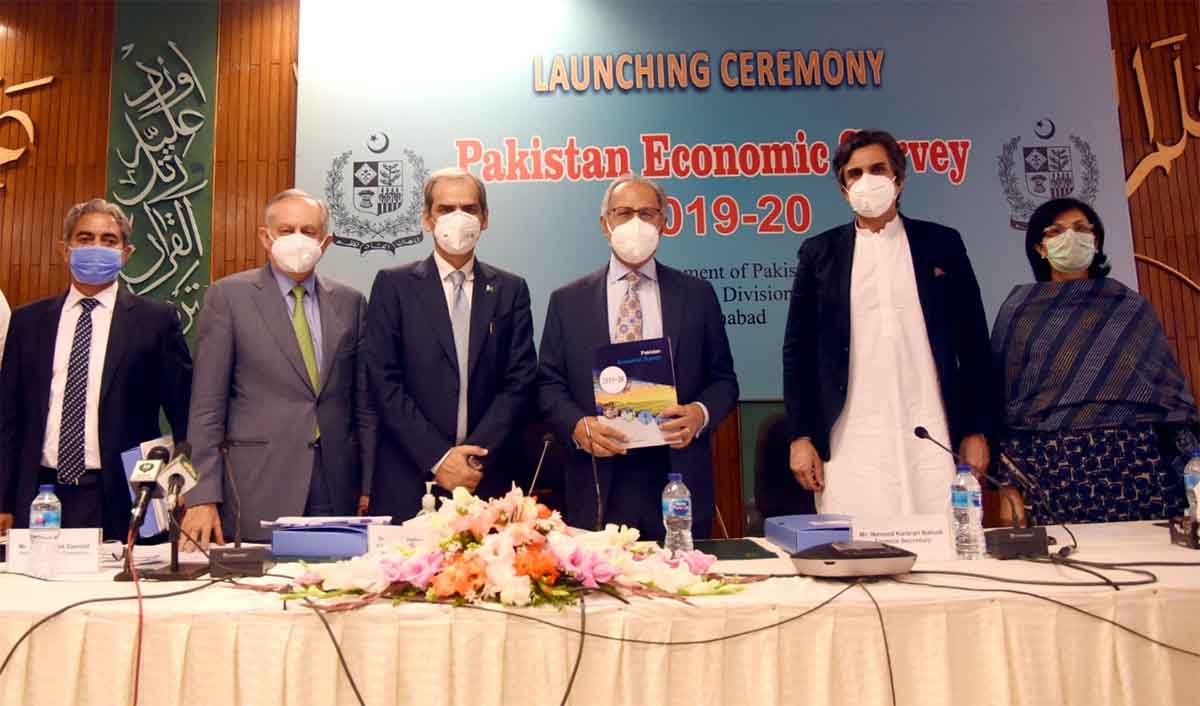
Adviser to the Prime Minister on Finance and Revenue Dr. Abdul Hafeez Shaikh can be seen in this picture with Abdul Razaq Dawood, Khusro Bakhtiar and Dr. Sania Nishter, among others, after launching the Pakistan Economic Survey 2019-20 in Islamabad on June 11, 2020. (Photo courtesy: Ministry of Finance)
Pakistan had set a target of Rs 5.5 trillion in revenue collection which was revised to Rs 3.9 trillion in view of the economic slowdown caused by the pandemic. “The aforementioned revision had thus forecast a revenue loss of Rs 899 billion. The actual shortfall is expected to be higher than what has been projected,” according to the survey document
However, Shaikh said the overall tax collection by the Federal Board of Revenue (FBR) increased by 10.8 percent to Rs 3.3 trillion during July-April 2020 against Rs 2.98 trillion during the same period last year. “The tax collection increased due to the policy initiatives taken by the present government,” he added.
However, he conceded that the tax target was “aspirational,” saying the government would not try to achieve it aggressively during the ongoing health crisis.
Shaikh said the government was cautious while opening the purse strings that resulted in primary surplus, implying that state expenditures were lower than income. “This was the first time in the country’s history that primary balance went into surplus,” Shaikh said.
Pakistan’s current account deficit squeezed by a massive 73.1 percent during the July-March FY2020, to $2.8 billion (or 1.1 percent of the GDP) against $10.3 billion last year (or 3.7 percent of the GDP) mainly due to the reduction in trade deficit by 31.0 percent to $14.7 billion, according to the survey.
Shaikh along with ministers and other government functionaries outlined the performance of the current administration in the outgoing fiscal year and stressed that it was doing its best to provide maximum relief to people.
“Despite a small budget, we doubled the allocation for the Ehsaas Program (Rs 142 billion) and money is being distributed among some 15 million people without political, racial or religious considerations,”, he noted.
Pakistan is projecting positive 2.3 percent for the next fiscal year 2020-21, though international financial institutions, including the World Bank, have predicted the growth rate to remain in the negative and be somewhere near 0.2 percent of the GDP in fiscal year 2020-21.





