RIYADH, 20 October 2003 — The 25th anniversary celebrations of Asharq Al-Awsat newspaper brought a galaxy of media stars together here last night — the old and the new, the pioneers and those now at the helm steering the Arab media into the future.
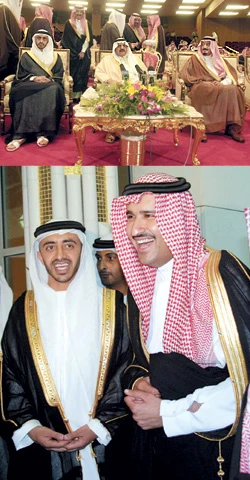
The function kicked off with Interior Minister Prince Naif and Riyadh Governor Prince Salman heading the crowd of distinguished guests.
On July 4, 1978, the first issue of the pan-Arab newspaper Asharq Al-Awsat was published, realizing the vision of its founders Hisham and Muhammad Ali Hafiz. Twenty-five years later, Asharq Al-Awsat goes from strength to strength. It continues to face challenges both on the regional and international levels, and remains perhaps the only international Arab newspaper that links all Arabs in the world.
The media has witnessed tremendous growth in the Arab world over the past two decades, with several Arabic news channels working around the clock; and the information revolution means that anyone now has access to the Internet for up-to-date news.
Competition also comes from the local market, as many regional newspapers adopted modern tools to improve their news coverage. But despite all this fierce competition, Asharq Al-Awsat has maintained its distribution rates and continues to be a reliable source of news for millions of readers in the Arab world.
Some of the reasons have to do with leadership, others with the recruitment of professional staff, the use of modern technology in publishing and printing, offering more than opinion, improving the page layout, and using reliable sources in all stories.
What makes Asharq Al-Awsat stand out is its ability to send its reporters out wherever news is being made. The newspaper’s bureaus are established in almost every major Arab country and beyond.
Another reason why Asharq Al-Awsat continues to shine is its opinion page and op-ed writers. Since the newspaper started, one of its policies has been to offer the reader a diverse range of opinion from prominent writers in the Arab world. Another specialty of Asharq Al-Awsat is its special print editions. The first special edition was printed at 4 p.m. GMT on Sept.11, 2001, a few hours after the terrorist attacks, and showed that Asharq Al-Awsat was faster at reaching the newsstands than other Arab publications.
The newspaper went online in 1995. On Aug. 10, 2000 the full version of Asharq Al-Awsat became available on the Net, and it now enables readers to access the different editions printed in Morocco, Saudi Arabia and Egypt. It also enables browsers to receive news from the wire agency Agence France Presse on the website just as their editors do.
Interior Minister Prince Naif in his speech last night congratulated Asharq Al-Awsat on its silver jubilee and commended the Arabic daily’s role in defending Arab and Islamic causes in the face of a strident foreign smear campaign. The prince reminded writers and journalists of their responsibility. “Those involved in media activities should be honest in words, should protect their reputation and defend their nation,” he explained.
“I would like to congratulate Asharq Al-Awsat newspaper on its 25th anniversary and I have the pleasure in joining your celebrations,” Prince Naif said.
During the ceremony, it was announced that Asharq Al-Awsat will be printing in Gaza, Palestine, in addition to Baghdad.
Prince Naif said the Kingdom’s public media had a humble beginning and commended the progress achieved by Saudi media over past years. “It has now become a powerful media,” he said, adding that Asharq Al-Awsat is an example for a good Saudi media having an Islamic identity and focusing on Arab issues and causes.
The prince said Asharq Al-Awsat is a newspaper with a mission. “It competes with others to find a better position in the fields of confrontation to defend the Islamic and Arab identity in the face of a flood of foreign media misinformation,” he said.
The minister said that confrontation was the best way to ward off the danger posed by the foreign media campaign. He also highlighted the importance of the pen in spreading knowledge and information. At the same time, he cautioned writers against making mistakes. “Words are capable of killing individuals,” he added.
Prince Naif said the press is not a field of competition to take control of news, information and entertainment. “Rather, it is a responsible mission and it should be done with freedom controlled by values. Press should reflect the qualities of man behind it, in terms of values and morals.”
Prince Naif honored the former editors in chief of the paper, Jihad Khazen (who served the daily from 1978 to 1980), Muhammad Al-Shibani (1980-82), Erfan Nizamuddin (1982-87), and Othman Al-Omair (1987-98), as well as the current editor in chief Abdul Rahman Al-Rashid, who took over the post in 1998.
The prince also honored the late Mahmoud Kahil as the best cartoonist in the past 25 years, and a member of Kahil’s family received an award on his behalf. Three employees who have served the company more than 25 years — Farook Luqman, editor in chief of Malayalam News; Al-Taher Al-Sayyed Khaleel of the finance department; and Muhammad Laik Azimuddin in the production and archives department — were also honored.
Earlier Prince Faisal ibn Salman, chairman of the Saudi Research and Marketing Group, which publishes Arab News, emphasized the role of the media in shaping the way people see and understand the contemporary world.
“The world stands at a crossroads and is being constantly shaped by great events. Major changes are taking place in politics and the economy, but the greatest change the world has ever witnessed is the one in information and communication technology,” he said.
“The information we receive through the media is not just a direct transmission of events taking place around us but an industry that brings the world to us through television, the print media and the radio. “The role of the media is not to describe what is happening on the ground but to actively contribute to shaping this reality. It provides us with an understanding of events and helps us better understand modern life.”
The prince offered a brief summary of the history of the group, and said its publications continued to “constantly upgrade its technical capabilities and invest in human resources to attain the highest standards of professionalism and journalistic credibility. The ultimate goal is winning the readers’ trust, since the whole process is based on trust.
“The company’s policy is governed by the basic principles on which this country is built; namely tolerance and acceptance of others regardless of our differences with them,” he said.
Prince Faisal said Asharq Al-Awsat prided itself on being a paper that accommodates all opinions. “We worked over the past 25 years to translate the motto into reality. In terms of content, the paper has given prominence to the news and opinions that concern all the Arabs wherever they are. This means attracting leading writers, reporters and editors from all over the Arab world.”
The prince said the communication revolution was an opportunity rather than a threat to newspapers worldwide.
“Some may think that the information revolution as evident in satellite channels and the Internet poses a threat to the print media and could even lead to the demise of newspapers. They may ask us to be a little cautious before launching new publications.
“But the reality is that with the growing use of the Internet, book sales -- let alone newspapers - have not been affected. Properly utilized, satellite television and the Internet can help boost newspaper circulation,” he said.
But he said the paper’s “first priority remains the building of modern human beings armed with knowledge, whom we train and whose skills we develop so they can compete in the information market. The Saudi Research and Publishing Company (SRPC) is now a unique school of journalism where many from all over the Arab world have graduated. No matter where they settle, they will continue to be held in high regard and remain loyal to this company.”
The prince said the project did not come out of nowhere.
“SRPC, which was set up in 1987, was the result of a collective and concerted effort that involved people with vision and foresight. My late brother, Prince Ahmad, was actively involved in building this great media edifice, and was joined by Hisham and Muhammad Ali Hafez who through their professionalism were able to establish and develop the group. They must be thanked and commended for their efforts. Hundreds of others also contributed to the building of this group, and our thanks go to them too.”