DUBAI: Artificial intelligence is a big topic of discussion at this year’s annual meeting of the World Economic Forum in Davos, which is being held under the central theme of “Collaboration for the Intelligent Age.”
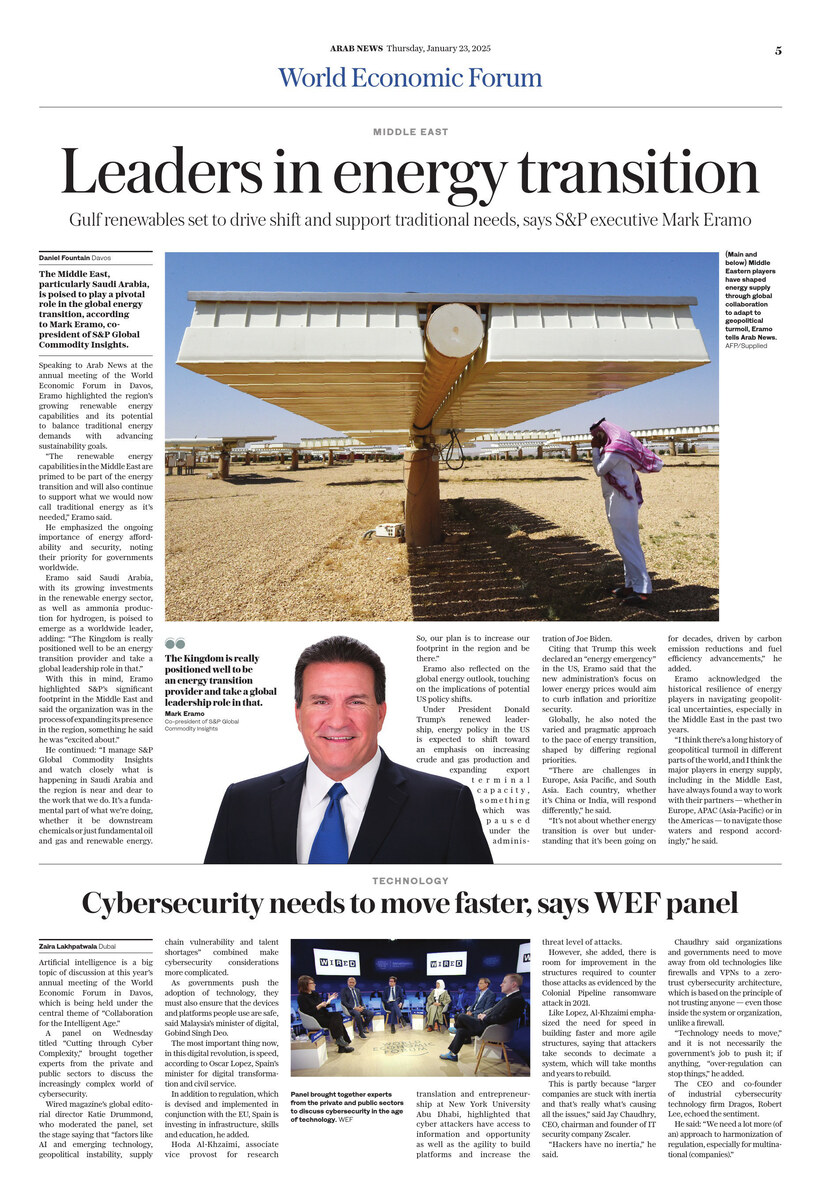
A panel on Wednesday titled “Cutting through Cyber Complexity,” brought together experts from the private and public sectors to discuss the increasingly complex world of cybersecurity in an age dominated by technology.
Wired magazine’s global editorial director Katie Drummond, who moderated the panel, set the stage saying that “factors like AI and emerging technology, geopolitical instability, supply chain vulnerability and talent shortages” combined make cybersecurity considerations more complicated, potentially “exacerbating inequity across the board.”
As governments push the adoption of technology, they must also ensure that the devices and platforms people use are safe, said Malaysia’s minister of digital, Gobind Singh Deo.
Last year, for example, Malaysia implemented the Cyber Security Act, establishing regulatory standards for the country’s cyber defenses, amended its data protection laws and introduced data-sharing legislation, he said.
The most important thing now, in this digital revolution, is speed, according to Oscar Lopez, Spain’s minister for digital transformation and civil service.
In addition to regulation, which is devised and implemented in conjunction with the EU, Spain is investing in infrastructure, skills and education, he added.
With 66 percent of organizations being concerned about AI’s impact on cybersecurity, according to WEF’s latest “Global Security Outlook” report, there is an urgent need for governments and businesses to build systems to counter cyberattacks.
Hoda Al-Khzaimi, associate vice provost for research translation and entrepreneurship at New York University Abu Dhabi, highlighted that cyber attackers have access to information and opportunity as well as the agility to build platforms and increase the threat level of attacks.
However, she added, there is room for improvement in the structures required to counter those attacks as evidenced by the Colonial Pipeline ransomware attack in 2021.
Like Lopez, Al-Khzaimi emphasized the need for speed in building faster and more agile structures, saying that attackers take seconds to decimate a system, which will take months and years to rebuild.
This is partly because “larger companies are stuck with inertia and that’s really what’s causing all the issues,” said Jay Chaudhry, CEO, chairman and founder of IT security company Zscaler.
“Hackers have no inertia,” he said.
Chaudhry said organizations and governments need to move away from old technologies like firewalls and VPNs to a zero-trust cybersecurity architecture, which is based on the principle of not trusting anyone — even those inside the system or organization, unlike a firewall.
“Technology needs to move,” and it is not necessarily the government’s job to push it; if anything, “over-regulation can stop things,” he added.
The CEO and co-founder of industrial cybersecurity technology firm Dragos, Robert Lee, echoed the sentiment.
He said: “We need a lot more (of an) approach to harmonization of regulation, especially for multinational (companies).”
Lee also presented an alternate view to the adoption of emerging technologies and automation, highlighting the perils of digitization.
“Some of these private companies are so excited to take that automation journey … that they really don’t understand some of the systems they’re putting in place,” he said.
“This means that when something goes wrong, it’s difficult, if not impossible, to pinpoint the cause if the company hasn’t invested in the right systems ahead of time,” he added.
Lee said that there is a lot of conversation around “the next big thing” and AI, but “you have no idea how little is being done correctly. The basics do work. It’s just (that) a lot of companies aren’t doing the basics.”