Gaza aid flotilla departs Barcelona again: AFP journalists

Gaza aid flotilla departs Barcelona again: AFP journalists
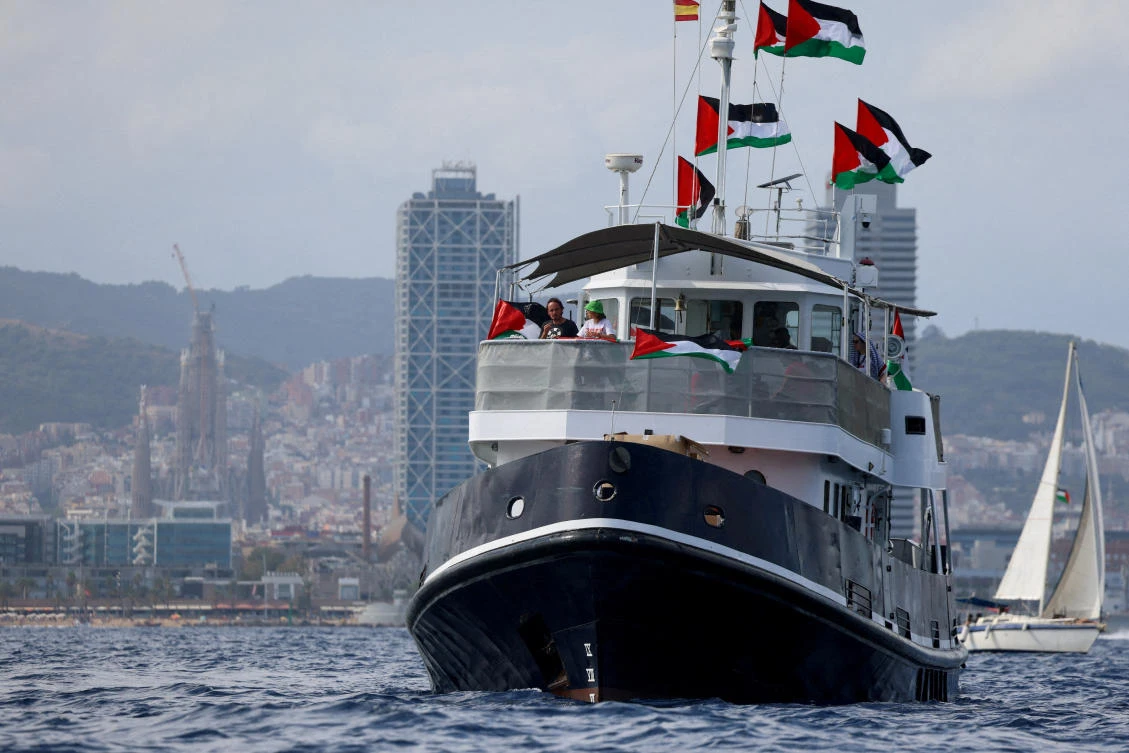
The flotilla is the largest attempt yet to break the Israeli blockade of the Palestinian territory by sea. (Reuters)
Short Url
Updated 01 September 2025
Follow

Gaza aid flotilla departs Barcelona again: AFP journalists

Gaza aid flotilla departs Barcelona again: AFP journalists
  • Around 20 vessels left the Spanish city on Sunday aiming to “open a humanitarian corridor and end the ongoing genocide of the Palestinian people”
  • But “due to unsafe weather conditions,” the flotilla returned to port “to allow the storm to pass,” the organization said

BARCELONA: A Gaza-bound flotilla carrying humanitarian aid and pro-Palestinian activists including environmental campaigner Greta Thunberg departed Barcelona again on Monday, several hours after winds forced it to return to the Spanish port, according to AFP journalists at the scene.
Around 20 vessels left the Spanish city on Sunday aiming to “open a humanitarian corridor and end the ongoing genocide of the Palestinian people” amid the Israel-Hamas war, said the Global Sumud Flotilla — sumud being the Arabic term for “resilience.”
But “due to unsafe weather conditions,” the flotilla returned to port “to allow the storm to pass,” the organization said in an earlier statement, without specifying when exactly the boats returned to Barcelona.
“We made this decision to prioritize the safety and well-being of all participants and to safeguard the success of our mission,” it added, citing gusts that exceeded 55 kilometers (34 miles) per hour.
Organizers said they were especially concerned about the risk the weather posed to the smaller boats.
Spain’s national weather agency AEMET had issued warnings of rainfall and strong storms for the northeastern region of Catalonia which includes Barcelona.
The activists from dozens of countries included Thunberg, Irish actor Liam Cunningham and Spain’s Eduard Fernandez, as well as European lawmakers and public figures, including former Barcelona mayor Ada Colau.
The flotilla is expected to arrive in Gaza in mid-September and comes after Israel blocked two activist attempts to deliver aid to the devastated Palestinian territory by ship in June and July.
The United Nations has declared a famine in Gaza, warning that 500,000 people face “catastrophic” conditions.
The war was triggered by an unprecedented cross-border attack on Israel by Palestinian militant group Hamas on October 7, 2023, which resulted in the death of 1,219 people, mainly civilians, according to an AFP tally based on official data.
Palestinian militants also seized 251 hostages, with 47 still held in Gaza, including 25 the Israeli army says are dead.
Israel’s retaliatory offensive has killed at least 63,459 Palestinians, mostly civilians, according to figures from Gaza’s Hamas-run health ministry which the UN considers reliable.
In Sudan, satellite images uncover atrocities in El-Fasher

In Sudan, satellite images uncover atrocities in El-Fasher
Updated 05 November 2025
Follow

In Sudan, satellite images uncover atrocities in El-Fasher

In Sudan, satellite images uncover atrocities in El-Fasher
  • Yale University’s Humanitarian Research Lab says the images are the only way to monitor the crisis in North Darfur's capital
  • Close-up aerial shots show evidence of door-to-door killings and mass graves

CAIRO: Satellite images from Sudan have played a crucial role in uncovering the atrocities committed during paramilitaries’ takeover of the last army stronghold in the western Darfur region.
In an interview with AFP, Nathaniel Raymond of Yale University’s Humanitarian Research Lab (HRL) said the aerial images were the only way to monitor the crisis unfolding on the ground in the city of El-Fasher, the capital of North Darfur.
On October 26, the paramilitary Rapid Support Forces (RSF), which have been fighting a brutal war with Sudan’s army for more than two years, claimed full control of the city they had besieged for nearly 18 months.
Close-up satellite images have emerged showing evidence of door-to-door killings, mass graves, red patches and bodies visible along an earthen berm — findings consistent with eyewitness accounts.


On October 28, HRL published footage from El-Fasher’s maternity hospital showing “piles of white objects” that were not present before and measured between “1.1 to 1.9 meters” (3.6 to 6.2 feet) — roughly the size of human bodies lying down or with limbs bent.
It said there were “reddish earth discolorations” on the ground nearby that could have been blood.
The following day, the World Health Organization announced the “tragic killing of more than 460 patients and medical staff” at the hospital.
The images released by HRL, which had been tracking the situation in El-Fasher throughout the siege, became “a spark plug for public outrage,” said Raymond.

‘Highest volume’

Since the start of the siege, HRL has been alerting the United Nations and the United States to developments on the ground, with its reports becoming a reference point for tracking territorial advances in the area.
Population movements, attacks, drone strikes and mass killings have been closely monitored in the city, where access remains blocked despite repeated calls to open humanitarian corridors.
Satellite imagery has become an indispensable tool for non-governmental organizations and journalists in regions where access is difficult or impossible — including Gaza, Ukraine and Sudan.
Several companies specializing in satellite imaging scan the globe daily, hindered only by weather conditions. Depending on the sensors onboard, satellites can clearly distinguish buildings, vehicles and even crowds.
HRL then cross-references the images with other material including online footage, social media and local news reports, according to Yale’s published methodology.
Raymond said that after El-Fasher’s fall paramilitaries “started posting videos of themselves killing people at the highest volume they ever had,” providing more material for analysis.
The team cross-checked these videos with the limited available information to identify, date and geolocate acts of violence using satellite imagery.
Raymond said the lab’s mission is to raise the alarm about the atrocities and collect evidence to ensure the perpetrators of war crimes do not escape justice.
He referenced similar aerial images taken after the 1995 Srebrenica massacre, which eventually helped bring charges against former Bosnian Serb military leader Ratko Mladic.
An international tribunal sentenced him to life imprisonment for war crimes and genocide.

Grim task ahead

The images from El-Fasher have triggered international outcry.
The prosecutor’s office at the International Criminal Court said on Monday that the atrocities there could amount to crimes against humanity and war crimes.
The public outrage was followed by a significant reduction in the amount of footage posted by paramilitaries on the ground, according to the HRL.
Of the videos still being shared, “very few, if any, have metadata in them,” said Raymond, who noted that the researchers had to count the bodies themselves.
He said they were not counting individual remains but tagging piles of bodies and measuring them as they get bigger.
He added, however, that the researchers’ workload has not decreased with the reduction in videos. Instead, they are now focusing on the grim task of tracing “the perpetrator’s transition from killing phase to disposal.”
“Are they going to do trenches? Are they going to light them on fire? Are they going to try to put them in the water?“