- Damascus commits to elections, international cooperation
- Syria requires major economic support, says Ibrahim Olabi
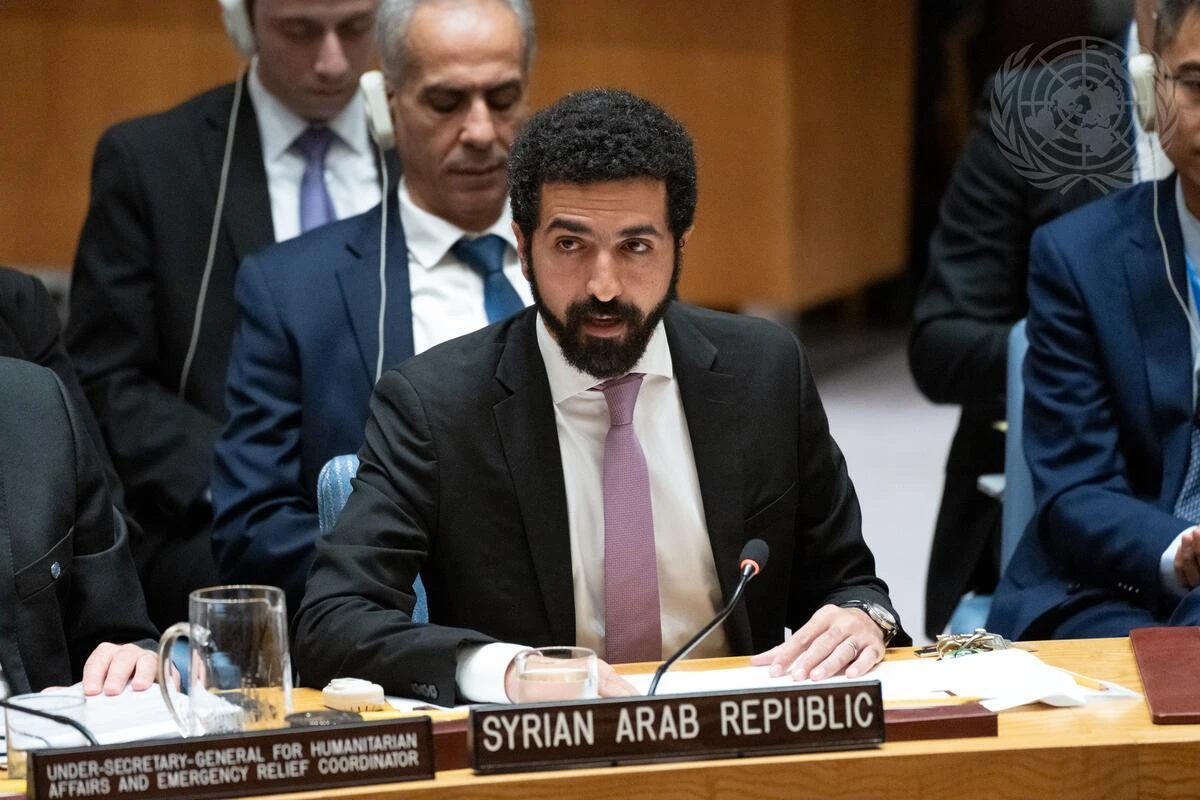
NEW YORK: The Syrian Arab Republic’s new Permanent Representative to the UN Ibrahim Olabi pledged to “turn hope into action” in a landmark address to the Security Council on Thursday, signaling what he described as a historic shift in the country’s approach to diplomacy, accountability, and national reconciliation.
Delivering his first remarks since assuming the post on Sept. 11, the 34-year-old British-German lawyer and human rights advocate, acknowledged international calls for justice and reform.
He vowed that Syria would “add to hope, action,” and work to restore unity and stability in a country ravaged by over a decade of war amidst the fall of the previous regime.
“Less than a year ago, a young Syrian woman sat at this very table speaking out against tyranny. Today, I stand before you as a representative of a new Syria — a Syria committed to freedom, dignity, and justice,” Olabi said.
Much of Olabi’s statement focused on recent unrest in Suwayda, a southern governorate that has seen mass protests and violent crackdowns in recent months.
He told council members that the Syrian government had adopted a comprehensive roadmap for resolving the crisis, developed during a tripartite meeting in Damascus with the US and Jordan.
The plan includes an official request for an investigation by the UN’s Independent International Commission of Inquiry on Syria and a commitment to hold accountable all perpetrators of violence, regardless of affiliation.
Olabi noted that suspects from the Ministry of Defense and Interior had already been arrested and that the government had taken “unprecedented steps” to cooperate with international investigators.
“The families of the victims should feel that justice was truly served,” he said, promising that the process would be inclusive and transparent.
The roadmap, according to Olabi, also envisions the creation of a local police force representative of Suwayda’s diverse population, reconstruction of destroyed areas, delivery of humanitarian assistance, and a campaign to promote national unity and counter extremism.
Olabi outlined what he called a “new political reality” in Syria, following the “liberation of the country from oppression” and the preservation of state institutions. He announced that Syria would soon hold the first elections “in decades” based on a genuine separation of powers.
“These elections will be a genuine opportunity for all Syrian men and women to participate in drafting the future of the country,” he said, promising a minimum of 20 percent representation for women on candidate lists and allowing international observers to monitor the vote.
Olabi said the electoral process would be carried out under judicial and media supervision, with oversight agreements already signed between the High Electoral Commission and civil society organizations.
In addition to political reforms, Olabi emphasized Syria’s efforts to revive its economy through agreements with foreign governments and international companies. He pointed to global partnerships and community-led initiatives from the Syrian diaspora aimed at supporting the country’s recovery.
However, he lamented what he called the international community’s “insufficient” support at both the humanitarian and developmental levels.
He urged member states to fulfill their pledges to the UN’s humanitarian response plan and warned that Syria is facing its worst drought in three decades, threatening food and water security.
“We need a quantum leap in international engagement to meet the scale of our challenges,” he said.
Olabi also condemned recent Israeli airstrikes in Syria and called on the UN Security Council to take urgent action. He accused Israel of expanding its operations in Syrian territory, particularly in the occupied Golan Heights, and cited relevant UN resolutions demanding Israeli withdrawal.
Olabi concluded his remarks with a sweeping vision for Syria’s future, one centered on inclusivity, sovereignty, and civil peace.
“Damascus, the heart of Syria, will continue to bring together all Syrian men and women,” he said. “They stand today united, looking towards the future, rejecting terrorism, hate speech, and extremism — turning the page on suffering and pain.”