‘We live with the dead’: Displaced Gazans shelter in cemetery

‘We live with the dead’: Displaced Gazans shelter in cemetery
1 / 2
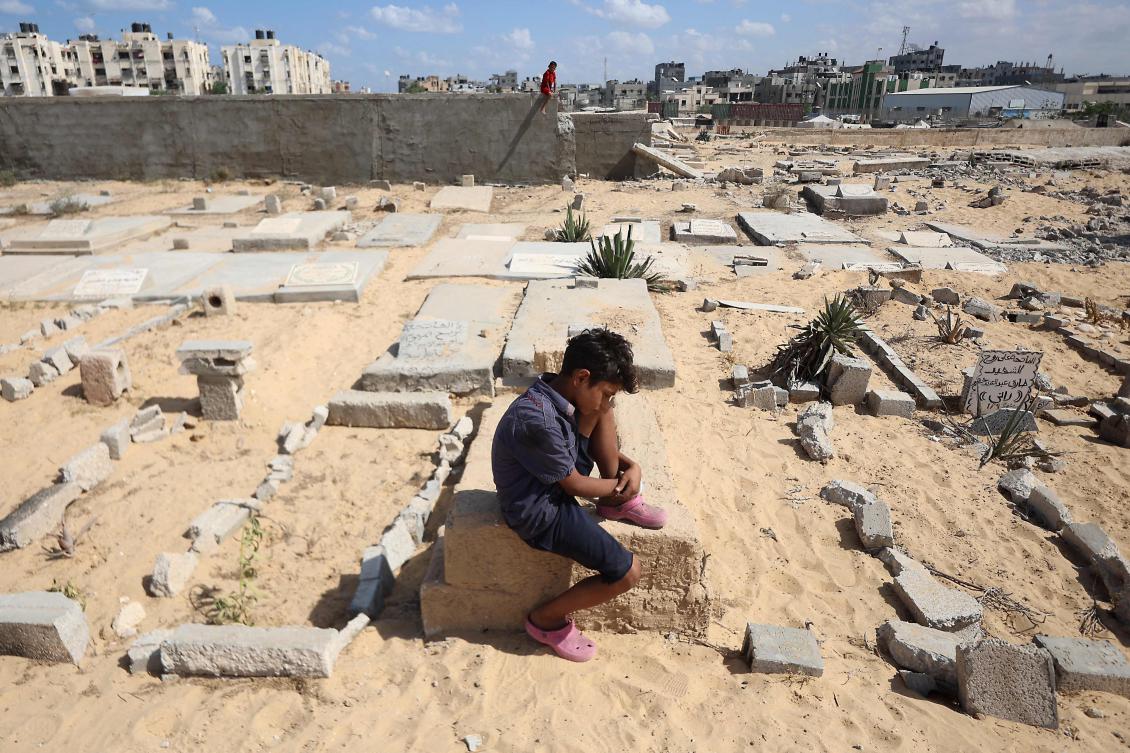
A boy sits on top of a tomb as displaced Palestinians set up temporary camp in the grounds of a cemetary in Khan Yunis in the southern Gaza Strip, on Sept. 25, 2025. (AFP)
‘We live with the dead’: Displaced Gazans shelter in cemetery
2 / 2
Randa Musleh, 44, sit with her children at a tent set up at temporary camp in the grounds of a cemetary in Khan Yunis in the southern Gaza Strip, on Sept. 25, 2025. (AFP)
Short Url
Updated 25 September 2025
Follow

‘We live with the dead’: Displaced Gazans shelter in cemetery

‘We live with the dead’: Displaced Gazans shelter in cemetery
  • “We had no other choice,” said Randa Musleh from inside her tent, drinking tea along with some of her 11 children
  • “People told us that we wouldn’t have to pay here, between the desert and the cemetery”

KHAN YUNIS, Palestinian Territories: Three children play with sand and pebbles among the tombstones in a southern Gaza cemetery, while a teenage boy, barefoot, carries two buckets of water through the graveyard before vanishing into a tent.
These macabre scenes are a daily reality for some displaced Palestinians, who, unable to find shelter elsewhere, have resorted to pitching tents in a cemetery in Khan Yunis, in the southern Gaza Strip.
“We had no other choice,” said Randa Musleh from inside her tent, drinking tea along with some of her 11 children.
She told AFP landlords “were asking for high sums of money.”
A relatively small patch of land covering 50 square meters (540 square feet) can cost as must as 1,000 shekels ($300) a month, Musleh said — a prohibitive sum for most Gazans.
She fled to Khan Yunis with her children when Israeli military operations intensified near their home in Beit Hanun, in Gaza’s north.
“I walked and walked until I found land for my children in a livable place... People told us that we wouldn’t have to pay here, between the desert and the cemetery,” she said.
“So, we set up tents and stayed here.”
As the Israeli army presses its offensive inside Gaza City, growing numbers of residents have fled south in recent days, scrambling to find space in an already overcrowded area where hundreds of thousands are sheltering.
On Thursday, the Israeli army said 700,000 people had left Gaza City, the territory’s largest urban center.
Israel says it seeks to dismantle remaining Hamas groupings in one of the last strongholds of the militant group, whose October 2023 attack triggered the war.
The UN humanitarian agency OCHA reported a lower figure, saying 388,400 people have been displaced from Gaza’s north since mid-August, most of them from Gaza City.
With demand for transportation and shelter soaring, prices have skyrocketed. According to UN data, families may be charged over $3,000 for transport, a tent and land space.
Many cannot afford these costs and are forced to travel on foot, setting up tents wherever space is available.
Living conditions are often dire.
“There is no water here, and my children walk about four kilometers (2.5 miles)” to get water, said Musleh.
“And we are in the desert — there are scorpions and snakes.”
The proximity to graves adds to the families’ distress.
“We are in the middle of the cemetery, and we find no life,” said Umm Muhammad Abu Shahla, who evacuated from the northern town of Beit Lahia.
“We live with the dead and our condition has become like that of the dead,” she told AFP.
To Abu Shahla, there is little hope after nearly two years of war.
“Let them bomb us with a nuclear missile on the entire Gaza Strip so that we can rest,” she said.

Tunisian opponents go on collective hunger strike to support jailed figure

Tunisian opponents go on collective hunger strike to support jailed figure
Updated 58 min 2 sec ago
Follow

Tunisian opponents go on collective hunger strike to support jailed figure

Tunisian opponents go on collective hunger strike to support jailed figure
  • Ben Mbarek launched a hunger strike last week to protest his detention since February 2023
  • Hazgui said “the family would also launch a hunger strike beginning tomorrow“

TUNIS: Prominent Tunisian opposition figures including Rached Ghannouchi said Friday they would go on hunger strike in solidarity with a jailed politician whose health they say has severely deteriorated after nine days without food.
Jawhar Ben Mbarek, co-founder of the National Salvation Front, Tunisia’s main opposition alliance, launched a hunger strike last week to protest his detention since February 2023.
In April, he was sentenced to 18 years behind bars on charges of “conspiracy against state security” and “belonging to a terrorist group” in a mass trial criticized by rights groups.
Members of Ben Mbarek’s family and leaders from opposition Ennahdha and Al Joumhouri parties said they would join the strike.
“Jawhar is in a worrisome condition, and his health is deteriorating,” said Ezzeddine Hazgui, his father and a veteran activist, during a press conference in Tunis.
Hazgui said “the family would also launch a hunger strike beginning tomorrow,” without specifying which relatives would take part.
“We will not forgive (President) Kais Saied,” he said.
Rights groups have warned of a sharp decline in civil liberties in the North African country since a sweeping power grab by Saied in July 2021.
Many of his critics are currently behind bars.
Ghannouchi, the 84-year-old leader of the Islamist-inspired Ennahdha party who is also serving hefty prison sentences, said he joined the protest on Friday, according to a post on his official Facebook page.
Ghannouchi said his hunger strike sought to support Ben Mbarek, but also to “defend freedoms in the country.”
Centrist Al Joumhouri party leader Issam Chebbi, who is also behind bars, announced he launched a hunger strike on Friday as well.
Wissam Sghaier, another leader in Al Joumhouri, said some members of the party would follow suit.
Sghaier said the party’s headquarters in the capital would serve as a gathering point for anyone willing to join.
Relatives and a delegation from the Tunisian League for Human Rights (LTDH) visited Ben Mbarek at the Belli Civil Prison where he is held southeast of Tunis and reported a “serious deterioration of his state.”
Many gathered near the prison to demand Ben Mbarek’s release.
The LTDH said there have been “numerous attempts” to persuade Ben Mbarek to suspend the hunger strike, but “he refused and said he was committed to maintain it until the injustice inflicted upon him is lifted.”
On Wednesday, prison authorities denied in a statement that the health of any prisoners had deteriorated because of a hunger strike, without naming Ben Mbarek.