Tanks thrust deeper into Gaza, medics say many injured trapped

Smoke rises during an Israeli military operation in Gaza City, as seen from the central Gaza Strip, September 28, 2025. (Reuters)
Short Url
Updated 29 September 2025
Follow

Tanks thrust deeper into Gaza, medics say many injured trapped

Tanks thrust deeper into Gaza, medics say many injured trapped
  • Witnesses and medics said Israeli tanks had deepened their incursions in the Sabra, Tel Al-Hawa, Sheikh Radwan and Al-Naser neighborhoods

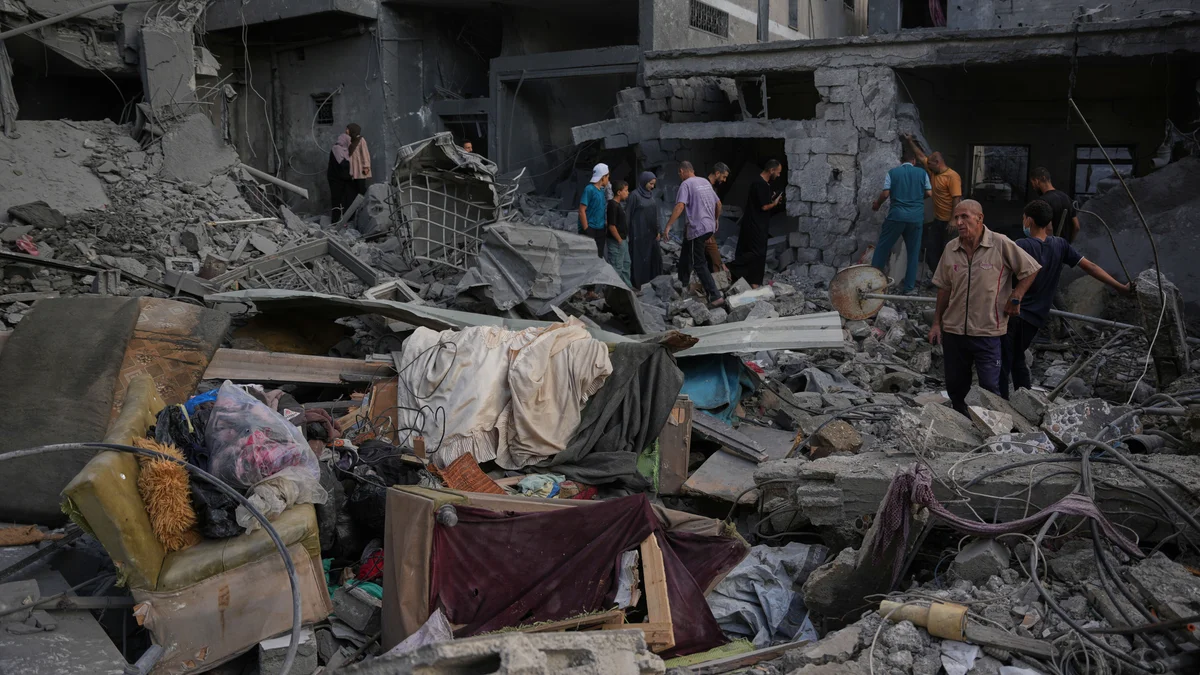
CAIRO: Israeli tanks moved deeper into Gaza City’s residential districts on Sunday, as local health authorities said they have been unable to respond to dozens of desperate calls, expressing concern about the fate of residents in the targeted areas.
Witnesses and medics said Israeli tanks had deepened their incursions in the Sabra, Tel Al-Hawa, Sheikh Radwan and Al-Naser neighborhoods, closing in on the heart and the western areas of Gaza City, where hundreds of thousands of people are sheltering.
The Israeli military launched its long-threatended ground offensive on Gaza City on September 16 after weeks of intensifying strikes on the urban center, forcing hundreds of Palestinians to flee although many still remain.
Trump scheduled to meet Netanyahu
Hamas, which Israel has demanded surrender, said Sunday it had not received a new proposal from mediators, after US President Donald Trump said Friday that “a deal on Gaza” seemed likely. Trump is scheduled to meet Israeli Prime Minister Benjamin Netanyahu at the White House on Monday.
A spokesperson for the US Embassy in Israel separately said that Ambassador Mike Huckabee would travel to Egypt to meet with Egyptian officials “as part of regular diplomatic consultations conducted between US embassies in the region.”
Egypt is among those mediating between Israel and Hamas.
The Civil Emergency Service in Gaza said late on Saturday that Israel had denied 73 requests, sent via international organizations, to rescue injured Palestinians in Gaza City.
Israeli authorities had no immediate comment. The military earlier said forces were expanding operations in the city and that five militants firing an anti-tank missile toward Israeli troops had been killed by the Israeli air force.
At least five killed in air strike
Over the past 24 hours, the air force had struck 140 military targets across Gaza, including militants and what it described as military infrastructure, the military said.
At least five people were killed in an air strike in Gaza’s Al Naser area, local health authorities said. Medics reported 16 more deaths in strikes on houses in central Gaza, bringing Sunday’s death toll to at least 21.
Israel’s military siege has caused a humanitarian catastrophe across Gaza. Four health facilities in Gaza City have shut down this month, the World Health Organization has said. Some malnutrition centers have also closed, the UN says.
Thousands remain in Gaza City
The World Food Programme estimates that between 350,000 and 400,000 Palestinians have fled Gaza City since last month, although hundreds of thousands remain. The Israeli military estimates that around a million Palestinians were in Gaza City in August.
Israel began its assault on Gaza nearly two years ago after an attack led by the Hamas killed about 1,200 people, with 251 taken hostage, according to Israeli tallies.
Since then, Israeli forces have killed more than 65,000 Palestinians in the enclave, according to Gaza’s health authorities, displaced the entire population, and crippled the territory’s health system.
UN secretary-general warns that war in Sudan is ‘spiraling out of control’

UN secretary-general warns that war in Sudan is ‘spiraling out of control’
Updated 6 sec ago
Follow

UN secretary-general warns that war in Sudan is ‘spiraling out of control’

UN secretary-general warns that war in Sudan is ‘spiraling out of control’
DUBAI: The United Nations secretary-general warned Tuesday that the war in Sudan is “spiraling out of control” after a paramilitary force seized the Darfur city of el-Fasher.
Speaking at a U.N. summit in Qatar, António Guterres offered a stark warning about el-Fasher and called for an immediate ceasefire in the two-year conflict that's become one of the world's worst humanitarian crises.
“Hundreds of thousands of civilians are trapped by this siege,” Guterres said. “People are dying of malnutrition, disease and violence. And we are hearing continued reports of violations of international humanitarian law and human rights.”
He added that there also were “credible reports of widespread executions since the Rapid Support Forces entered the city.”
U.N. officials have warned of a rampage by the paramilitary Rapid Support Forces after it took over the city of el-Fasher, reportedly killing more than 450 people in a hospital and carrying out ethnically targeted killings of civilians and sexual assaults.
The RSF has denied committing atrocities, but testimonies from those fleeing, online videos and satellite images offer an apocalyptic vision of the aftermath of their attack. The full scope of the violence remains unclear because communications are poor in the region.
The RSF besieged el-Fasher for 18 months, cutting off much of the food and other supplies needed by tens of thousands of people. Last week, the paramilitary group seized the city.
Asked if he thought there was a role for international peacekeepers in Sudan, Guterres said it was important to “gather all the international community and all those that have leverage in relation to Sudan to stop the fighting.”
“One thing that is essential to stop the fighting is to make sure that no more weapons come into Sudan,” he said. “We need to create mechanisms of accountability because the crimes that are being committed are so horrendous.”
The war between the RSF and the Sudanese military has been tearing apart Sudan since April 2023. More than 40,000 people have been killed, according to U.N. figures, but aid groups say the true death toll could be many times higher. The fighting has driven more than 14 million people from their homes and fueled disease outbreaks. Meanwhile, two regions of war-torn Sudan are enduring a famine that is at risk of spreading.
“It is clear that we need a ceasefire in Sudan,” Guterres said. “We need to stop this carnage that is absolutely intolerable.”