Pacific islands youth group wins prize for climate legal action

Pacific islands youth group wins prize for climate legal action
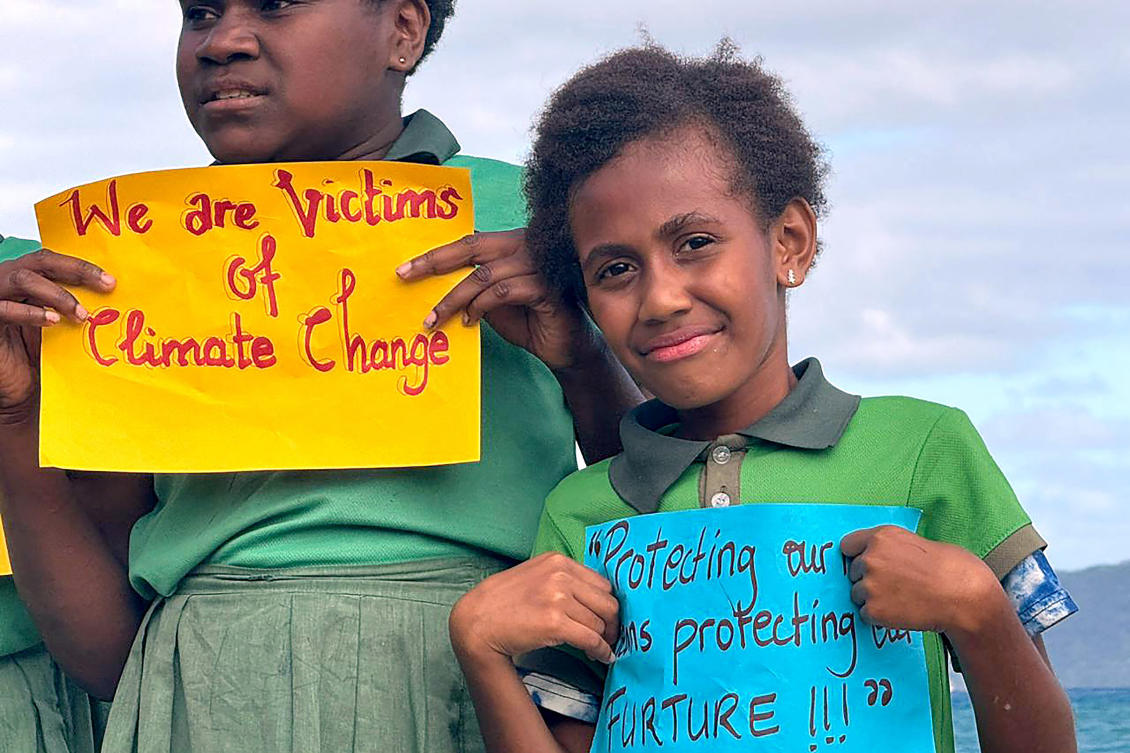
Law students at the University of the South Pacific in Vanuatu in 2019 decided to take the issue of climate to the International Court of Justice. Above, schoolchildren from north of the Vanuatu capital of Port Vila on July 24, 2025. (AFP)
Short Url
Updated 01 October 2025
Follow

Pacific islands youth group wins prize for climate legal action

Pacific islands youth group wins prize for climate legal action
  • Prize also honored Sudan’s humanitarian aid network Emergency Response Rooms
  • Burmese anti-corruption group and a Taiwanese champion of digital democracy was feted as well

STOCKHOLM: A youth-led student group and a human-rights lawyer that took the issue of climate to the International Court of Justice (ICJ) received the Right Livelihood prize on Wednesday, dubbed an “alternative Nobel.”
The prize also honored Sudan’s humanitarian aid network Emergency Response Rooms, as well as a Burmese anti-corruption group and a Taiwanese champion of digital democracy.
Frustrated by slow global efforts to tackle climate change, 27 law students at the University of the South Pacific in Vanuatu in 2019 decided to, in their words, “get the world’s biggest problem before the world’s highest court.”
The Pacific Islands Students Fighting Climate Change’s (PISFCC) campaigning culminated in the ICJ in July this year delivering an advisory opinion that states have legal obligations to address climate change.
While not legally binding, advisory opinions carry political and legal weight.
The prize jury hailed the group “for carrying the call for climate justice to the world’s highest court, turning survival into a matter of rights and climate action into a legal responsibility.”
Faced with the threat of rising sea levels and harsher weather patterns in places like the Pacific Ocean, island nations are particularly at risk from climate change.
“It’s an existential problem for young people in countries like Kiribati, in Tuvalu, in Marshall Islands. They’re witnessing the effects of climate change every high tide,” Vishal Prasad, director of PISFCC, said in July.
The group shared the prize with Julian Aguon, a human-rights lawyer from Guam, whose law firm, Blue Ocean Law, developed the legal strategy to carry the case.
The Sweden-based Right Livelihood Foundation also honored Emergency Response Rooms, a community-led grassroots network, for distributing aid during Sudan’s civil war.
The network was described as “the backbone of the country’s humanitarian response amid war, displacement and state collapse.”
Justice For Myanmar (JFM), a covert group of Burmese activists working to expose companies profiting from and propping up the country’s military junta, was also honored.
Taiwanese programmer and cyber ambassador Audrey Tang also received the award for “advancing the social use of digital technology to empower citizens, renew democracy and heal divides,” the jury said in a statement.
The Right Livelihood award was established in 1980, when Swedish-German stamp collector Jakob von Uexkull sold part of his collection to found it, after the foundation behind the Nobel Prizes refused to create new honors in the fields of environment and international development.


Peru declares Mexican president persona non grata over asylum spat

Peru declares Mexican president persona non grata over asylum spat
Updated 52 min 14 sec ago
Follow

Peru declares Mexican president persona non grata over asylum spat

Peru declares Mexican president persona non grata over asylum spat
  • The two Latin American countries have had strained diplomatic relations for years, but tensions rose on Monday when Mexico granted asylum to ex-PM Betssy Chavez, prompting Peru to break off formal ties

LIMA: Peru’s Congress voted to declare Mexican President Claudia Sheinbaum persona non grata on Thursday, after her country granted asylum to a former Peruvian prime minister on trial for allegedly aiding a 2022 coup attempt.
The two Latin American countries have had strained diplomatic relations for years, but tensions rose on Monday when Mexico granted asylum to ex-PM Betssy Chavez, prompting Peru to break off formal ties.
Chavez was Peru’s prime minister in December 2022 when then-president Pedro Castillo was ousted for trying to dissolve Congress following a months-long standoff.
The declaration against Sheinbaum was passed on Thursday in a 63-33 vote by Peru’s Congress, which also recently removed Castillo’s highly unpopular successor, Dina Boluarte.
Fernando Rospigliosi, the right-wing acting Congress president, said “it has been clearly established” that Sheinbaum interfered in Peru’s affair, “not only in words” but also by granting Chavez asylum.
Socialist lawmaker Jaime Quito meanwhile criticized the measure, saying “once again, they are making an international embarrassment by breaking relations with our sister country Mexico.”
Following the breakdown in diplomatic relations, interim president Jose Jeri announced on Monday night that Mexico’s top diplomat in Peru had been given a “strict deadline to leave.”
Relations between Lima and Mexico deteriorated sharply over the ouster of Castillo, a former rural schoolteacher and trade unionist dubbed Peru’s “first poor president.”
Back in December 2022 Castillo was on his way to the Mexican embassy in Lima to request asylum together with his family when he was arrested and charged with rebellion and abuse of authority.
Chavez was charged alongside him, and the pair went on trial in March.
While Castillo has been in preventive custody since his impeachment, Chavez was released on bail.
She has taken up asylum at the Mexican ambassador’s residence as Peru’s Foreign Ministry evaluates a request for safe passage to Mexico.
Prosecutors had sought a 25-year term for Chavez for allegedly participating in Castillo’s plan.
They have sought a 34-year sentence for Castillo.