22 killed in church scaffolding collapse in Ethiopia: state media

22 killed in church scaffolding collapse in Ethiopia: state media
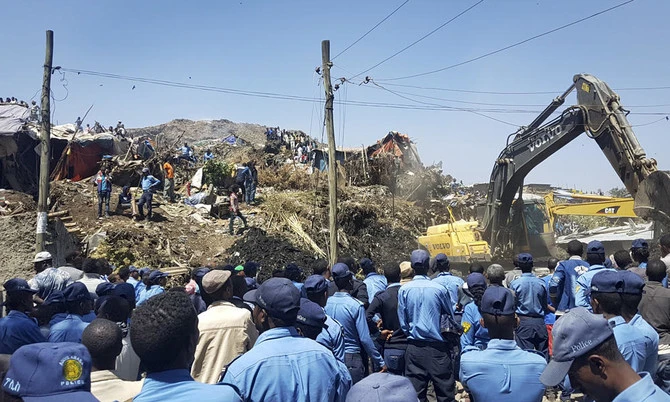
Makeshift scaffolding set up at a church in Ethiopia collapsed Wednesday, killing at least 22 people and injuring 55, state media said. (AP/File)
Short Url
Updated 01 October 2025
Follow

22 killed in church scaffolding collapse in Ethiopia: state media

22 killed in church scaffolding collapse in Ethiopia: state media
  • The incident occurred at around 7:45 am in the town of Arerti
  • “Many pilgrims were killed or sustained physical injuries,” local official Atnafu Abate told EBC

ADDID ABABA: Makeshift scaffolding set up at a church in Ethiopia collapsed Wednesday, killing at least 22 people and injuring 55, state media said.
The incident occurred at around 7:45 am in the town of Arerti, roughly 70 kilometers (43 miles) east of capital Addis Ababa, when a group was visiting for an annual Virgin Mary festival.
“Many pilgrims were killed or sustained physical injuries,” local official Atnafu Abate told the Ethiopian Broadcasting Corporation (EBC), putting the toll at 22 dead and 55 wounded.
Some remained under the rubble, he said, without giving any further details about those trapped or possible rescue efforts.
Some of the more seriously hurt were taken to hospitals in the capital, he added.
Images shared on the ECB’s official Facebook page showed a mess of collapsed wooden poles, with crowds gathering amid the dense debris.
Other pictures appeared to show the outside of the church, where scaffolding had been precariously constructed.
Health and safety regulations are virtually non-existent in Ethiopia, Africa’s second most populous nation, and construction accidents are common.
The sprawling country is a mosaic of 80 ethnic groups and among the oldest Christian nations globally.
Its predecessor, the Axumite Empire, declared Christianity the state religion in the fourth century.


Nepal registers 125 parties for post-uprising polls

Updated 2 sec ago
Follow

Nepal registers 125 parties for post-uprising polls

Nepal registers 125 parties for post-uprising polls
Katmandu: Nepal’s Election Commission said on Wednesday that 125 political parties had registered to contest the first parliamentary polls since a mass uprising in September ousted the government.
Many are established parties, but some of the movements vying for seats in the March 2026 vote were formed by youth activists who helped launch the anti-corruption protests that shook the country earlier this year.
“We are working with a belief that all political parties and citizens are eager to bring a new leadership to the country through the election,” commission spokesman Narayan Prasad Bhattarai told AFP.
Registration remains open for another two weeks.
The final list, including the exact number of new parties and those associated with youth groups, will be released after the November 18 deadline.
The September protests, triggered by a brief ban on social media, quickly morphed into a nationwide movement against economic hardship and government corruption.
Two days of violent unrest killed at least 73 people, and saw parliament, courts and government buildings set ablaze.
In the aftermath, former chief justice Sushila Karki, 73, was appointed interim prime minister to guide the Himalayan nation until elections.
Nepal’s political future remains uncertain, with deep public distrust of established parties posing a major challenge to holding credible elections.
But Bhattarai insisted the commission was determined to “conduct the election in a peaceful, impartial, and fear-free environment.”
Karki on October 29 held the first talks between political parties and youth representatives since the protests, attended by all major political parties including that of ousted premier KP Sharma Oli.
The unrest further weakened Nepal’s already fragile economy, with the World Bank warning in October that “heightened political and economic uncertainty are expected to cause growth to decline” to 2.1 percent.
The bank estimates a “staggering” 82 percent of Nepal’s workforce is in informal employment, with GDP per capita at $1,447 in 2024.