A limestone pharaonic painting vanishes from the famed Saqqara necropolis in Egypt

A limestone pharaonic painting vanishes from the famed Saqqara necropolis in Egypt
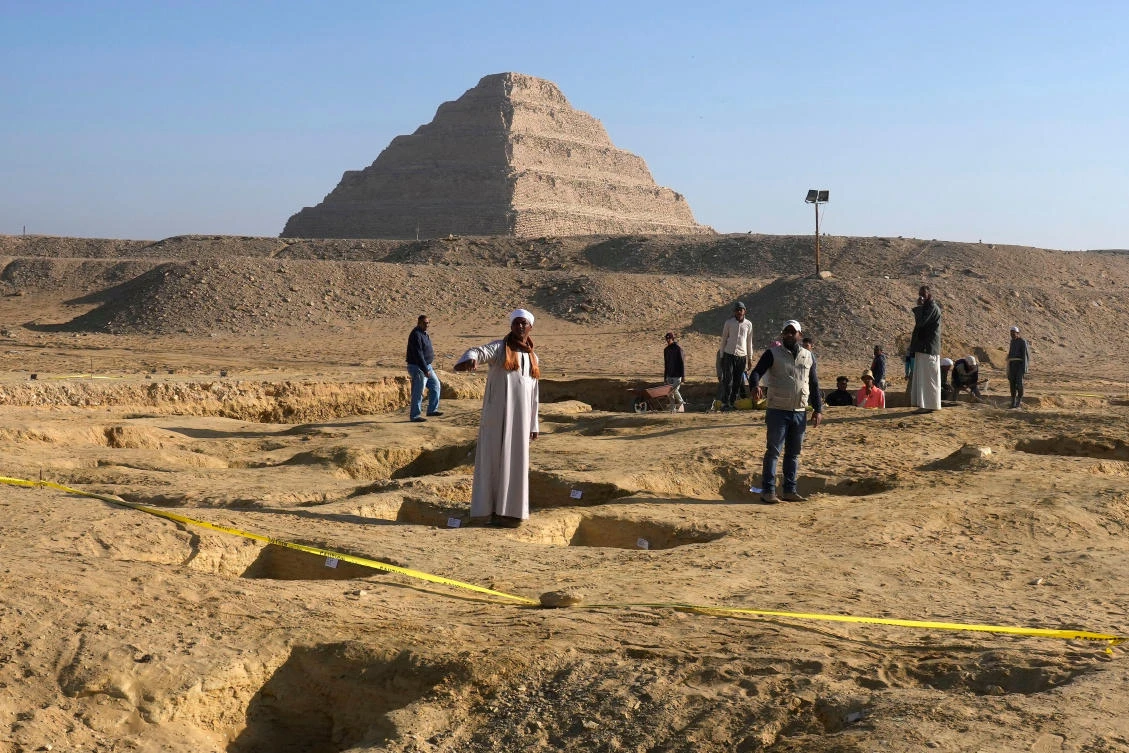
FILE - Egyptian antiquities workers dig at the site of the Step Pyramid of Djoser in Saqqara, 24 kms. (15 miles) southwest of Cairo, Jan. 26, 2023. (AP)
Short Url
Updated 06 October 2025
Follow

A limestone pharaonic painting vanishes from the famed Saqqara necropolis in Egypt

A limestone pharaonic painting vanishes from the famed Saqqara necropolis in Egypt
  • The painting was in the tomb of Khentika in the Saqqara necropolis outside Cairo
  • Prosecutors were investigating the circumstances of the painting’s disappearance

CAIRO: A limestone pharaonic painting has gone missing from Egypt’s famed Saqqara necropolis, becoming the latest artifact to disappear in a country known for its rich and lengthy history.
The painting was in the tomb of Khentika in the Saqqara necropolis outside Cairo, Mohamed Ismail, secretary-general of the Supreme Council of Antiquities, said Sunday. The mastaba tomb was found in the 1950s and hasn’t been opened since 2019.
Ismail’s statement said prosecutors were investigating the circumstances of the painting’s disappearance and didn’t give further details.
Egyptian media reported the painting exhibited the ancient Egyptian calendar that divided the year into three seasons mirroring the Nile River’s ebb and flow. It included the flooding season, Akhet, the planting season, Proyat, and the harvest season, Shomu.
The tomb dates to the sixth dynasty of the ancient Old Kingdom — roughly from around 2700 B.C. to 2200 B.C.
Cairo 24 news outlet reported that a British mission working in the tomb discovered the painting was missing in May.
The tomb is one of the few mastaba tombs of ancient Egypt to have a curse inscribed on its facade. The inscriptions warned intruders they could face divine punishment, according to British Egyptologist Harry James, who co-authored a research paper on the tomb in the 1950s.
The Saqqara site is part of a sprawling necropolis at Egypt’s ancient capital of Memphis that includes the famed Giza Pyramids, the step pyramid of Djoser, as well as smaller pyramids at Abu Sir, Dahshur and Abu Ruwaysh. The ruins of Memphis were designated a UNESCO World Heritage site in the 1970s.
Sunday’s announcement came less than a month after an ancient pharaoh’s bracelet was stolen from the Egyptian Museum in Cairo and melted for its gold.
The gold bracelet with a lapis lazuli bead belonged to Pharaoh Amenemope, who reigned about 3,000 years ago. It was stolen on Sep. 9 while officials at the museum were preparing artifacts for an exhibit in Italy. Authorities said it was taken from a restoration lab at the museum and funneled through a chain of dealers before being melted down.
Monumental art displayed in shade of Egypt’s pyramids

Monumental art displayed in shade of Egypt’s pyramids
Updated 56 sec ago
Follow

Monumental art displayed in shade of Egypt’s pyramids

Monumental art displayed in shade of Egypt’s pyramids
  • “There is an estimate that it’s more or less five million people reached by the message of the Third Paradise”
  • A thousand small cylindrical acrylic mirrors planted in the sand compose a Morse code poem imagining a dialogue between Tangun, the legendary founder of the first Korean kingdom, and an Egyptian pharaoh

CAIRO: Installations by renowned international artists including Italy’s Michelangelo Pistoletto and Portugal’s Alexandre Farto have been erected in the sand under the great pyramids of Giza outside Cairo.
The fifth edition of the contemporary art exhibition “Forever is Now” is due to run to December 6.
The 92-year-old Pistoletto’s most famous work, Il Terzo Paradiso, comprises a three-meter-tall mirrored obelisk and a series of blocks tracing out the mathematical symbol for infinity in the sand.
“We have done more than 2,000 events all around the world, on five continents, in 60 nations,” said Francesco Saverio Teruzzi, construction coordinator in Pistoletto’s team.
“There is an estimate that it’s more or less five million people reached by the message of the Third Paradise.”
The Franco-Beninese artist King Houndekpinkou presented “White Totem of Light,” a column composed of ceramic fragments recovered from a factory in Cairo.
“It’s an incredible opportunity to converse with 4,500 years — or even more — of history,” he told AFP.
South Korean artist Jongkyu Park used the measurements of the Great Pyramid of Giza to create the geometric structures of his installation “Code of the Eternal.”
A thousand small cylindrical acrylic mirrors planted in the sand compose a Morse code poem imagining a dialogue between Tangun, the legendary founder of the first Korean kingdom, and an Egyptian pharaoh.
Farto, better known as Vhils, collected doors in Cairo and elsewhere in the world for a bricolage intended to evoke the archaeological process.
Six other artists, including Turkiye’s Mert Ege Kose, Lebanon’s Nadim Karam, Brazil’s Ana Ferrari, Egypt’s Salha Al-Masry and the Russian collective “Recycle Group,” are also taking part.