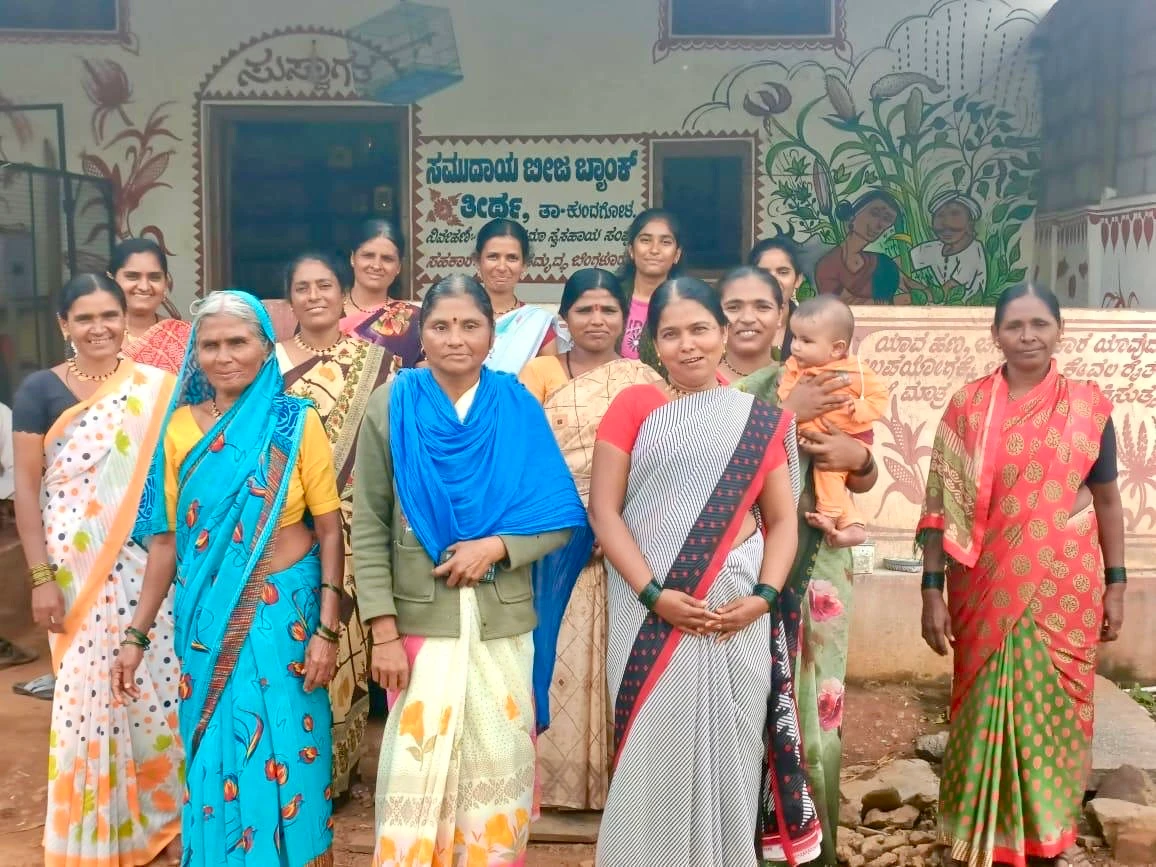
- Women’s self-help group from Karnataka wins ‘Nobel prize for biodiversity conservation’
- They convinced thousands of local farmers to cultivate millets and shift to organic farming
NEW DELHI: When Bibi Jaan started learning agriculture in 2018, she became the first woman in her family in rural Karnataka to do so. Little did she know that a few years later, she would be leading a collective that is gaining global recognition for pioneering sustainable farming.
Agriculture has been increasingly difficult in the southwestern Indian state due to unpredictable weather patterns. Located some 100 km from the Arabian Sea coast, the region is semi-arid, and crops largely depend on the monsoon, which means that delays caused by the changing climate directly reduce yields.
To address these challenges, Bibi Jaan and her 15-member women’s team — Bibi Fatima Self-Help Group in Teertha village, Dharwad district — reintroduced traditional farming methods and millets.
These are drought-tolerant crops, which decades ago were staples in drylands as they require little water, input, and do not degrade the region’s already vulnerable soil.
The women received training from Sahaja Samrudha, a nonprofit organization based in Karnataka, which is dedicated to empowering rural communities through sustainable agriculture and agrobiodiversity.
“I started my journey in 2018. I was just a housewife. My husband and family never sent women outside the home for work,” Bibi Jaan told Arab News. “It all started when Sahaja Samrudha came to our village.”
She and other women received training in the village and at a center Mysore, where they learned about seed and soil conservation, and cultivation methods that do not rely on artificial fertilizer and pesticide.
Turning into an advocacy group, they started to share their knowledge with others and slowly managed to convince them to shift to organic farming.
“I have a core team of 14 members, including 10 Muslim and four Hindu women,” she said.
“We started campaigning among farmers to promote seed conservation, multiple cropping, and the importance of preserving land. Even during the COVID pandemic, we remained active.”
Millets were widely popular in Karnataka before the Green Revolution in the 1960s and 1970s, which promoted high-yield varieties of wheat, rice, and maize, as well as chemical fertilizers and irrigation.
Over the years, however, soil exploitation, climate change and water scarcity have made such plantations increasingly prone to droughts and failure, and millets started to be revived as more resilient and sustainable crops.
It took a few years for people to realize that growing them can be safer and in the long run more profitable.
“When you start organic farming, there will be no increase in yields for the first three years, and production will be lower. Now, the yields have increased,” Bibi Fatima said.
“Our products go to other parts of the country. We don’t get any support from the government.”
Her collective now supports 5,000 farmers in 30 villages, community-run seed banks with different varieties of millets, and five plants to process them into flour.
In August, the self-help group won the Equator Initiative Award from the UN Development Programme. The prize is often referred to as the “Nobel Prize for Biodiversity Conservation.”
The award recognized their leadership in nature-based climate action, promoting traditional crops and sustainable farming. The collective represented India and was honored alongside organizations from Argentina, Brazil, Peru, Indonesia, Kenya, Tanzania, Papua New Guinea, and Ecuador.
For Krishna Prasad Govindaiah, director of Sahaja Samrudha, who convinced Bibi Jaan’s father to encourage her to engage in promoting organic farming, the win was a recognition of 25 years of grassroots work.
“In the Bollywood film ‘Dangal,’ the father wrestler could not win any award and he trained his two daughters in wrestling, and they won awards. For me, it is this kind of moment,” he told Arab News.
“My group fathered the Bibi Fatima Self-Help Group, and they made it at the international level ... I cried when I heard about the award.”
As the recognition brought the spotlight to the village and to Karnataka, he wished it would inspire other rural communities to become more resilient and build sustainable livelihoods.
“Today villages are disappearing, farming is not a profitable business, farming communities are decreasing, and climate change is impacting,” he said. “We need a ray of hope. In this scenario, the Bibi Fatima Self-Help Group is a ray of hope.”