Russia sentences Bulgarian to jail after critical online posts

Russia sentences Bulgarian to jail after critical online posts
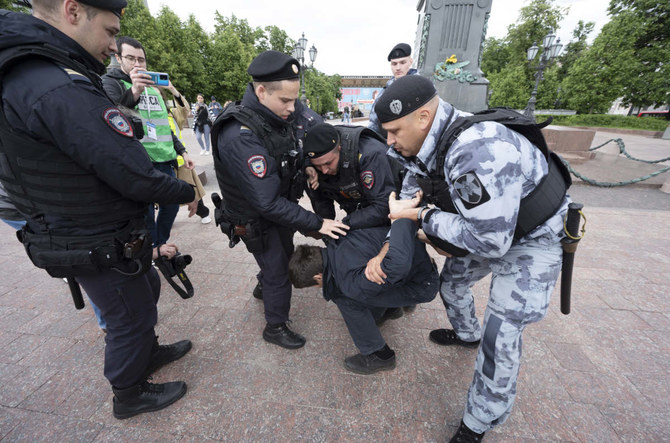
A Russian court has sentenced a Bulgarian-Russian dual national to three years in prison on charges of "justifying terrorism", Bulgaria's foreign ministry told AFP on Thursday. (AP/File)
Short Url
Updated 09 October 2025
Follow

Russia sentences Bulgarian to jail after critical online posts

Russia sentences Bulgarian to jail after critical online posts
  • The ministry has said the case shows Russia’s “systematic” actions against dissent
  • The verdict is not final and can still be appealed

SOFIA: A Russian court has sentenced a Bulgarian-Russian dual national to three years in prison on charges of “justifying terrorism,” Bulgaria’s foreign ministry told AFP on Thursday.
The ministry has said the case shows Russia’s “systematic” actions against dissent.
Russia has detained, fined or jailed large numbers of people, including Westerners, on charges of alleged treason, terrorism, sabotage and spying, in what rights groups say is a crackdown on dissent.
Since the start of Moscow’s invasion of Ukraine in February 2022, such trials have multiplied and have generally been accompanied by heavy sentences.
A Russian court sentenced the Bulgarian woman, who lives in Russia, on September 9 after finding her guilty of “justifying terrorism” in online posts, a ministry spokesperson said.
The accused had described Crimea as being “illegally occupied” and had expressed support for the Russian Volunteer Corps — a unit of Russian nationals fighting for Ukraine classed as a “terrorist” organization by Moscow — according to a written response this week by the ministry to parliament.
Bulgaria became aware of the case after the defendant’s sister notified the Bulgarian Embassy in Moscow in the spring.
The verdict is not final and can still be appealed.
According to the ministry, the case illustrates the Russian authorities’ “systematic and targeted actions” that are aimed at stifling freedom of expression and controlling information.
The actions result in “disproportionate” sanctions against opinions contrary to Moscow’s official line, “particularly in the context of Russia’s military aggression against Ukraine,” it added.
A UN special rapporteur said in September that Russia systematically restricts freedom of expression and other rights as it seeks “to crush civic space... eliminate political opposition, suppress culture (and) distort historical truth.”
EU in last-minute talks to set new climate goal for COP30

EU in last-minute talks to set new climate goal for COP30
Updated 25 min 49 sec ago
Follow

EU in last-minute talks to set new climate goal for COP30

EU in last-minute talks to set new climate goal for COP30
  • EU ministers meet to try to pass new climate target
  • Bloc’s credibility at risk ahead of COP30 climate talks

BRUSSELS: EU climate ministers will make a last-ditch attempt to pass a new climate change target on Tuesday, in an effort to avoid going to the UN COP30 summit in Brazil empty-handed.
Failure to agree could undermine the European Union’s claims to leadership at the COP30 talks, which will test the will of major economies to keep fighting climate change despite opposition from US President Donald Trump.
Countries including China, Britain and Australia have already submitted new climate targets ahead of COP30.
But the EU, which has some of the world’s most ambitious CO2-cutting policies, has struggled to contain a backlash from industries and governments skeptical that it can afford the measures alongside defense and industrial priorities. EU members failed to agree a 2040 climate target in September, leaving them scrambling for a deal days before European Commission President Ursula von der Leyen meets other world leaders at COP30 in Belem, Brazil, on November 6.
“The geopolitical landscape has rarely been more complex,” EU climate policy chief Wopke Hoekstra told a gathering of climate ministers in Canada on Saturday, adding that he was confident the bloc would approve its new goal.
“The European Union will continue to do its utmost, even under these circumstances, in Belem to uphold its commitment to multilateralism and to the Paris Agreement,” he said.
The starting point for talks is a European Commission proposal to cut net EU greenhouse gas emissions by 90 percent from 1990 levels by 2040, to keep countries on track for net-zero by 2050.
Italy, Poland and the Czech Republic are among those warning this is too restrictive for domestic industries struggling with high energy costs, cheaper Chinese imports and US tariffs.
Others, including the Netherlands, Spain and Sweden, cite worsening extreme weather and the need to catch up with China in manufacturing green technologies as reasons for ambitious goals. The draft compromise ministers will discuss, seen by Reuters, includes a clause demanded by France allowing a weakening of the 2040 goal in future, if it becomes clear EU forests are not absorbing enough CO2 to meet it. Brussels has also vowed to change other measures to attempt to win buy-in for the climate goal. These include controlling prices in an upcoming carbon market and considering weakening its 2035 combustion engine ban as requested by Germany.
A deal on Tuesday will require ministers to agree on the share of the 90 percent emissions cut countries can cover by buying foreign carbon credits — effectively softening efforts required by domestic industries.
France has said credits should cover 5 percent, more than the 3 percent share originally proposed by the Commission. Other governments argue money would be better spent on supporting European industries than buying foreign CO2 credits.
Support from at least 15 of the 27 EU members is needed to pass the goal. EU diplomats said on Monday the vote would be tight and could depend on one or two flipping positions.
Ministers will try first to agree the 2040 goal, and from that derive an emissions pledge for 2035 — which is what the UN asked countries to submit ahead of COP30.