India to upgrade Kabul mission to full embassy, signaling deeper ties with Taliban

India to upgrade Kabul mission to full embassy, signaling deeper ties with Taliban
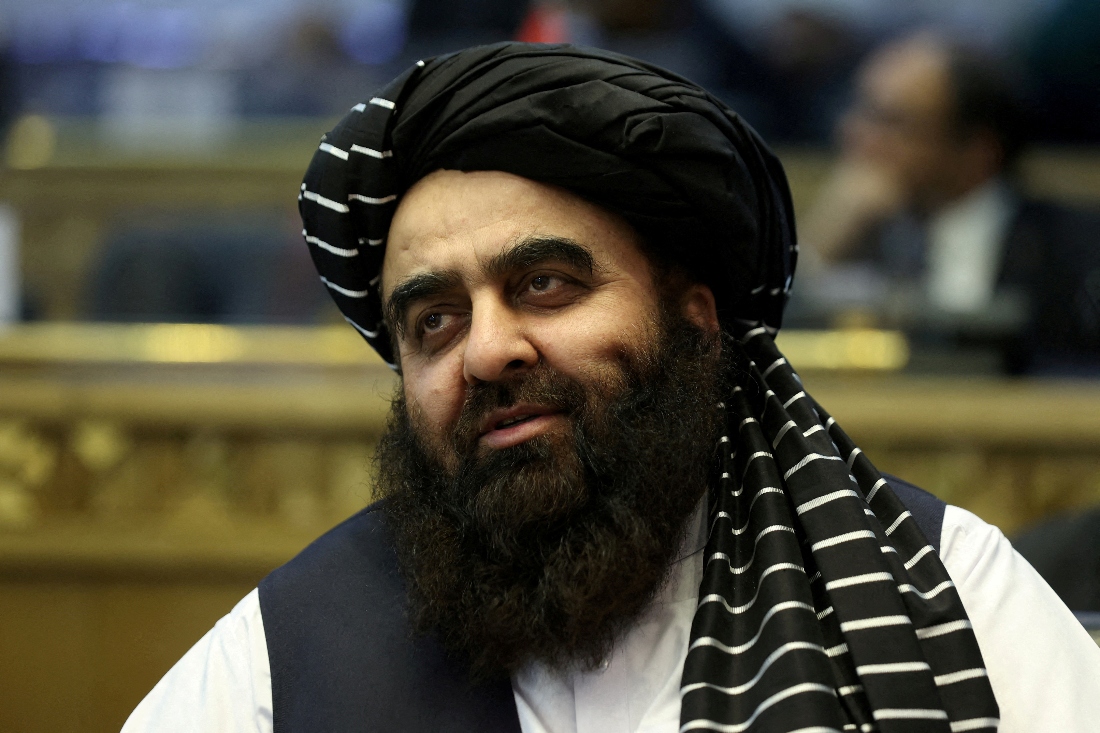
Afghanistan's Taliban Foreign Minister Amir Khan Muttaqi attends the Tehran International Conference on Palestine in Tehran, Iran. (WANA via Reuters)
Short Url
Updated 10 October 2025
Follow

India to upgrade Kabul mission to full embassy, signaling deeper ties with Taliban

India to upgrade Kabul mission to full embassy, signaling deeper ties with Taliban
  • The move underlines the deepening ties between India and Taliban ruled Afghanistan despite their historic antipathy for each other
  • Indian Foreign Minister Subrahmanyam Jaishankar said India was committed to Afghanistan’s development and pledged support in sectors including trade, health and education

SRINAGAR: India is upgrading its technical mission in Kabul to a full embassy, India’s foreign minister announced Friday after meeting his Afghanistan counterpart in New Delhi. The announcement was made during the first high-level diplomatic engagement since the Taliban seized power in 2021 after two decades of US military presence.
Indian Foreign Minister Subrahmanyam Jaishankar said India was committed to Afghanistan’s development and pledged support in sectors including trade, health and education. He said New Delhi is committed to Afghanistan’s sovereignty and territorial integrity.
“Closer cooperation between us contributes to your national development, as well as regional stability and resilience,” he said, addressing Afghanistan’s Foreign Minister Amir Khan Muttaqi at a joint press briefing after their meeting in New Delhi.
Muttaqi, who is among multiple Afghan Taliban leaders under UN sanctions that include travel bans and asset freezes, arrived in New Delhi on Thursday after the UN Security Council Committee granted him a temporary travel exemption. The visit follows Muttaqi’s participation Tuesday at an international meeting on Afghanistan in Russia that included representatives of China, India, Pakistan and some central Asian countries.
India’s pragmatic outreach to the Taliban
The move underlines the deepening ties between India and Taliban-ruled Afghanistan despite their historic antipathy for each other.
Both have something to gain. The Taliban administration seeks international recognition. Meanwhile, India seeks to counter regional rivals Pakistan and China, who are deeply involved in Afghanistan.
India’s Foreign Secretary Vikram Misri met Muttaqi in Dubai in January, and India’s special envoy to Afghanistan visited Kabul in April to discuss political and trade relations.
Experts say India’s decision to engage with the Taliban at higher levels reflects a strategic reassessment shaped in part by the consequences of previous non-engagement as well as to avoid falling behind its strategic rivals.
“New Delhi views the world through the prism of its rivalry with either China, Pakistan, or both. The Taliban’s efforts at a balanced foreign policy, which involves establishing relations with rival countries and groups, mirror New Delhi’s own playbook,” said Praveen Donthi, senior analyst with the International Crisis Group.
The visit comes while Afghanistan’s ties with Pakistan are strained, especially over refugee deportations and border tensions, and India’s engagement is seen as a strategic counterbalance to Pakistan’s influence. India also aims to limit Chinese dominance in Afghanistan through infrastructure and diplomatic presence.
“With Beijing proactively engaging the Taliban, New Delhi wouldn’t want its primary strategic rival to hold exclusive influence over Kabul,” Donthi said.
He said Pakistan had a similar hold over the Taliban in the past but due to its deteriorating ties with Islamabad, New Delhi sees an opportunity to “develop modest influence over Kabul and strengthen its position as a regional power.”
India’s checkered past with the Taliban
When the Taliban took over Kabul four years ago, Indian security analysts had feared that it would benefit their bitter rival Pakistan and feed an insurgency in the disputed region of Kashmir, where militants already have a foothold.
But New Delhi maintained steady contact with the Taliban despite these concerns and established a technical mission in Kabul in 2022, a year after the Taliban returned to power, focusing on humanitarian aid and development support. It continued engagement through back-channel diplomacy and regional forums that subsequently prompted increased engagement between the two countries this year.
India’s renewed engagement with the Taliban comes despite the ruling Hindu-nationalist Bharatiya Janata Party’s focus on religious identity and past encounters with the group.
In 1999, during the BJP’s previous term, militants hijacked an Indian plane to Taliban-ruled Afghanistan. Negotiations, involving Taliban officials, led to the release of three jailed insurgents in exchange for hostages.
That event left a deep mark on the BJP and National Security Adviser Ajit Doval, who was engaged in those negotiations, said Donthi. Now India “has been driven to proactively engage with the Taliban, both to avoid similar pitfalls and to accomplish a strategic need to counter Pakistan.”
The Taliban’s isolation
India has long hosted tens of thousands of Afghan nationals, including students and businesspeople, many of whom fled the Taliban. Afghanistan’s embassy in New Delhi shut down permanently in November 2023 but its consulates in Mumbai and Hyderabad continue to operate with limited services.
The Taliban has engaged in high-level talks with many nations and established some diplomatic ties with countries including China and the United Arab Emirates. In July, Russia became the first country to recognize the Taliban ‘s government.
Still, the Taliban government has been relatively isolated on the world stage, largely over its restrictions on women.
Gautam Mukhopadhaya, who was India’s ambassador in Kabul between 2010 to 2013, said the engagement between India and Afghanistan “may or may not lead to formal de jure recognition” of the Taliban government. He said he believed India should not take “that additional step to legitimize oppressive and unpopular Taliban rule” and “should preserve some levers to enable positive change internally for the benefit of all Afghans.”
Why France’s ex-President Sarkozy may be released from prison after just 20 days

Updated 5 sec ago
Follow

Why France’s ex-President Sarkozy may be released from prison after just 20 days

Why France’s ex-President Sarkozy may be released from prison after just 20 days
PARIS: A court in Paris will decide whether to release France’s former President Nicolas Sarkozy from prison on Monday, just 20 days after he was incarcerated.
He was sentenced to five years in prison following his conviction for criminal conspiracy in a scheme to finance his winning 2007 campaign with funds from Libya.
Sarkozy, 70, is the first former president of modern France sentenced to actual time behind bars. He was previously convicted on corruption charges, but was ordered to wear an electric monitor rather than serve a prison sentence.
Sarkozy’s legal team is appealing his conviction and has also filed a request for an early release. An appeal trial is to take place at a later date, possibly in the spring.
On Monday, a court in Paris is to examine his request for release, with a decision expected later that day.
The former president, who served from 2007 to 2012, says he’s innocent and contests both the conviction and the decision to incarcerate him pending appeal.
Why Sarkozy may be released from prison
The Paris court found Sarkozy guilty on Sept. 25 and said the prison sentence was effective immediately. But as soon as he was incarcerated on Oct. 21, his legal team filed a request for an early release.
A court is to make a decision Monday based on article 144 of France’s criminal code, which states that release should be the general rule pending appeal, while detention remains the exception — for example for those considered dangerous or at risk of fleeing to another country, or to protect evidence or prevent pressure on witnesses.
It does not involve the motives for the sentencing.
During Monday’s hearing, Sarkozy is expected to provide guarantees he will comply with justice requirements for conditional release.
If granted, he would be placed under judicial supervision and could be released from La Santé prison in Paris within a few hours.
What Sarkozy has been convicted of
In its Sept. 25 ruling, a Paris court said Sarkozy, as a presidential candidate and interior minister, used his position “to prepare corruption at the highest level” from 2005 to 2007 with the aim of financing his presidential campaign with funds from Libya — then led by longtime ruler Muammar Qaddafi.
The panel of three judges said that Sarkozy’s closest associates, Claude Guéant and Brice Hortefeux, held secret meetings in 2005 with Abdullah Al-Senoussi, Qaddafi’s brother-in-law and intelligence chief, despite the fact that he was “convicted of acts of terrorism committed mostly against French and European citizens.”
Al-Senoussi is considered the mastermind of attacks on a Pan Am jumbo jet over Lockerbie, Scotland, in 1988 and a French airliner over Niger the following year — causing hundreds of deaths. He was convicted in absentia and handed a life sentence by a Paris court in 1999 for the attack on the French UTA Flight 772.
The court said a complex financial scheme was put in place, although it said there’s no evidence the money transferred from Libya to France ended up being used in Sarkozy’s 2007 campaign itself.
Why he says it’s a plot
Sarkozy consistently said he is innocent and the victim of “a plot” staged by some people linked to the Libyan government, including what he described as the “Qaddafi clan.”
He suggested that the allegations of campaign financing were retaliation for his call — as France’s president — for Qaddafi’s removal.
Sarkozy was one of the first Western leaders to push for military intervention in Libya in 2011, when Arab Spring pro-democracy protests swept the Arab world. Qaddafi was toppled and killed in the uprising that same year, ending his four-decade rule of the North African country.
In addition, Sarkozy notes the court cleared him of three other charges — passive corruption, illegal campaign financing and concealing the embezzlement of public funds.
He also points to the court’s failure to establish a direct link between the money from Libya and his campaign financing as further proof of his innocence.
Other legal proceedings looming
Monday’s hearing is not the only legal case pending against Sarkozy.
France’s highest court, the Court of Cassation, is set to issue its ruling on Nov. 26 over a separate conviction for illegal campaign financing of Sarkozy’s unsuccessful 2012 reelection bid.
An appeals court in Paris last year sentenced Sarkozy to a year in prison, of which six months were suspended. He is accused of having spent almost twice the maximum legal amount of 22.5 million euros on the reelection bid that he lost to Socialist Francois Hollande.
Sarkozy denied the allegations.
The former president also is at the center of another judicial investigation related to the Libya financing case.
French judges filed preliminary charges in 2023 against him for his alleged role in an apparent attempt to pressure a witness in order to clear him. Sarkozy’s wife, supermodel-turned singer Carla Bruni-Sarkozy, was also given preliminary charges last year for alleged involvement.
The witness, Ziad Takieddine, was central in accusations Sarkozy received illegal payments from the Libyan government. He later retracted his statement.
Sarkozy was found guilty of corruption and influence peddling by both a Paris court in 2021 and an appeals court in 2023 for trying to bribe a magistrate in exchange for information about a legal case in which he was implicated. The Court of Cassation later upheld the verdict.
Sarkozy was sentenced to wear an electronic monitoring bracelet for one year. He was granted a conditional release in May due to his age, which allowed him to remove the electronic tag after just over three months.