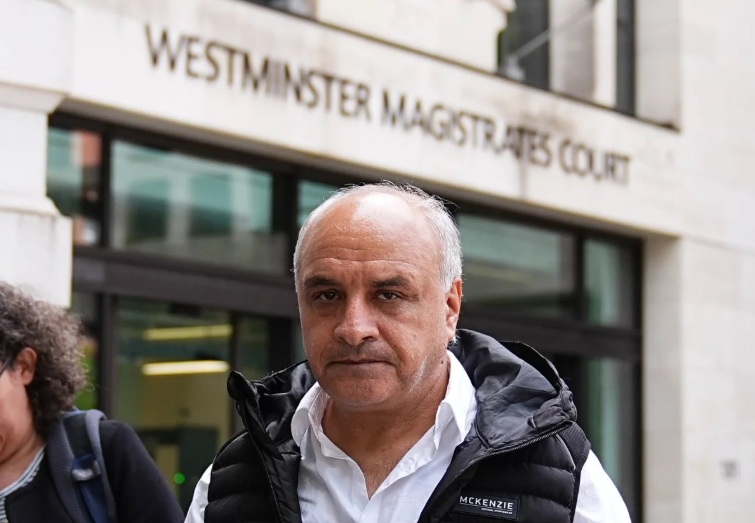
Turkish-born man who burned Qur'an in London wins appeal

Turkish-born man who burned Qur'an in London wins appeal
A Turkish-born man who burned a Koran in London won an appeal on Friday against his conviction, in a ruling hailed by free-speech campaigners. (X/@ArchRose90)
Short Url
Updated 10 October 2025
Follow

Turkish-born man who burned Qur'an in London wins appeal

Turkish-born man who burned Qur'an in London wins appeal
  • Coskun had set the religious book alight outside the Turkish consulate in London in February
  • Judge Bennathan told Southwark Crown Court that: “There is no offense of blasphemy in our law“

LONDON: A Turkish-born man who burned a Qur'an in London won an appeal on Friday against his conviction, in a ruling hailed by free-speech campaigners.
Hamit Coskun, 51, was found guilty in June of a religiously aggravated public order offense and was issued with a fine.
He had set the religious book alight outside the Turkish consulate in London in February while shouting slogans against Islam.
His case was taken up by the National Secular Society (NSS) and the Free Speech Union (FSU), who argued that Coskun was essentially being prosecuted for blasphemy.
Ruling in Coskun’s favor, judge Joel Bennathan told Southwark Crown Court on Friday that: “There is no offense of blasphemy in our law.”
“Burning a Qur'an may be an act that many Muslims find desperately upsetting and offensive,” according to the judge.
He said that the criminal law does not seek to “avoid people being upset, even grievously upset.”
“The right to freedom of expression, if it is a right worth having, must include the right to express views that offend, shock or disturb,” he added.
Blasphemy laws were abolished in England and Wales in 2008.
In a statement, Coskun, who is half-Kurdish and half-Armenian, said he came to England “having been persecuted in Turkiye, to be able to speak freely about the dangers of radical Islam.”
“I am reassured that, despite many troubling developments, I will now be free to educate the British public about my beliefs,” he added.
The FSU said the successful appeal sent a message that “anti-religious protests, however offensive to true believers, must be tolerated.”
Coskun has also received the support of the opposition Conservative party’s justice spokesperson Robert Jenrick.
British Asian community urged to share sacrifice of their veteran relatives

British Asian community urged to share sacrifice of their veteran relatives
Updated 10 sec ago
Follow

British Asian community urged to share sacrifice of their veteran relatives

British Asian community urged to share sacrifice of their veteran relatives
  • More than 2.5m people from Pakistan, India, Bangladesh, Nepal and Sri Lanka served in the Second World War
  • A new digital archive hopes to share the memories of their service

LONDON: British families of Pakistani, Indian and Bangladeshi origin are being urged to safeguard the memories of war veterans in their family to highlight the sacrifice of Asian soldiers in the Second World War.

The appeal came as a survey showed half of the British public were unaware that Indian troops served in the war, The Guardian reported.

My Family Legacy, a project supported by the Royal British Legion, is constructing a digital archive of veterans’ experiences to highlight the shared stories and sacrifices of Britain’s Pakistani, Indian and Bangladeshi communities.

More than 2.5 million people from those countries, as well as Nepal and Sri Lanka, served in the Second World War.

My Family Legacy is a joint project by the British Future think tank and the British Asian newspaper Eastern Eye.

It is appealing to British Asian families to provide names, stories and pictures of veteran family members, in order to keep their memories alive.

Even among British Asian communities, only about 60 percent of people were aware of the sacrifice of Asian soldiers in the war, according to Focaldata polling.

On Nov. 4, a UK parliamentary memorial event hosted by Tanmanjeet Singh Dhesi MP, chair of the House of Commons defense committee, was held to honor late war veterans.

The event honored Havildar Maj Rajinder Singh Dhatt MBE, who took part in the Battle of Kohima, which repelled a Japanese attack on India, and Sgt. Mohammad Hussain, who left home at 16 to enlist and fought in the Battle of Monte Cassino in Italy.

Their stories are among the first to be added to My Family Legacy’s archive site.

Speaking at the memorial, Dhesi said that the sacrifice of Asian veterans must not be “airbrushed and ignored.”

Hussain’s grandson, Ejaz Hussain, said: “The shared history, as a united people fighting for one common cause in spite of their differences, serves as the ultimate metaphor for future generations on how we must remain united as a country. Only then can we overcome any and all challenges in an uncertain world.”

Dhatt’s granddaughter, Amrit Kaur Dhatt, said: “It is so important to capture stories of Commonwealth and ethnic minority soldiers, like my grandfather’s, because they were left out of mainstream history. I fear that today’s society clearly hasn’t learned enough from history.”

By helping to honor Britain’s Asian military veterans, the Royal British Legion hopes to make families feel included in remembrance, said Gail Walters, the charity’s director of network engagement.

Families providing details of their relatives’ service will help build a “fuller picture” of the “integral role” they played in British history, she added.